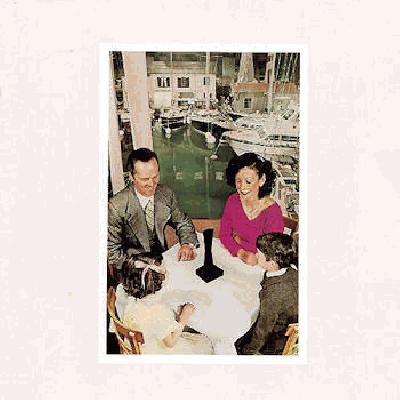
Review Summary: The closest Led Zeppelin ever came to heavy metal
While Presence has often been branded as the start of Led Zeppelin’s decline, it’s more like scaling back to adjust their priorities. It’s easily the most stripped down album they ever released, largely doing away with the style excursions that had defined their triumphant middle era with nary a keyboard in sight. The vocals also feel more restrained and less prone to showboating, no doubt a consequence of the severe car accident that affilcted Robert Plant around the time.
The band makes up for these potential concerns by putting the guitars in their most prominent position. Zeppelin has certainly had their share of iconic riffs on past albums, but peeling back the bells and whistles puts them at the forefront with the structures taking on a more casual air. This also emboldens the rhythm section as Bonham’s drums hit harder than ever while John Paul Jones having to put his toys away results in some of his most potent bass playing. Say what you will about the first two albums’ thunder, Presence might be the closest they ever got to heavy metal.
“Achilles Last Stand” is enough in itself to assert this notion, propelled by the sort of bass-driven gallop that would later come to define Iron Maiden and their ilk. It’s amazing how the song is able to sustain the momentum over the course of ten-plus minutes without getting too exhausted or played out, but it helps that everybody gets their places to stand out. The guitar leads play off the bass with epic flair, the periodic drum rolls break things up nicely, and the vocal cadences are climactic. In a way, it feels like an answer and full realization of the naïveté on “The Immigrant Song.”
Subsequent songs may not be at the same power level, but they come with enough muscle to keep from getting overshadowed. “For Your Life” and “Hots on for Nowhere” are driven by bluntly catchy riff sets and off-the-cuff layouts, efficiently getting the job done without much flash. “Royal Orleans” is an especially tight deep cut, dominated by a funky bass groove that makes one overlook some of the more questionable lyrics.
It’s also nice to see the band throwing back to their blues roots on a couple songs, armed with the tight loftiness their musicianship had picked up in the years between. The reinterpretation of Blind Willie Johnson’s “Nobody Fault But Mine” is especially cool in this regard, masterfully alternating between swirling guitars and echoing vocal effects and groovy verses. The closing “Tea for One” feels like an update of the “Since I’ve Been Loving You” template, closing the album out in a near ten-minute jam.
Presence may not be among the best Led Zeppelin albums, but there’s a case to be made for it being their most overlooked. With the band generally being at their best when fully committed to over the top rock god splendor, it’s easy to be unimpressed by this album’s simpler setup. However, it’s ultimately a different framing for them to show off their core strengths. If III is where to get acclimated to Led Zeppelin’s rustic folk side, then Presence does the same for their big dumb heavy rock side.