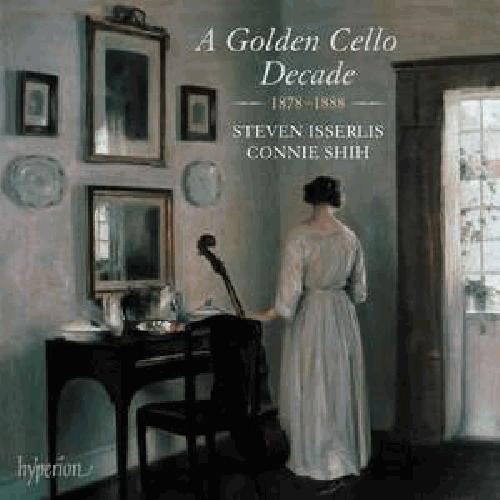
Review Summary: A masterclass in interpretation that showcases some undeservedly obscure composers alongside lesser-known works by established masters
In the world of Classical music, in which much of the output of any given performer focuses on new interpretations of past works, finding a novel theme around which to build a new recording can be a unique challenge. Dedicating an album to pieces from a single decade is a novel idea, although Steven Isserlis is no stranger to choosing perhaps unusual elements to be his unitive theme. Here, the fact that the works selected are from a single decade, and aren’t typically recognized as among their composers’ greatest makes this theme a doubly unusual move. But it’s a move that is rewarding as Isserlis has dug deep to uncover works that may otherwise have never seen the light of day, works that, if the joint strengths of Isserlis and Connie Shih have anything to say about it, will receive the recognition and acclaim they deserve.
Opening with Bruch’s melancholic Kol Nidrei proves to be a masterstroke, as the formidable interpretive abilities of the musicians make what could have been a beautifully melancholic but lightweight bit of fluff into something that is rich with varied color and mood, Isserlis’s dynamically bold expression on cello dialoguing effortlessly with Shih’s lighter, responsive touch on the piano, aided by Olivia Jageur’s delicate contribution on harp. The fact that Isserlis has chosen to open his album with a work by a Jewish composer is not the product of chance. Although the ostensible theme of this album is the decade spanning from 1878 to 1888, over half of the works selected are by either female or Jewish composers, all of whom, with the exception of Bruch, have only recently been rediscovered. It’s this unspoken theme of the album, the focus on marginalized composers whose background may have resulted in their relative obscurity that is a strength of the album, although Isserlis isn’t strictly limiting himself to minority composers, as seen with his interpretation of the original Cello Sonata by Richard Strauss and the Four Romantic Pieces for viola and piano by Dvorak, here arranged by Isserlis for cello.
The Strauss Sonata, an earlier piece of Richard’s that made me want to dig deeper into his romantic period after an uneven reaction to all the stodgy Sturm und Drang of his later works, is at turns sprightly, moody, serene and rapturous, and if the theme of the final movement stumbles slightly into frivolity, it can easily be dismissed as a product of youthful exuberance. The Dvorak pieces, originally for violin and piano and arranged by Isserlis, are typically lyrical compositions from the Czech composer, more in keeping with his purely romantic style than his national or ethnic sensibilities, although the second of the Romantic pieces touches on Czech folk melody. It’s a showcase of much of what made Dvorak great, his lyricism, the ability to (for the most part) invoke sentiment without making everything too treacly, his ability to make even the most demanding parts a product of necessity rather than empty ostentation.
But as stated above, it's the pieces by lesser-known composers that give A Golden Cello Decade much of its value as a piece of advocacy and interpretation. And nowhere is that better seen than on Luise Adolpha Le Beau’s Cello Sonata in D minor, a piece that, when I gave it the time and attention it deserved, stood out as the highlight of this collection. Its ear-catching melodic lines gracefully develop into new themes and evolutions, each of its three movements bringing the great strengths of the instruments to bear in different ways, whether it’s the at-turns serene and stormy moods of the piano in the first movement, the rich melancholy of the cello part in the Andante, or the bubbling exuberance of the flitting piano runs in the final movement.
Finally, Isserlis closes with two obscure works by Jewish composers, both of which are being recorded for the first time, and which are among the record’s highlights. And thank God the Ernst David Wagner piece functions as more than just a sly dig at the virulent antisemitism of his more famous namesake (as Isserlis has stated), a move that would have been petty and silly enough to damage both the credibility of the Jewish composer’s work and the album on which it first appears. The piece is powerful in its own right, beginning as a funereal dirge recalling both traditional Jewish music and the bare elements of Chopin, doubling down on its sedate grandeur in the second half. The final piece by Isaac Nathan is deliberately reminiscent of Bruch’s Kol Nidrei, the latter piece having lifted its melody from the former, more obscure work. It lends a sense of completeness to the album, a circularity that adds to the graceful arrangement of the whole experience. That here the musicians have chosen to rein in the emotional maximalism of the earlier pieces here bolsters that sense of finality, that completion, and only speaks to their technical and conceptual strengths.
But although one can hardly fault the interpretive abilities of the musicians, the music does occasionally lean towards that flabby, sappy quality that the music of the late romantic period tended to stumble into. But this is in spite of, and not because of the quality of Isserlis and Shih’s abilities, and in fact their interpretation is often forceful, subtle and dynamic enough to mitigate whatever maudlin tendencies the music may occasionally veer into. The playing on the album is forceful, subtle and integrated, each performer in tune with the mood of the music and with the playing of the other, each knowing precisely when to draw back, when to give room, when to allow the interplay between instruments to showcase a particular melody or emotion. That the duo should be so adept at bringing the potential of the heretofore lesser-known pieces into full bloom illustrates their dedication to making sure these pieces are given the attention they so richly deserve. And anyone with even a passing interest in Romantic music, the cello or discovering composers undeservingly left in obscurity should find something here to love.