Review Summary: Symphonic metal perfection
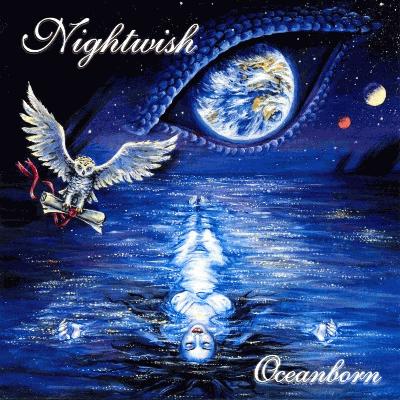
If Angels Fall First saw Nightwish debut in awkward tentative puberty, then 1998’s Oceanborn was where they managed to put all the pieces together. The band’s established symphonic metal flourishes are maintained, but those lingering folk meanderings are edged out in favor of a bombastic power metal execution that’s somewhere between Stratovarius and Sonata Arctica’s subsequent showings. The roster of musicians also sees some solid bolstering as a proper bassist was found in Sami Vanska and a string quartet was brought in to tastefully broaden the band’s scope.
But even with these extra bells and whistles thrown in, the perfect synergy between the keyboards and the guitars ends up being the album’s most powerful asset. While the two played together nicely enough on its predecessor, both instruments received a major boost of confidence here while playing off each other with relentless enthusiasm. I love how the opening “Stargazers” has the synths giving the rhythmic bursts some extra punch while the guitar leads play off the driving chugs in soaring, airy fashion. Elsewhere, “Sacrament of Wilderness” makes its weird textures and hyperactive speeds work while the shredding solos and trade-offs on “The Pharaoh Sails to Orion” give the six-minute epic an even more rousing flavor.
Of course, this album is also where Tarja Turunen comes into her own as one of the most commanding vocalists in the genre. While her accent somehow getting even thicker between albums might make the lyrics nigh unintelligible, especially for casual listeners, the controlled power she exudes along with the melismatic melodies gives the songs even more of an otherworldly aura. The clashing layers on the chorus of “Gethsemane” could’ve gotten dissonant in a lesser singer’s hands and even if she gets into outright showboating at the climax of “Passion and the Opera,” it’s awe-inspiring every single time. Even the male vocals courtesy of Finntroll’s Tapio Wilska come out cool despite a rather flat delivery, particularly on “Devil & the Deep Dark Ocean.”
The songwriting also sees astronomical improvement compared to Angels Fall First, fulfilling that album’s promising variety with much more focused structures and adept pacing. Having everything seemingly operating at a million miles an hour risks an exhausting listen, but there’s enough substance in the compositions for each song to carry a distinct flavor. On top of blazing highlights like the opening “Stargazers” and “Passion and the Opera,” “Moondance” makes for a jubilantly dreamy jig of an instrumental that “The Riddler” follows with its own catchy bounce.
Even the ballads end up being pretty damn good. I must admit that “Swanheart” is a major adjustment with its standstill balladry bringing the momentum to a screeching halt, but even that wins me over with its swelling build and gorgeous layers. The closing cover of The Snowman’s “Walking in the Air” is also a beautiful addition that emphasizes the original’s melancholic nostalgia in a way that keeps from getting overly saccharine, a balance that the band would frankly struggle with in the years to come...
While there are plenty of bands that have pulled off a major glow-up with their second album, it’s truly amazing to see just how much Nightwish improved in just a year’s time. While the nonstop flamboyance on display still makes Oceanborn an acquired taste for more hardened listeners, it’s the sort of album that sees its perfectly concentrated songwriting somehow made even better by its fitting musicianship. The sincere enthusiasm keeps the extravagance from feeling pretentious and the precise layouts keep the sheer volume of ideas from getting too out of control. For all the orchestras and choirs that Nightwish would incorporate to make their sound even bigger in the future, I wager that they never sounded grander than they did under this simpler framing. As far as I’m concerned, this is symphonic metal perfection.