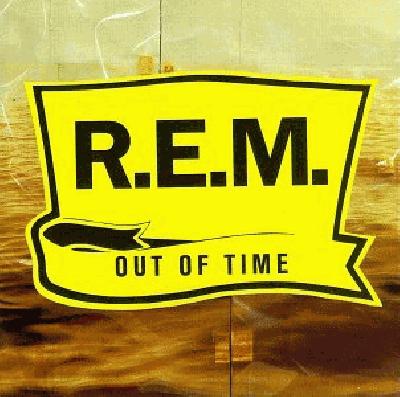
Review Summary: REM's most diverse album shows a still relevant fusion between chaos and harmony, between incoherence and sheer splendour.
In the moment of the release, "Out Of Time" was considered unanimously a great album. Some magazines declared it a masterwork. With the passing of time, the opinions became mixed, with the listeners recognizing in "Out of Time" the first moment when REM really felt uninspired and their music sounded dull and dusty. The album is too mainstream to be appreciated by college rock fans and too alembicated to be tasted by pop enthusiasts. Also, it misses the contemporary audience, the public recognizing in it a record with only two memorable songs surrounded by just pretty moments.
I think "Out of Time" deserves a better fate and reappraisal. At continuous listens, the chaotic mix between commerciality and experiment becomes the vehicle for one of the most varied statements of the nineties. Like a sunny variant of "Green", "Out Of Time" may be one of the strangest albums from the mainstream wave of alternative rock. A mix between dad rock, sentimental ballads, depressive moments, a questionable instrumental song and a spoken track, "Out Of Time" feels like the product of a band that was rushed to make another album to fulfil the magnificent fusion between commercial and personal released by "Green". Instead of focusing on dizzy soundscapes like its predecessor did, REM created this mix between chaos and pure pop mastery, enriching the entire creation with a decisive essence..
The album isn’t well organized, the order of the tracks feeling like a random mix. The first moment (and the worst due to an uninspired rap inclusion) continues with "Losing My Religion", whose melancholic character is followed by the depressive "Low". The upbeat tone of the beginning contrasts in a strident way with "Losing My Religion" and the hermetic "Low" defies the musical dynamism in favour of a sinking into depression. This order encountered all over the album’s course doesn’t fit with the status of a great creation, but REM’s songwriting and conception destroys this impression. What would have been disastrous for the majority of bands metamorphoses into a beautiful meditation. This bipolar tracklist makes the album more daring than any other REM record until "Monster", giving the entire sound an experimental stamp.
Also, the uncanonical construction becomes more and more evident with "Near Wild Heaven," which lights up the darkness expressed by "Low." From here, the work’s dissonant character is more apparent, unfolding in moments which oscillate between pop sensibility and country folk accents. Although "Endgame" is an uninspired instrumental that fails to elicit emotions and feelings, it serves as an excellent prelude to "Shiny Happy People". Even if "Shiny Happy People" isn’t considered among the best songs of REM’s career, its construction is truly outstanding. Without a memorable character, an engaging melodic line and Kate Middleton’s vocal accompaniment, the song wouldn’t be so massively played on almost every famous radio station and it wouldn't have raised so many views on Youtube.
"Belong" forms a beautiful exercise in atmospheric ambiguity, being a mysterious passage to the melancholic side constituted by "Half A World Away", "Texarkana" and "Country Feedback". These songs form the main reasons that make REM’s music so unforgettable: the sadness punctuated by emotional harmonies, the lush sentiment of lost and the regretful retrospection. They feel like folk-infused renditions of the alternative substance from "Green", this section creating a bridge between the previous work and the present orientation. "Me In Honey" summarizes the music’s strong points. The calm, the melancholy, the happiness, and, again, Kate Middleton’s voice, prove the record’s expressive beauty.
Being both accessible and experimental, "Out Of Time" gives a magnificent spectacle of emotional alternative rock nuances that will find an impressive extrapolation on "Automatic For The People", encompassing a sentimental multivalence. We have tenderness and depression, country and indie rock, disaster and construction, and, finally, a powerful album with a powerful voice. Feeling like a masterwork made in a short time (although the pause between "Green" and "Out Of Time" is nearly three years), the album presents something from all REM’s creative phases, thrown into an almost illogical mix, which amplifies the imperfect passion of a heartfelt melody.