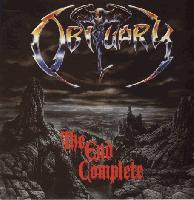
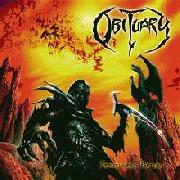
Beloved by many and celebrated as one of the essential faces on any imaginary Mount Rushmore of death metal, Obituary founded in 1984 under the name Executioner. Later dropping the 'E', before settling upon their current name, they are a Floridian band renowned and respected for a more restrained style of death metal utilizing far slower tempos and a songwriting-first approach with its roots found clearly in a mixture of thrash metal and doom metal. Where death metal in the 1990's sought to explore new boundaries and push the envelope as regards technicality, Obituary continued to churn out material both safe and yet captivating. The band would arguably peak in 1990 with 'Cause Of Death,' but they are best known for 1992's 'The End Complete,' which went on to sell a quarter of a million units worldwide.
Obituary's personnel has adjusted numerous times over the years, with The End Complete being recorded as a five-man collective. Allen West takes the role of lead guitar, showcasing his ability to write tasteful solos with a lot of melody on "Dead Silence," whilst Trevor Peres handled the rhythm guitar duties. The pair make for an efficient duo, welding together songs that are characterized by the addictive mixture of slow and brooding riffs and the faster moments punctuated by a Slayer beat. "In The End Of Life" opens with a meticulous, atmospheric blend of captivating slower riffs and drumming from Donald Tardy that is kept simple and basic, but is impressive nontheless. The verses of this song provide ample opportunity to discuss the most notorious aspect of the band: John Tardy's vocals. This man doesn't growl, but instead snarls his way through these songs in a manner that is both clear and yet absolutely disgusting. John really has an ability to evoke the morbid emotions and activity described in the songs lyrics, and his popularity amongst fans of the band and the scene as a whole is testimony to that. Frank Watkins is the band's final recording member here, and is largely a nonentity on the bass guitar. Whilst his contributions are audible, they mostly just mirror whatever the rhythm guitarist is performing, rendering them essentially useless. A sad trend amongst many metal bands is for this exact mirroring practise to take place, and it is a shame when these musicians obviously have the talent and could clearly do something to stand out amongst the crowd.
'The End Complete' is not a "moments" album, but instead is an experience that warrants being listened to in its entirety. Obituary really weaved a murky tapestry here, and whilst it is not quite to the exceptional standard of the previous two albums, it is one that scarcely wastes a moment of its thirty-six minute runtime. "Sickness" is a personal favorite of mine, serving only really as an example of the things the band does well throughout the whole album. When their intention is to be intense, that is achieved in the stellar final thirty seconds; when the band wishes to lay down an infectious groove, they showcase this is in their arsenal in the opening of this song; and, finally, when a slower tempo is required, they utilize this tool to enormous effect throughout the middle of the song. This is a dynamic, kinetic album, with phenomenally structured songs that each feel as necessary as their predecessor and their successor. The introduction to the title track uses stop-start drumming and an alternating pattern of the guitar riff, and they repeat this after the first barrage of vocals once again without it feeling redundant. The drum rolls in the first section of "Back To One" and the guitar solo are so precisely placed that it is almost surgical, and an extremely competent production keeps it sounding consistent.
'The End Complete' is an album that maintains its role as a gateway album into the genre for newcomers, and is often looked at with a small amount of disdain by veterans as a result, and this is utterly ludicrous. Whilst the template constructed in their first two albums was also better executed there, this is an album as dark and warped as anything else in their discography, and holds such a high standard of songwriting throughout that it commands attention. Be it the slower groove or the faster Slayer beats, the band had honed their craft to near perfection by this point, and it is a sad point that must be made that they would never again hit these heights.