The origin story of Flower Travellin’ Band isn’t all too different from many other bands from the same time period. In the 1960s, producer Yuya Uchida had formed several bands, with little to no success outside of Japan. His latest breakup was with the band Yuya Uchida & the Flowers, who had only recorded a single album before going their separate ways. That album, which featured the members stark naked and standing in a sunny field, was a fairly standard covers album, featuring songs from popular psych rock acts of the day (Jimi Hendrix, Cream, etc.). However, with the formation of his new band, dubbed the Flower Travellin’ Band, Uchida had his eyes set on international fame. He wasn’t content being locked into the Japanese underground; he wanted to walk the Earth.
And, for some inexplicable reason, the band decided that the best way to do that would be to copy their past mistakes. Their first record, Anywhere, was a mini-album of covers with the band nude on the front. But this time, riding motorcycles. While that likely didn’t help them very much, what really sealed their fate was that their renditions of the songs, while competent, were nothing special. Very standard hard/progressive rock fodder. And just like that, Yuya Uchida once again had built a band with no foreseeable success outside of the underground.
Now, the way this story has played out so far, this seems like an open and shut case. A producer assembled two different psych rock cover bands with the hope that they would be popular outside of their home country. Some nudity was shown, it failed both times, and there’s your happy ending. But that isn’t what happened to the group. Perhaps spurred on by their emigration to Canada, the band was already gearing up for their follow-up. This time, with all-original material.
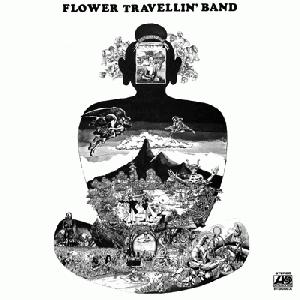
That album ended up being 1971’s Satori, one of the 1970’s most enduring heavy psych documents; one that would only grow in popularity with time and be constantly referenced by music critics and fans alike. It’s not difficult to see why. While their previous work had mostly felt staged and groomed (most likely due to Yuya Uchida’s influence), Satori was raucous and freeing. It was a noticeable improvement, at the very least.
The album is split into five “parts,” though they aren’t connected in any other meaningful way. “Satori, Part 1” begins with an ominous march of heavy guitars, before truly bursting to life with Akira Yamanaka’s shrill, off-beat vocals. Highlight of the record, “Satori, Part 2,” mixes in-your-face rhythmic percussion with shredding improvisational guitar. Given that the album was famously recorded in a single session, it makes sense that the album is at its highest when the band is allowed to roam free with their Eastern-influenced fervor.
By that same token, the Flower Travellin' Band is at their weakest when they fall back on their more basic hard rock sound. “Satori, Part 4” is a bluesy rocker that is a competent emulation of more popular Western acts of the time, but very little more.
In revisiting this album alongside their entire discography, learning about their background as a covers band casts a dim shadow over Satori. I guess in my mind, I had always pictured the Flower Travellin’ Band as this mythical, larger-than-life force. Most likely because I first heard of the band when I was just starting to get into music seriously. So it’s sort of disheartening to find that their story was so much more mundane. That’s not the band’s fault, I know that. And I would be more willing to overlook that if Satori did hold up to the impossible standard that I had set for it however many years ago. Really, if the music was good, what did it matter how they were formed?
It pains me to say it, but Satori isn’t the classic it once was to me. The best moments on the album are shuffled to the front, leaving the B-side weaker by direct comparison. Too much of the album’s runtime is spent on overlong passages of hard rock soloing, and not enough developing the more interesting Eastern influences they set out to include here. Instead of carving out their own unique identity, you can still hear inklings of the band’s previous unsuccessful attempts to grab the international stage.
Let me be very clear: this is my personal journey with the Flower Travellin’ Band. For the large sum of you reading/skimming this, you will find an excellent Japanese psych rock band with a harder edge. There is plenty to like here and I still enjoy the highlights off it (Parts 1-3) enough to recommend it. But as a complete record, Satori falls just short of its mythical greatness.