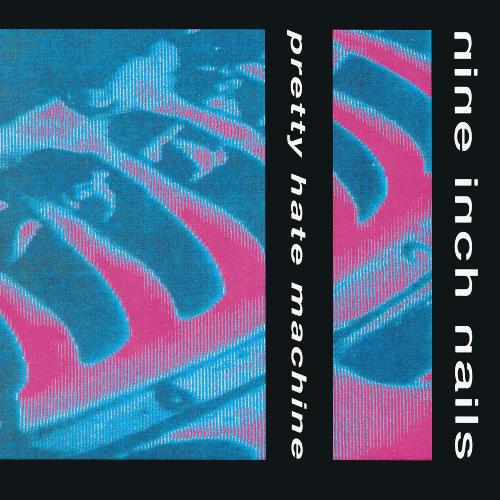
Pretty Hate Machine by Nine Inch Nails
Genres: Industrial Rock, EBM, Synthpop
Released: October 20, 1989
Label: TVT
1989 was quite a good year for industrial music; it saw releases from
Ministry,
Godflesh,
Skinny Puppy,
Einstürzende Neubauten, and
the Young Gods, among others, but one album, one band even, would come to overshadow them all:
Nine Inch Nails, the brainchild of multi-instrumentalist Trent Reznor, who saw a meteoric rise from a janitor borrowing a studio in his spare time to the gateway for most youth, at least most that I’ve met, to the industrial scene. Unfortunately, their popularity has come to eclipse most other industrial acts, and perhaps especially the early acts, and as much as I enjoy their early works and Reznor’s film scores, I concur with even their detractors: y’all need to listen to more industrial music. Still, they’ve some classics under their belt, and it’d be remiss of me to not write about at least one of their albums in my quest to explore as much of the industrial scene and chronicle it as possible.
Right out of the gate is an all-time classic NIN single and live staple, “Head Like a Hole”, which opens with a bizarre series of sounds; sounds like Reznor’s working out and simultaneously shuffling a deck of cards. Then he starts singing, and already it’s quite distinct; he’s certainly on pitch and can carry a song, and I can’t imagine any if NIN’s music without his voice, but the man sounds like a teenager whose balls are considering dropping but haven’t fully committed yet, and he still sounds like that to this day. From the very beginning, Reznor’s always had a gift for crafting hooks in a way that a lot of his contemporaries and forbears didn’t, though that was seldom what industrial music was about
: the chorus resonated with a lot of listeners at the time, and it will most likely always hold true as long as rebellious youth continue to hold authority figures in contempt:
“Head like a hole
Black as your soul
I’d rather die
Than give you control”
Though hardly representative of the rest of the album, it functions quite well as an opener in getting the listener pumped for the rest of the record, and it also slaps even harder live, though the same can be said for most of the material from this LP.
“Terrible Lie” is no less venomous and accusatory, taking on God as Reznor loses whatever faith he might have once had in a natural antecedent to “Heresy” from
The Downward Spiral. The minimal beat contrasts quite nicely with the chorus of a descending synth, which only serves to highlight the moments of atheistic angst and feelings of betrayal. “Down In It” is the one low-point in an otherwise outstanding first side; Reznor openly admitted to ripping off “Dig It” by Skinny Puppy, which is decidedly far more interesting due to more complex production. Bizarrely, Reznor comes dangerously close to rapping, so this song could arguably be a predecessor industrial hip hop, made almost a decade before
Dälek wrought upon the underground their brand of noisy, irate rap music. Still a bop, for the most part, though it is cheapened by the nursery rhyme recitation towards the end.
Surprisingly, “Sanctified” makes bass slaps feel threatening, with a narrative about a one-sided relationship where Reznor seems to be completely owned by his partner. Adding to the atmosphere of discomfort is the bursts of white noise in the right ear and what sounds like a slamming door in the other ear that accompanies the title and every word sung that happens to rhyme with it, it sounds like
Prurient and Einstürzende Neubauten are recording in neighboring studios.
“Something I Can Never Have” showcases Reznor’s background as a classically trained pianist, and true to the lyrical content about heartbreak, it sounds like something someone would come up with while spontaneously plonking on a keyboard after a relationship ended badly. This is easily the least industrial song on the album, but what little industrial elements there are augment the music well; during the choruses, Reznor sounds like he’s battling against a machine trying to claim him, something only his erstwhile partner could save him from because, in Reznor’s words, she makes it all go away. “Grey would be the colour if I had a heart” is an awkward lyric that I find momentarily reminds me that I’m only listening to an album, but otherwise this song breaks up the two halves of the album quite nicely, which is just as well, because the second half is where the cracks in the production really start to show.
“Kinda I Want To” is apparently the worst thing Reznor’s ever recorded, at least in his own eyes. I wouldn’t go that far, the subject matter about what I think might be internalized homophobia is definitely intriguing, but I agree that it’s a low point. The synths sound thin, like they’re being stretched to their limits, and the production choices are odd to say the least, more specifically the gratuitous channel switching throughout the song, like the music can’t decide which channel to play through so it just switches between both ears.
Of the ten songs, “Sin” sounds like it was most calibrated for the dance floor, which isn’t in and of itself a bad thing; I can see myself getting down with this, and getting down hard if I heard this come on in a club. Some of the most awkward lyrics yet are contained in this song; the chorus in particular feels as such as Reznor tries to rhyme “kiss” with “fist” with grace. The pulsating synths make it bearable, if only because of the urge to move my body it instills, but otherwise, meh.
“That’s What I Get” is even more annoying, with Reznor singing the title over and over again against keyboard programming that sees a sudden increase in complexity in the final minute. It was an alright chorus the first iteration, but that being most of the song combined with Reznor’s timbre and inflection only doubles the annoyance factor. “The Only Time” sees the bass slaps from “Sanctified” return, and the funk influences enhances the sleaziness of the lyrics, then loud distorted synths come in and we’re treated to yet another inane sample that drags the song down.
“Ringfinger” is the closest this side of the record gets to reclaiming the consistency of the first half, it crafts a nice atmosphere with the minimal reverberating synths to go with the toxic marriage Reznor’s singing about. It’s marred only by the guitar, which sounds like it was recorded with a can and serves only to take me out of the experience and remind me that this album was made in the late ‘80s, but otherwise it’s a nice closer (no pun intended).
Classic though this album may be,
Pretty Hate Machine is ultimately more front-loaded than an SUV with a hippo strapped to its hood, and the production has aged poorly in several areas. That being said, the fact that Reznor somehow got Flood to master this is impressive alone, because he was already well-established in the music industry, having worked with
Depeche Mode,
Nitzer Ebb,
New Order, Ministry,
Nick Cave and the Bad Seeds, and later
P. J. Harvey and
Sigur Rós, but otherwise, its aging process only becomes more salient when compared to its contemporaries. Skinny Puppy’s
Rabies, for example, still sounds fresh, New Order’s
Technique puts this to shame, and going back even farther,
Throbbing Gristle’s early albums, especially
20 Jazz Funk Greats, barely sound a day old. Most of the live staples still sound good, and the songs here that I enjoy I really enjoy, but otherwise, it mostly just feels like a springboard that later albums would refine and perfect.
I find the melodrama also harms several songs, but I can see why it was so lauded in its day; it was nakedly emotional in a way that most industrial music just isn’t. Sure, there was rage sometimes, but otherwise, at least in my experience, a lot of industrial music made very certain to keep a clinical distance between itself and its audience. Then along comes Trent Reznor singing about various manifestations of failed romance, and it must’ve been a breath of fresh air in 1989. Though time hasn’t been kind to this album, it’s still ultimately a good showcase of Reznor’s musical talent, the first half slaps for the most part, and somehow I still enjoy it after all these years.
Favourite tracks: "Head Like a Hole", "Terrible Lie", "Sanctified", "Something I Can Never Have"
Least favourite(s): "Sin", "The Only Time", "That's What I Get"