Review Summary: An industrial record for industrial people.
I suspect anyone more familiar with the post-industrial scene will probably be in for a shock if or when they check out the work of industrial originator
Throbbing Gristle because of how different their work is from what calls itself industrial these days. Compared to current industrial music, TG’s sound was more abstract, more anti-musical, possibly far more adventurous and experimental. I don’t know if the same can be said of the rest of the early industrial scene, unless
Coil and
Einstürzende Neubauten count, though if they do, then the first wave must’ve been far more varied than the post-industrial that was to follow. Distant though their sound is from the (post-)industrial of today (unless I’m not looking nearly hard enough), I contend that their early work should probably be essential listening for industrial fans, especially if they’re interested in the genre’s history.
Throbbing Gristle, or TG, were a band that originated from the performance art collective COUM Transmissions, whose anti-establishment shows and theatrics included phallic symbols, used menstrual pads, fascistic symbols, and other transgressive imagery. TG founder Genesis P-Orridge met the other future members during their time with COUM, Cosey Tutti, Chris Carter, and Peter “Sleazy” Christopherson, the latter of whom would go on to be one of the most constant members of Coil, and they continued to offend contemporary sensibilities with music about serial killers, manipulation, and visceral descriptions of such injuries as burns, though their work steadily became more… “musical”, for lack of better words. Basically, if you couldn’t tell already, “
20 Jazz Funk Greats” should be regarded with the same skepticism as “antidepressant liquor” or “the Brian Blessed Anechoic Chamber”, and you’re right to, but that shouldn’t dissuade you from listening to this record at least once.
The title track is where I finally went “oh, so this is where
Ministry,
Skinny Puppy, and
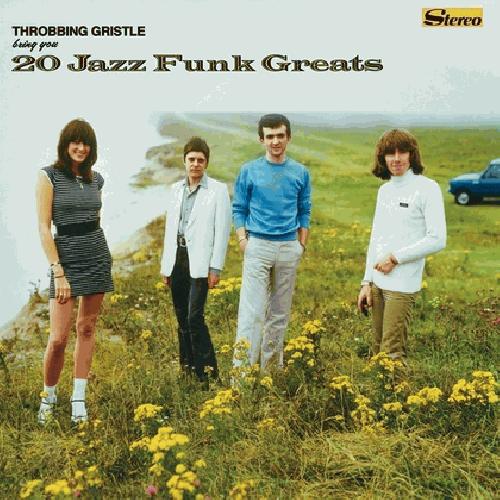
Nine Inch Nails got some or most of their ideas from.” Their first two albums reminded me more of noise music and power electronics than anything else, possibly because my ears are broken, but I found it all came together here. It’s a simple drum beat and synth passage that’s accompanied by other stranger sounds such as heavily manipulated cornets, and quite rhythmic for early TG, which eases the listener into the album, though it doesn’t do much to prepare for the album’s more sinister moments. “Beachy Head” is the first song to have the eeriness that can be expected from TG, and it suits its namesake perfectly; Beachy Head is a popular place for suicides in southern England, and that’s where the cover was taken. The synth sounds like a foghorn sounding over the coast, and the field recordings of waves and seagulls from where I assume is Beachy Head complements the song’s mood nicely. I find staring at the cover while listening to it only enhances the experience, because it was shot in foggy conditions, and the band is worryingly close to a cliff edge.
“Still Walking” is even more tense, with a drum pattern that constantly pans from ear to ear which soundtracks strange metallic samples and a dissonant squawking violin courtesy of Genesis. “Tanith” is one of the few moments of peace on the album, featuring improvised vibraphone playing alongside bass. Heavily treated descending violin glissandos threaten to pervert the tranquil atmosphere, they’re just screechy and slightly discordant enough to almost offset the song’s placidity, but even so, the song remains a welcome reprieve from the ominous mood piece that is “Beachy Head”.
“Convincing People” has Genesis drolly monologuing about... well, convincing people, against a sequencer loop and overdriven bass. While the sequencer is steady, and the bass slightly less so, the rest of the instrumentation is considerably more unpredictable; erratic synth plashes sound off throughout the song, and it only gets more discomfiting when several layers of Genesis vocals pile onto each other. While it’s not the most unsettling part of the album, it still adds to the anxiety, and it’s certainly one of the record’s weirdest moments.
“Exotica” feels like it should be a moment of peace, but it isn’t. Sleazy’s vibraphone solo is dreamy and pleasing to the ear, but it’s surrounded by synth parts that fade in and out, giving the piece a sense of menace that slightly perverts an otherwise pretty song. “Hot on the Heels of Love” sounds like a blueprint to EBM, with a synth melody backed by a propulsive kick drum. Cosey’s breathy vocals give the song a softer touch compared to the songs led by Genesis, though the song still manages to keep me on edge because the sporadic snare sounds like a whip cracking in the left ear.
“Persuasion” is one of the few songs on the album that reaches the nightmare fuel potential of TG’s previous albums. That’s not to say what came before didn’t cultivate an atmosphere of unease, but “Persuasion” is on a whole other level; Genesis sings about some manner of persuasion against a sparse two note melody of G and C natural and samples of screaming women in unspecified but obviously compromising positions. It’s not clear what Genesis is persuading their victim to do, but the samples make it clear that whatever they have in mind is something gruesome. Genesis’ deadpan delivery makes the song all the more unsettling, it’s like whatever horror they’re perpetrating, they’ve done so many times that nothing phases them anymore. Cosey’s erratic, atonal guitar punctuates the sampled screams, accentuating the song’s horrific nature, and as if that weren’t enough, it only gets worse when you take into account that Cosey was in an abusive relationship with Genesis.
As if to make up for the horror show that is “Persuasion”, “Walkabout” is the most gorgeous song in the track listing, a steady synth arpeggio and a series of whole notes courtesy of Chris Carter which I find far more reminiscent of mid-70s
Cluster and
Brian Eno as of
Another Green World than anything TG had done up to this point. The most vibrant and upbeat song is followed by the most jarring and second-most disturbing song, “What a Day”. The opening will probably startle you if you’re listening with headphones, that first percussive strike sounds like a car door being loudly closed. The song’s a dissonant, grinding tape loop that is soundtrack to the title being screamed over and over again while other electronic textures wind in and out of the track. The song ending is a welcome relief, though “Six Six Sixties” provides one last offering of darkness. The track’s a bookend of sorts; where the opener was a laidback drumbeat with a rudimentary bassline, “Six Six Sixties” has a similarly placid drumbeat but this time accompanied by a foreboding overdriven guitar and stream-of-consciousness lyrics that end in a state of uncertainty with the word “just.”
While it might turn off people whose idea of industrial music comes from bands like NIN,
20 Jazz Funk Greats is a classic for a reason; the means with which this album and its predecessors were made hugely influenced many a future industrial act. TG is the reason why sampling is a staple of industrial and most, if not all, its offshoots, their imagery also greatly inspired acts like Skinny Puppy, among others, and they set a precedent for transgressive themes that often led to controversy.
Historical significance aside, I just happen to like it on its own merits; I’m not sure how much of this is due to the reissue, but Carter’s programming has aged quite well, and I find it sounds better than some other early industrial releases I’ve heard. While perhaps it can be criticized for how drastically the tone can change from song to song, especially in the second half, when it commits to a mood it does so well and so completely that I’m not really bothered by the mood whiplash. The title may be a piss-take, but as far as I’m concerned, it at least didn’t lie about the “Greats” part, and that’s all that matters.
Favourite tracks: “Beachy Head”, “What a Day”, “Convincing People”, “Exotica”, “Hot on the Heels of Love”, “Tanith”
Least favourite track(s): “20 Jazz Funk Greats”, if I had to choose one.