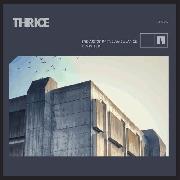
Review Summary: Safe alt-rock that fails to live up to Thrice's lofty standards.
Before I get into exactly why
To Be Everywhere Is To Be Nowhere is the worst Thrice album since
Identity Crisis, let me talk about why ‘Black Honey’ is one of their best songs, period. It bothers me how little the song gets discussed, especially considering how often Kensrue’s post-hiatus lyrics are lambasted for their simplicity (which I’ll be partaking in shortly). Thrice has a long history of lamenting mankind’s arrogance – in fact, if you look closely, the entirety of
The Alchemy Index was built around criticizing our abuse of the world we inhabit. Each “element” is mother nature’s way of reminding us that she’s in control, an idea that comes through in spades on tracks like ‘Kings Upon the Main’ and ‘The Lion and the Wolf’ – both of which see men die at the hands of nature. Dustin has always had a penchant for poeticizing these ideas, but he’s never crafted a more appropriate metaphor than he does on ‘Black Honey’ which, on a micro scale is a criticism of American greed, but on a macro scale is an indictment of our intrinsic desire to always take more than we need from the Earth. The song paints the picture of a man ignorant enough to question why he’s getting stung by a swarm of bees as he reaches into their nest to steal all their honey: “I keep swinging my hand through a swarm of bees / 'Cause I, I want honey on my table….I can't understand why they're stinging me….I'll rip and smash through the hornet's nest / Do you understand I deserve the best?” The last line is particularly infuriating because it feels so entitled and makes me want to slap the imaginary narrator in the face. But then I look around at the lavish lifestyle that even lower-end middle class Americans enjoy – iPhones, Nikes, multiple cars – and it’s clear why the rest of the world hates us as we whine and complain about
still not having enough. If it was a child acting this way, you’d say they’re being bratty and ungrateful – but when a world powerhouse does it for oil? Well, that’s different. Just ask us – we’re
Americans, and we deserve the best. How dare these pesky little hornets from the middle east sting us as we take what we need, right?
I have to rein myself in when discussing ‘Black Honey’ because it detracts from the much more obvious point, which is that practically nothing else about Thrice’s post-hiatus comeback album requires even a drop of intellectual perspiration. On 2011’s
Major/Minor, Dustin preachily wrote “Will we never turn to grieve the damage done…never quake with rage at what we have become?” The band spent half a decade reflecting upon the increasingly perilous state of the world and apparently decided that the best way to address it, from their platform, was through a bland alt-rock record. It lacks diversity both within and between individual tracks, and most of the lyrics sound like they were drudged up from a well of sociopolitical clichés and shallow do-goodedness. The album immediately lulls you into a sense of indifference with ‘Hurricane’, whose chorus repeats “It's gonna rain, it's gonna rain, till the levee breaks.” Aside from some interesting guitar effects, it doesn’t “quake” with much of anything at all. On ‘Blood on the Sand’, Kensrue decries racism in the most surface-level of ways: “We panic at the sight of different-colored skin…I'm not afraid to take a stand, to make it right — this has to end!” Obviously his heart is in the right place, but when compared to
The Alchemy Index's sonnets and especially
Beggars’ eloquent parables – all of which felt like grand artistic statements –
To Be Everywhere merely comes off as motel art. It’s vaguely pleasing, it says the right things, but anyone could have made it. The peak of the album’s simplicity rears its ugly head when Dustin screams, “Come on, we gotta wake up!” on the aptly titled ‘Wake Up.’ Just typing that made me roll my eyes a little. All that time off clearly dried up the ink in Kensrue’s metaphorical pen, because lines like this never would have found a home at any juncture during the band’s first incarnation.
Most Thrice fans are well aware of Kensrue’s post-2011 lyrical free-fall, so even though it plays a large role in
To Be Everywhere’s ineffectiveness, it’s certainly not the only reason. Almost all of the songs follow an extremely basic verse-chorus, verse-chorus progression that eliminates any hint of the experimental Thrice that we witnessed on
Vheissu and
The Alchemy Index. To make matters worse, Kensrue’s vocals rarely alternate to the gentler tones of an ‘Open Water’, ‘Atlantic’, or ‘Circles’, nor do they intensify to the fiery depths of a ‘Flame Deluge’, ‘Like Moths to Flame’, or ‘The Earth Will Shake’ – instead they’re stuck in a Kroeger-ish purgatory of gruffness. To be fair, that has always been Dustin’s default register, but it’s more than just a tad disappointing to hear him content
not to push the songs where they seem to naturally want to go. He makes a rare exception on ‘Salt and Shadow’, a breathtakingly smooth closer in the same vein as ‘Silver Wings’, but the majority of
To Be Everywhere Is To Be Nowhere feels almost deliberately held back from its potential – boxed in by a combination of flavorless songwriting and Dustin’s lack of tonal creativity.
It’s not that the songs themselves are terrible – the tracks, as basic as they are, still pack hooks, memorable choruses, and the occasional nugget of wisdom. The lack of vocal/structural variation could be argued from a certain angle as consistency of atmosphere. However, it’s difficult not to feel let down by Thrice making a “rock” album when we’ve seen them craft genre-bending albums that wax lyrical poetic in a way that could pass for existential literature. Obviously you never want to judge an album by its respective artist’s greatest achievement, but even as a standalone piece I’m not sure that
To Be Everywhere Is To Be Nowhere does any one thing exceptionally well. The phenomenal lyrics to ‘Black Honey’ and the flawless production on ‘Salt and Shadow’ notwithstanding, there isn’t anything that Thrice actually aspires to here aside from making safe alt-rock with political lyrics. That sort of thing sells, but it’s never been the band’s calling card. They’re free to chase this direction further, but this is the point where I exit the ride in favor of Thursday or O’Brother.