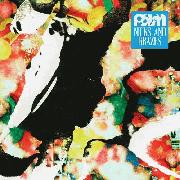
Review Summary: Post-punks takes the pop leap, almost stick the landing.
Before the release of Rock Island, Palm seemed to have hit their ceiling stirring up buzz amongst the more experimental circles of post-punks – specifically the type that might at least dabble in mathrock or prog scenes. The band drew influence from the This Heat oriented, more avant-garde, jarring, and dissonant side of post punk, even citing the band as a point of common interest that helped to bring the band together at its inception. While Palm had a certain catchiness – often found in Eve Alpert and Kasra Kurt’s doubled Panda Bear-esque vocal style – the band found its home in challenging time signatures, sporadic and deep grooves, and interwoven angular guitars, limiting the band to a fringe level of success and keeping their fandom within DIY and underground circles.
Rock Island sees the Philadelphia based quartet projecting themselves into more accessible realms on their Carpark Records debut. With this record, Palm successfully expands their sonic palette to include more synths, drum machines, and midi triggers, distancing themselves from the confines of more traditional rock instrumentation. In this expansion, the outfit embraces (as the title implies) a more tropical, island sound, aligning them in a certain way with the retro resurgence that can be seen in contemporaries such as the likes of Toro y Moi or Jerry Paper. Palm, while aesthetically embracing this throwback influence, also take cues in their arrangements and melodies, harkening back to the likes of Haruomi Hosono and YMO’s early tropical explorations and the regularly associated Japanese city-pop movement. In this application, Palm shows some maturity in embracing their influences not only at the surface level, but also demonstrating a deeper understanding of what made this style of music work.
Although Palm does a great job of embracing and incorporating new influences to freshen up and diversify their sound, they run into trouble trying to move on from their past identity. The band achieves the most when it has an anchor or driving feature that allows the outfit to freely layer some of its less traditional melodic and rhythmic ornamentation around this frame. This functions perfectly in tracks such as ‘Dog Milk’, with its motif of midi-triggered steel drums repeating and serving as the backbone of the track, or the nearly krautrock-like repetition in the latter half of both ‘Bread’ and ‘Heavy Lifting’. These moments highlight the potential sensibility that Palm has for crafting more purposeful tracks, giving themselves a sense of direction that stays true to the group’s identity, both past and present. That said, Palm has a tendency for an everything-at-once approach that can easily push the teetering balance from enthusiastic and experimental towards exhausting. Songs such as the more relaxed, meditative ‘Swimmer’ and the somber, spacious ‘(Didn’t What You Want) Happen’ demonstrate Palm’s willingness to give the listener the time to breath, but the band seems to be hesitant at times to fully devote themselves to their new sound and embrace the potential that comes along with it. The aptly titled ‘Forced Hand’ demonstrates the band regressing to their more spastic, skramz-y style that may have fit on their previous Trading Basics, but now delineates the album’s energy and direction. Moments such as this come off as vestigial limbs that hinder the group, and the album, rather than making any considerable contribution.
Overall, Rock Island showcases Palm’s significant growth and demonstrates their potential as a group that can achieve wider popular appeal without sacrificing their integrity as a progressive and experimental band. With their latest effort being their strongest yet, they provide an imperfect, but incredibly entertaining and engaging experience that showcases the benefits of taking risks. Rock Island documents a band fighting against their instincts for disruption and growing into a band that allows themselves to do things that would have at one point felt foreign. Palm takes a truly courageous leap on their sophomore album, and the growing pains are a minor price to pay.