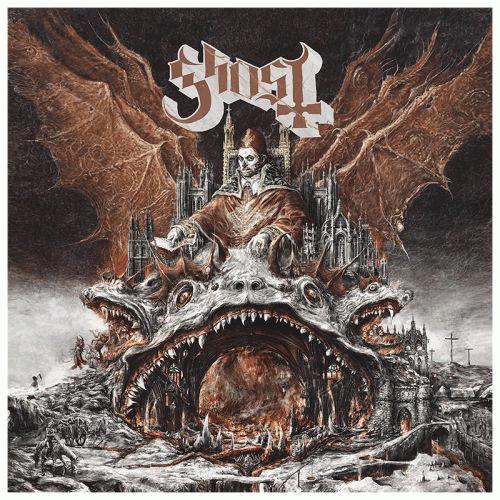
Review Summary: A new, friendly Ghost in the eyes of the faithful.
A few seconds after a little girl hauntingly sings a rendition of the nursery rhyme "Ring a Ring o' Roses" in the introductory "Ashes", the eerily familiar melody of "Spöksonat" from Ghost's third and groundbreaking album
Meliora slowly begins to surface, connecting the dots, weaving the threads between past and present until the band's massive sound bursts in announcing the beginning of the last temptation signed by the Swedish masked entity known as Ghost, the ominously titled
Prequelle. And just like that the transition is complete. A new army of Ghouls lies ready to take over the Clergy's frontlines, this time under the flamboyant leadership of a mysterious runner-up that goes under the name of Cardinal Copia.
Three Popes later, the theatrical troupe that Tobias Forge has been meticulously directing since the release of
Opus Eponymous in 2011 seems to reach its zenith with the release of Ghost's fourth and most ambitious album up to date. Everything falls right in place. Forge’s obsession with Candlemass and Mercyful Fate, which was present in Ghost’s early works now give way to an unavoidable and even trending 80s callback of glorious hooks and tempestuous guitar solos that speak of Abba and screams Blue Oyster Cult. The change of direction is a consequence of plans with greater scope, like Forge himself said in an interview: "If you want to play in bigger venues, you need to have albums that sound like you're playing in big places." Taking that to heart, Forge has been able to spawn hopelessly addictive tracks, positioning them on an evil scheme of a record that makes it flow so well that it allures the listener into a never-ending jam of demonic proportions.
Kicking things off, the drumbeat of formal opener and first single "Rats" is soon joined by an Ozzy Osbourne "Shot in the Dark" era riff dancing along public friendly “auaaaah(s)”, a first impression that reflects the ambition of Forge’s new incarnation of the band. Traces of the good old Ghost follow up in "Faith", a track that stomps its way with steady step marking one of the heaviest moments of the album. We are thrown then into "See the Light", a raging mid-tempo where the impressive production achieved by Royal Blood and Pixies producer Tom Dalgety shines in full splendor. The first half foreclosures with the first of two instrumental tracks, "Miasma", an unexpected collection of sounds that range from a homage to the rhythm guitar of Michael Jackson's "Beat it" to prog rock synth melodies and an explosive final sax solo courtesy of one of the Clergy’s favorites: Papa Nihil himself.
Ghost's new direction strips itself from the spooky looks of a Satanist Pope and four monks wearing hooded black robes in favor of a more friendly and uplifting image. This has been represented live during the ongoing US tour by the way the new Ghouls interact with the audience and between themselves plus being directed masterfully by Forge's new stunt, the charismatic Cardinal Copia, a cross between Marilyn Manson and a young Ted Danson rocking a pimp’s suit. This new concept that draws abundantly from the power of nostalgia has a bewitching ambassador in second single "Dance Macabre". The song already made waves when it was unveiled through Instagram stories featuring the likes of Phil Anselmo, Kirk Hammet and M. Shadows bobbing their head to the wicked tune, and it did so thanks to its impossibly sticky chorus, reminiscent of bands like Kiss, Journey or Survivor, an influence that Tobias have always admitted and that has become a craft in which he, as a songwriter, has already proved his mastery in the past with Billboard breakers like "Square Hammer" or "Cirice".
Prequelle is generous regarding the inclusion of power ballads. "Pro Memoria" has an almost "November Rain" feel to it while closer "Life Eternal" carries the promise of an absolute ecstasy if it's ever included in future live sets. "Witch Image" is probably the biggest surprise of the album, a deep cut shrouded by luscious vocals that leaves a magical imprint hard to wash away. "Helvetesfönster" is probably the strangest moment of the album, featuring Opeth's very own Mikael Åkerfeldt on guitars, the instrumental tune sails in between a sea of dragon themed folk and 70s progressive rock before the aforementioned "Life Eternal" sends off the album with a pleasant and almost rapturous death.
The evolution in Ghost’s sound will probably not please the entirety of their fan base but the undeniable quality of an album like
Prequelle shouldn't be precipitately ignored. With this new release, Ghost takes an immense step forward consolidating themselves as one of the most fascinating and captivating rock bands of the moment, bringing upfront the grandiosity of the genre of past days and channeling it with the irresistible charm of Lucifer himself.