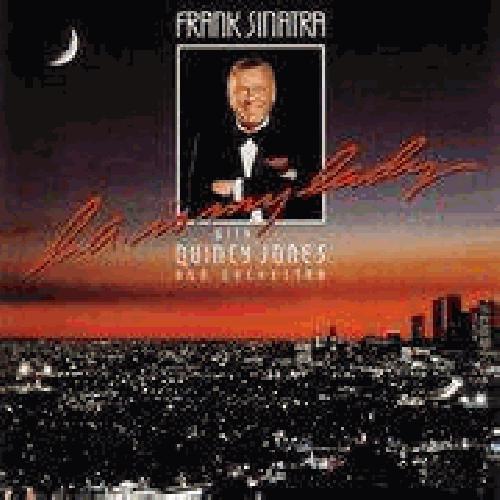
On paper, "L.A. Is My Lady" could've been a fine record for Ol' Blue Eyes: a great selection of standards, a proven collaborator in producer Quincy Jones, and a fine set of musicians backing him up. Unfortunately, the album manages to fall short of these expectations, its only significance being that it ended up as the last full length studio album he ever recorded (not counting those 'Duets' albums).
Much like his mid-1960s' recording, "L.A. Is My Lady" suffers due to its attempt to sound contemporary rather than playing to Frank's strengths. At this point in his career, Frank didn't need hit records or singles to prove himself (he arguably didn't ever need to do that after about 1965 or so), so the decision to do another album meant to cater the current trends is a bit preposterous.
"L.A. Is My Lady" kind of reminds of "Trilogy"'s 'The Past' segment, in that it features the great American Songbook material Frank is known in arrangements meant to sound 'retro,' for lack of a better term. They are all great songs on paper, but the 1980s' slickness doesn't blend well with the old fashioned lyrical and melodic sensibilities they were written under. This is especially true for Frank's bizarrely lifeless take on "Mack The Knife"; between George Benson's dull jazz guitar and whomever did that godawful scatting, not to mention Frank's lazy vocal (which he himself hated and redid two years later), this version is almost insulting. I don't think Frank could have ever taken the song from Bobby Darin, but he still could've done a lot better with this one (and the live versions are actually much more exciting).
The newer material on the record is also problematic. The title song is another attempt at a geographic anthem like "My Kind Of Town" or "New York, New York," but the song has none of the depth or excitement of either of those tracks and instead falls flat on its face. "The Best Of Everything" is outright corny, albeit catchy, and exemplifies the dearth of appropriate quality material Frank was faced with at this point in his career. I guess it's interesting for being the only Frank song that mentions skateboards, in case you forgot it was 1984. Most disappointingly, Frank's take on "How Do You Keep The Music Playing," a song he was tailor made for, falls short despite Frank's best efforts. Again, the generic MOR arrangement and Frank's bland vocal are the prime culprits here; imagine a grand, crescendo heavy Jenkins or Riddle arrangement and a gradually building vocal from Frank ending on an epic note, and you'd have had a real winner here.
Despite its flaws, there are some damn good moments on this album. The version of "Stormy Weather" is quite soulful, his weathered voice adding a whole new dimension to the song. The updated Sammy Cahn classic "Teach Me Tonight" is deliciously sexy and quite risque for Frank, and he sounds like he's having a blast singing it. "A Hundred Years From Today" is quite touching, as is the playful "Until The Real Thing Comes Along" (though the updated modern lyrics about punching out Mr. T. and other nonsense are ridiculous). Finally, the album's high point comes at the very end with a spirited "After You've Gone," which moves along at an intense pace before ending on one final high note that Frank holds forever. It's a triumphant performance, and a fitting end to Frank's studio career (minus the Duets efforts and a few scattered studio tracks in 1986-88).
"L.A. Is My Lady" is certainly a disappointing album, especially as the last full length studio album Frank ever recorded. It's a shame that such an ostensibly fine pedigree couldn't live up to their potential, and instead became smothered under misguided commercial ambitions. That said, it's still Frank, and there are enough songs where he rises to the occasion to make it a worthwhile (if not regular) listen.