Review Summary: Everything in it's Right Place, Right Time
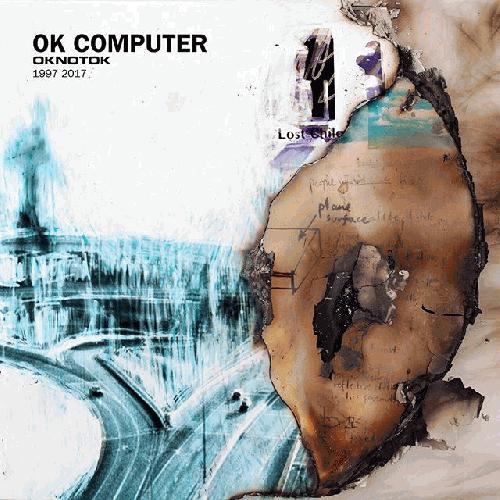
The twentieth anniversary of OK Computer, replete with re-issue, re-master, beguiling bonus tracks, altered cover art, poses a problem for younger music journalists. We knew, we’ve had it drilled into us, that the album is epochal, the pivot on which 90s Rock music hinged, and that’s fine; more daunting is that it is one of those rare albums that, we are told, was considered a colossus as soon as it was released. I was 5 when OK Computer was released, so I can’t attest to whether it bended the musical world into a new shape; all I have are fragments, reviews buried out of internet archives, hearsay, a guy at the pub who swore it changed his life the first time he listened to it and who hasn’t stopped listening since.
A further compromise we reviewers, amateur or professional or lauded, must make is that according to postmodern historiography, the artifact of a given era has long since ceased being an effect of a cause, but represents a cause of its own, or rather it doesn’t represent anything but becomes its own referent by virtue of the time it was recorded and released. Which is to say, if you subscribe to the view that OK Computer is about increasing alienation in the face of overwhelming technological advances, OK Computer isn’t just a reflection of it; it becomes an argument that the thing was the case.
But there is no doubt OK Computer was huge. The New Yorker, The New York Times and the Washington Post -- the holy trinity of Newspapers of Record -- covered it and lavished with fulsome praise, breaking the arch remove their reviewers are usually asked to employ.
With great ubiquity comes a need to interpret, deconstruct, demystify. Were Radiohead cast as Elektra, doomed to offer ominous oracular prognostications to deaf ears? Was OK Computer the trajectory of the Tories, The Tourist crashing them to the earth and offering hope, or was it a warning to Blairites to temper their hope because, well, meet the new boss same as the old boss? “It’s going to be a glorious day”, wails Thom ironically. Somehow, the listener harbours doubts.
Or there’s the most popular interpretation, that the proliferation of technology, as well as it’s almost unfathomably accelerated advances, would beget not unity but alienation, loneliness and atomisation. Conversely, according to Thom Yorke, it was just about how sh**ty touring was, the result of pent-up frustration, anguish and homesickness writ into 48 minutes of experimental (for the time) rock. I’m sure if you look on Jstor there will be psychiatrists who say it’s about Oedipal attraction, psychologists who have diagnosed Yorke with mania, historians who were ired because Radiohead got the details wrong in Paranoid Android. Was Johnny Greenwood fiddling while Rome was burning? With a guitar solo that portentous, one is made to think the answer is yes.
Truthfully all of these interpretations could be true, and cogent arguments have been made for each. I wouldn’t have enough energy to argue with fanatics. But is it not also true that OK Computer happened to be released in a time of great upheaval? The new millennium was looming, politics had shifted, war had re-entered the public consciousness. Could it not just be that this album, which now denotes so much, just happened to be released at the right place, right time?
***
I don’t know. It strikes me that retroactively appraising OK Computer is an exercise in futility, for the reasons outlined above but also because: if you’re reading this, you don’t need me to tell you that the guitar twinkles in Let Down are so direct and haunting that trading a limb to hear it for the first time again seems a fair exchange; that the menace and mania of Paranoid Android has been parsed; that the sinister Climbing up the Walls, sinewy as a spider’s web, has been applauded in every conceivable way.
All I have then, really, is my own personal experience, which is fairly typical. Bought from a sale bin at the behest of a friend. Thought it was excellent, at times splendid, but a little over-rated. Branched out into Kid A, which really threw me for a loop, as it were. Perused the rest of their discography eagerly. Now, even though I’ve long since clocked the Pitchfork canon and my interest in indie music has waned, they are one of my favourite bands in perpetuity.
OK Computer was the launching point, as fine an introduction as any, but I was always puzzled by its universal appeal. It is, and people forget this, a difficult album. Their first two mediocre stabs at first grunge-inflected britpop and then staid alternative rock. Nothing suggested that they’d go on to create an ambitious, experimental, wary and weary experience that would, twenty years later, still be critically interrogated.
Then came university (“college”, for those in the lesser hemisphere), where Radiohead was as intrinsic to the experience as that first script of antidepressants. The ratio of Radiohead posters to dorm rooms was probably 1:15, and many a formative experience was had combining marijuana, sh*t-talk and that weird dude across the hall from you’s Paranoid Android EP, spinning and crackling and immediate. The faux-arguments about which album was the best; discussions about which track they should have bloody recorded, or included on Amnesiac instead of f***ing Spinning Plates. They made up the fabric of my first year, thanks to OK Computer. They were not just a band, but a cultural phenomenon.
So it’s funny that, these days, OK Computer isn’t really even their most acclaimed album, that position long supplanted by Kid A. It was slow in the making -- when I first heard Hail to the Thief and In Rainbows, the first two albums that I was conscious of coming out, being a fan of the band now, reviews raved about a “return to form” and “casting off electronica shackles”. Now -- perhaps because of the advent and popularity of electronica -- Kid A is the critical darling. Strange that there was a time that it was designated for loners, creeps and weirdos; history has erased the trepidation towards that album, and the unfair comparisons to OK Computer (after praise that effusive, the critics weren’t exactly going to give it an easy run). But here we are, in 2017, and OK Computer, with its comparative dearth of experimentation seems -- well, kinda lame. Even Thom Yorke confessed that “that whole album [OK Computer] is really f***ing geeky”, and lyrics like “interstellar burst / i’m off to save the universe” and “hitler hairdo is making me feel ill” don’t exactly dispute the point.
If I can conject as to why this is, I’d put my finger on the prevailing interpretation of the album -- technology bad, we’re unprepared for doomsday, dystopia is just around the corner -- being deeply unfashionable, as we’ve discovered technology is, despite its problems, not as bad as all that, really. It’s kind of cringey, thinking about that sort of naysaying and primitivism, like people who thought y2k really would be the end of the world; it’s most embarrassing, too, for those who bought into it.
So the reason why this re-issue is both being seen as important, but also paradoxically as something to blow dust and cobwebs off, is because a prevailing interpretation stagnated, despite the album's continued ability to beguile, harrow, scare and amuse in equal measure. It’s a precarious position to be in; the reappraisal will either re-make it, or be its death knell.
I think that it will be the former, not just because it will introduce the uninitiated to what is surely one of the benchmark albums of the previous century and in the Rock canon, but because the interpretations have been proved infelicitous and wayward.
For me, OK Computer is fundamentally about two things: dislocation and purification. Radiohead were paranoiacs, not Luddites, five among countless who felt that something was wrong, that they were out place, but couldn’t put their fingers on why. So we get Thom Yorke professing to be “uptight” in subterranean homesick alien, murmuring “do not cry out or hit the alarm” but sounding more bemused than psychopathic -- how is it possible, he seems to ask, that someone close to him seems so far away? The album was recorded in a shed in Oxfordshire, Jane Seymour’s country mansion in Bath and crucially, in the case of How I made my millions, inside Thom Yorke’s flat, his late, missed partner preparing dinner in the background. No matter where he is -- a country lane, a car speeding through a city, in the air in Tourist, even in his own flat -- there is nowhere he feels at home. How can this singular depiction not resonate? My generation -- our generation, I’d hazard -- is known for being disaffected and lost, as our parent’s world has receded out of reach. We don’t have the same precedents and rituals to hang onto. In a way, raised on internet forums and HBO as much as Moby Dick and mathematics, we are the first of our kind, or at least it feels that way. How can we fail to see the solace offered by OK Computer, which captures that specific alienation with preternatural ease?
The purification one is tougher to pinpoint, but I think its been mistaken for technological reticence for all these years, and it deserves its time in the evaluation chambers. It’s been suggested that Fitter Happier is the thematic crux of the album, and I agree, but too much import has been placed on the robotic voice which delivers the soliloquy: “fitter. Happier. More productive.” That the monologue is delivered by a robot isn’t indicative of humanity relinquishing control to technology, but something more basic and long-standing; the quest of capitalism to purify the “impure”, perfect “imperfections” in order to create a docile, happily working population working the anthill. Just stand in the dole office, take their measly offerings, and you realise pretty quickly how much you’re worth to a system who values you only for your labour capacity and output -- literally, not enough to live on. Serious transgressors belong to prisons or, as Deleuze noted, the asylum.
This is not a new idea, but it’s one well rendered here. Their use of robotic voice isn’t a fear of what humans would turn into: it’s a rendition of what they feared they were already, programmed by societal strictures with no room for individuality or error. It’s metaphorical, not a warning. The purity theme permeates the record -- Yorke’s entreaty for it to “rain down” to cleanse “the panic, the vomit” (living in England, I imagine his plea was granted pretty quickly), his insistence, convincing himself more than anyone, that it’s going to be a “glorious day” and his “luck will change” -- i mean, all this bespeaks wanting to be better, right? But when “better” is measured in mechanistic, capitalistic terms, where does that leave us? Alone, alienated, astray.
While it’s true that OK Computer has proved weirdly, eerily prescient in some aspects -- we literally command our phones by saying “OK Google”, and it’s not too much of a stretch to say google has usurped computer as the metonym of technological advance du jour -- I think OK Computer’s success lies in it tapping into something more basic, more primal. I hope re-evaluations do it more justice than to reduce it to a hackneyed, reductive theme. If this re-issue makes anything clear, it deserves better.
And speaking of the re-issue, it’s rare than a remaster has made itself felt more forcefully than here. The percussion is foregrounded, to the detriment of the vocals, which makes for a fascinating comparative listen. Tracks like “Airbag” and “Climbing up the Walls”, which always straddled the line between trip-hop and rock, lean closer towards the former. Electioneering, which in its original recording was rather muted, has real snarl to it, the faux-illocutionary “we trust we have your vote” sounding as nasty and pithy as the subject matter -- the thrall of demagoguery -- requires. It is, frankly, revelatory, to hear tracks one though were toss-off and have them transmorph before your eyes like the best of parlour tricks. Elsewhere, Subterranean Homesick Alien, my personal favourite, has never sounded so crisp, so longing. Paranoid Android still bangs and brings the air guitar out of retirement, No Surprises still haunts. It’s a fine job, and worth the time of a votary and a novice alike.
And the second disk! Man! OKNOTOK, a disc of B-sides which mark the anniversary, is that rare thing, a collection of scraps that sounds like an album proper. If it had been released this year I would have thought it fresh and inventive, never mind that it was recorded twenty years ago. It’s that good. While it does defer to their idols in a way OK Computer didn’t (fan-favourite Polyethylene 1 + 2, for example, employs the acoustic-turns-electric trick Pixies and Weezer were so fond of, while Pearly owes much to R.E.M, Palo Alto to Can), it provides insight into how judicious the band where when assembling the final cut. None of the B-Sides slouch either -- the militaristic drum-beat of I Promise, complimented by a genuinely lovely vocal melody and sweeping strings, is Radiohead at their most accessible and powerful. Big Boots (here, “Man of War”, but I’m a purist) is unbearably tense, and lyrically excellent, and Meeting in the Aisle pre-figures some of the rockier moments in Hail to the Thief. Finally we see things out with the haunting pseudo-ballad “How I Made my Millions”, effortlessly spine-tingling, the kind of simple and affecting piano lilt bands like Evanescence and Muse would have slaughtered to come up with. Never has brilliance sounded so relaxed or so easy; rarely is anxiety and desolation this attractive a prospect to wallow in.
When Radiohead announced the second disk, they sardonically promised us songs “rescued from defunct formats, prised from dark cupboards and brought to light after two decades in cold storage.” What’s funny is that, after the work the re-issue does recontextualising it, it seems like OK Computer itself, despite being the most talked about album of a decade, that has been brought back into the light, and it shines luminescent and iridescent.
In twenty years, I think, A Moon Shaped Pool will get similar re-issue treatment, with essays praising it for it’s perspicacity in auguring Brexit, the rise of populism, the collapse of things we thought would exist forever. But we who lived through it, who know Yorke’s lyrics are always cryptic and Greenwood’s instrumentation always abstruse, will know that truth. Radiohead just happened to be in the right place at the right time, capturing universal unease and filtering it through penetrating music. An ability which is, in its own way, a kind of brilliance.