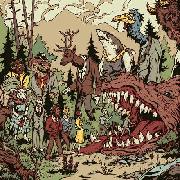
Review Summary: No place for me.
Full disclosure: I don't particularly like
DIVISI. This was somewhat painful for me to realize, as a die-hard Birds fan from their early
Plan B days to the golden age of
Conversation Piece and
No Place. Comparisons to the rest of their discography are unavoidable; it's incomprehensive, even stupid, to drop
DIVISI in a vacuum and evaluate it devoid of context, especially when context is so very relevant to my distaste for the album. I felt a very personal connection to the band's first three offerings, and I don't exaggerate when I say that some of my most revered musical experiences of all time are found scattered among them. I am disappointed that
DIVISI was not what I wanted it to be, but perhaps more importantly, I could not bring myself to enjoy it for what it is. Which sucks, although this kind of experience is nothing new. Any music lover will have already gone through the same thing: a previously beloved roster goes through a great shakeup, changing their direction in the process. The new sound turns out to be simply too different from what drew you in initially, and your interest fades. A bond is severed. Such is my current relationship with the band.
In the case of the Birds, the 'great shakeup' was represented by the departure of co-frontman and 'swancore' legend Kurt Travis, who apparently left because the band was considering such a drastic change of sound in the first place. Before you ask, no, this review is not the moan of a Kurt fanboy dissatisfied with the exile of his idol; it's not only the problem of what Kurt took with him when he left, it's what left alongside him, the elements that were organically shed in the band's pursuit of change.
Gone are the frenzied harsh vocals and it's a damn shame, since Cory has greatly matured since his earliest days in Discovery of a Lifelong Error. Gone are the delicious pop hooks, the interesting vocal interplay between Lockwood and Travis. The overall tone has shifted to ill effect; it is no longer an adrenaline-fueled journey of sonic schizophrenia, rife with tension and surprise, dubious tempo changes and crunchy riffs. Instead,
DIVISI is a quieter, ambient-oriented affair, packed with those haunting and ethereal bridge sections. It's 'Myth of Lasting Sympathy' and 'Kuroi Ledge' repeated ad nauseum, and while those two tracks were not necessarily bad ones, they were certainly the weakest among their peers. However, that weakness was mitigated by the louder, more impressionable songs, which formed a delightful buffer of contrast. On
DIVISI, there is no such contrast. As a result, it does not feel like the band has progressed. Rather, the opposite seems to be the case, and their sound is more stripped down, homogeneous, and flaccid than it ever has been before. It's hardly post-hardcore; there's nearly nothing 'hardcore' to be found within this meandering, samey soundscape. The album's problems even manifest in the cover art. It's dark, minimal, and significantly less detailed than their previous album covers.
The new tone poses yet another issue.
DIVISI's lyrics are superb, far and away from the rest of the crowd, but they are also very dark, brooding, and depressing, which veteran listeners recognize as standard fare for Cory Lockwood. This time around, however, the only word I can think of to describe them is 'melodramatic'. This does his writing a disservice; 'melodramatic' implies a degree of deceptive exaggeration. I have no doubt that when Cory is singing about his departed mother in 'For Shelley' he is being emotionally honest, with himself and his audience, but at the same time it feels oddly constrained and plastic, a problem I never ran into when listening to the equally sullen lyrics of
Conversation Piece and
No Place. Perhaps I can't enjoy it now because I'm a different person than I was years ago, perhaps my emotional state is more mellow and grounded than it was in years past. Or perhaps, as I theorize, no matter how strong an album's emotional foundation and lyrical clout, or the skill ceiling of its performers, everything becomes severely diminished by milquetoast, unmemorable songwriting. It's all the more frustrating because we know the band, even without Kurt, is capable of so much more, on every creative and technical level. We have entire albums worth of evidence.
Do not let me dissuade you from giving the album a chance. To someone else in a different place in life, in a different state of mind, this album may very well become a favorite, and serve you as faithfully as the older albums did me. But in the meanwhile, there is a jarring disconnect between what I feel and what the album attempts to evoke. Even so,
DIVISI still features a certain rawness and lyricism that is sadly absent in the scene, and is certainly not an 'average' album by any stretch of the word. But the overall execution lacks the same kinetic punch and gritty explosiveness that made A Lot Like Birds so magnetic to me initially, and it's evident that
DIVISI is handily dwarfed by the band's previous accomplishments.