The long rock song - otherwise known as the "epic" - has become such a staple of progressive rock over the years that it's easy to overlook how easily the concept can be fucked up in the wrong hands. You have to take so many things into account: "how will I make all the sections fit in conjunction with each other? How will the piece flow as a cohesive whole? What twists and turns should I add to keep the listener interested? What is the emotional draw of the track with all of that in mind?" That last one is just as important as the others, and in this regard Opeth have succeeded where many have failed. Ever since their debut album
Orchid, a steady balance of tight musicianship and vivid atmosphere has been their bread and butter. Even in their new work (
Pale Communion,
Sorceress), while more subdued and paying homage to the 70s prog classics, those two elements have essentially stood their ground. The allure of Opeth's music has often been that, not only are the instrumental and lyrical aspects masterfully woven together, but the songs simply feel
complete. They tell an interesting story; the sections don't feel overly fragmented; most importantly, they aren't intent on generating as much overt technical wankery as a musician can muster. But it's safe to say that Opeth have tried some variations over the years;
Damnation was perhaps the most notable experiment due to an absence of anything metal-related, but
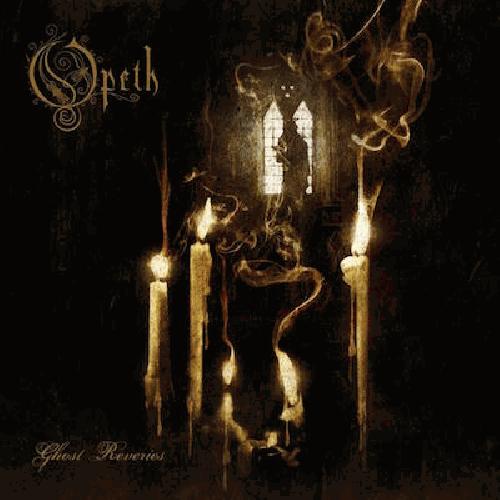
Ghost Reveries is what I'd feel confident in labeling an experiment as well... an experiment of "balance." What balance?
The balance of every Opeth album to date.
When it came out in 2005,
Ghost Reveries truly felt like the culmination of all Opeth had done at that point; it was epic, grand, complex, atmospheric, dark, lyrically stunning, technical, varied, and featured some of frontman Mikael Akerfeldt's best vocal work yet. Truth be told, this all pretty much applies today as well. Whereas the album's follow-up
Watershed was more intent on branching out in a progressive rock direction (which would continue from
Heritage onward),
Ghost Reveries simply feels like a stronger balance of classic prog and extreme metal influences. But let's go back to that term "epic." Out of the eight songs featured here, half of them go beyond the ten-minute mark. This isn't new for Opeth; hell,
Morningrise consisted entirely of songs that exceeded that point! But it's fascinating how this album never quite gets stale with each of its epics, all of them filling their run-times with an endless slew of quotable lyrics and masterful songwriting prowess. The opener "Ghost of Perdition" immediately sets the tone with a pounding death metal riff and Akerfeldt's inhuman grows, but once the metal elements subside, there's a heavy dose of sorrow thrown into the song's atmosphere. The folk-esque acoustic guitar section in the middle captures an isolated beauty that's only heightened by the distinct lack of drums during the entire section, and the final death metal stretch uses electric guitar chords that lend themselves to both aggression and melancholy. Of course, we get certain songs that almost entirely highlight the band's aggressive side, such as the haunting and intense tour-de-force "The Grand Conjuration." However, the ballads ("Hours of Wealth," "Atonement," "Isolation Years") are just as crucial to the big picture being created here. "Isolation Years" in particular is one of the best songs Opeth have ever written, as clean guitars and mellotrons meet a lyrical portrait of loneliness and despair. Akerfeldt's vocals are especially great here, exhibiting an amazing level of vulnerability; during the choruses, in which he switches to wispy high vocals, he's able to sound emotionally wounded to perfectly match the vibe of instruments.
Speaking of instruments, I suppose it's no surprise that the boys in the band are at the top of their game here. It's worth noting that this was Peter Lindgren's last appearance on an Opeth album, and it seems as though he was determined to make one hell of a last stand. The way he and Mikael Akerfeldt connect on the album is sublime, particularly on the more melodic segments. One of the best moments on this record from a guitar point of view comes from the end of "The Baying of the Hounds," in which Mikael's acoustic guitar chords meet Peter's surging electric guitar chords on top of Martin Lopez's busy drumwork, creating one of the most cathartic and emotional moments in the band's career. Stuff like that is why Peter Lindgren is still sorely missed in the band; granted, the newest addition to the band, keyboardist Per Wilberg, is definitely a welcome change in the line-up. It seems a bit inevitable that Opeth would eventually hire a keyboard player, given how they were going further and further into 70s progressive rock territory (not that every prog band back then used keyboards), but Wilberg really does round out the group well. He even adds some real atmosphere to songs like "The Baying of the Hounds" and "Atonement," which manage to sound darker and more sinister with that Hammond organ included (especially during the heavy moments). Martin Mendez’s work on the album is great too, if a tad understated at times. He does get his moments, such as the rolling bass lines near the end of “The Baying of the Hounds” or how he subtly switches octaves alongside Martin Lopez’s steady drumming on “Atonement.” Much like Queen or Rush, the real draw of an album like this is hearing so many talented players being able to meld together as one formidable unit. That’s why “The Grand Conjuration” in particular gives me chills; when Akerfeldt bellows the titular words with his growls, “THAAAAA GRAAAAND CONNNNNJUUUUURAAAAATIONNNNN” and a mellotron-driven death metal riff follows in such epic fashion, it’s the kind of moment that remains etched in your brain for a long time.
Even among Opeth’s impressive and consistent catalog,
Ghost Reveries still manages to be ridiculously impressive. It may not quite be their best (
Still Life claims the top honor for me personally), but it’s incredibly close. Perhaps the album does drag in places - “Reverie/Harlequin Forest” comes to mind - but the 66-minute run-time still feels remarkably short for what it is. As a whole
Ghost Reveries has all the elements you could want in an Opeth album. It’s deeply emotional, maintains the band’s progressive rock influences, adds a good helping of death metal fury, and is extremely consistent. That, and it’s just fun to listen to for all its songwriting intricacies as well as its twists and turns; it also serves as a nice entry point into Opeth’s body of work, as it’s not quite as abrasive as previous works they released.
Ghost Reveries has an absolute mountain of accolades to its name, and I can’t really say they’re wrong; it’s just that good.