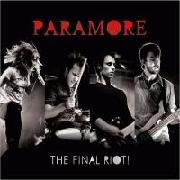
Review Summary: When the Farro brothers left, the signature sound of Paramore didn't just fade away, it disappeared altogether.
I don't listen to a lot of Paramore songs, let alone albums, but I feel connected to the band; not because I enjoy its music, but because it reminds me of middle school. During those years, my two best friends obsessed over Hayley Williams. They listened to Paramore songs non-stop and dyed their hair every six months. Of course my parents never let me dye my hair, but I eagerly joined the Hayley Williams fanclub anyway. We spent our afternoons jamming to “crushcrushcrush” and “misery business” and, in the summer before high school, formed a girl band. Needless to say, it sucked, and then Twilight happened so naturally we lost interest in Paramore; and eventually, we lost interest in each other when we found different niches in high school. But, despite my now defunct relationship with my former best friends, I look fondly on those middle school afternoons. I'll listen to a track from Riot! every now and then and feel the same energy as I did back then. However, I never actually listened to a Paramore album from beginning to end until now... two years after the self-titled album came out.
It's apparent that, when the Farro brothers left, the signature sound of Paramore didn't just fade away, it disappeared altogether; a conglomeration of ill-fitting sounds filling the void. As the album not-so-subtly projects, Paramore wanted to move on and its new sound reflected the new, reinvented and mature, Paramore. However, reinvented or not, the new sound is the product of the band's inability to recreate the work of the Farro brothers. If anything, this album proves that they made Paramore, and the band succeeded because of Hayley's voice and overall appeal. She brought the best out of Josh's already good compositions. In
Paramore, even her voice can't save several subpar tracks. As far as maturity goes, this album is the opposite of mature. Nearly every song, if not all, relates in some way to the Farro brothers. The lyrics, frequently spiteful and acerbic, convey the deep resentment Paramore feels for its former bandmates. And even though bitter lyrics aren't mature, they're not necessarily bad. They're understandable and relatable. They're also far less pesky than albums full of songs with lyrics that wallow in heartbreak and drone on and on about chest pains. For this reason, the unfortunate breaking up of the band could've worked to Paramore's advantage. It gave them both the focus of a typical break-up album and great material to back it up (unlike a generic break-up album); two things that their previous albums needed. Unfortunately, Paramore failed to use what they had to work with well, and consequently, the album lacks cohesion.
The album suffers, foremost, from its length. If a long album has a lot of filler, then the artist or band should remove it. The most obvious examples of filler in Paramore's album are the interludes. They have a certain appeal, but they don't belong in this album. They disrupt the mood of the album three times. Aside from the interludes, the tracks don't flow well from one to the other. It's as if Paramore chose “Fast In My Car” and “Future” as the opening and closing songs and then haphazardly scattered the rest of the songs without giving any thought to effective sequencing. Or, maybe they tried to arrange it better, but the silly songwriting on more than a few songs made it impossible to discern good placements. Furthermore, while most of the songs stray from Paramore's original sound, the ones that do try to emulate it like “Be Alone” fall short; shadows of their pre-break up counterparts.
In conclusion,
Paramore has a lot of shortcomings. The songs aren't well-integrated. The album experiments, and creates a few nice musical moments, but it's unable to combine the separate elements to form a harmonious and interconnected package. Therefore, it's hard to enjoy the album as a whole. And even when the songs are analyzed individually, the ones that are initially catchy like “Still Into You” lose their novelty after a couple listens like a lot of pop songs. “Future” is more layered, and should have the potential to grow on the listener, but even it doesn't have the effect it intends. Instead, it's drawn out and unmemorable like most of the songs on the album. The albums three redeeming songs are “Now”, “Proof”, and “Part II”. While I don't get the same satisfaction from listening to these songs as I do from older Paramore songs, they're good and show that Paramore has potential to improve once it finds and refines its new sound.