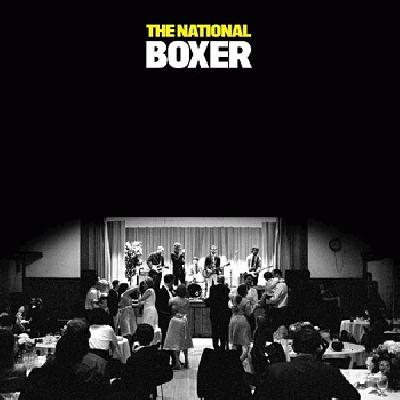
Review Summary: Put it on after a long day at work and you won't be disappointed.
Joyce Carol Oates is infamously quoted in the literary community for saying “the first sentence can’t be written until the final sentence is written,” presumably because then the work receives some sort of cohesion. I’ve always believed that about albums, too. Cohesion will make a good first track will stick with you while the others follow.
Take “Fake Empire.” After a quick fade-in, the piano establishes something close to the pulse of the song. Matt Berninger’s delicate yet confident baritone sings about staying out late with insidious drinks - you won’t even notice Bryce Dessner’s left hand at the keys, even by the time the guitars sprinkle in. It’s not until the bass kicks come in that the song really begins to pull the way it’s been waiting to, and when the rhythm section stops holding back, the stretch of the hemiola becomes entirely established. “Let’s not try to figure out everything at once” sings Berninger - a comfort he extends to those who start to paradoxically feel how the song stretches to find ground, yet seems perfectly comfortable in its execution. The tension is both subtle and ubiquitous, but never inconsistent. We’re half awake in our fake empire, and we know it.
“Fake Empire” is the only track on the album that plays with tempo. Dessner would later reveal that he wrote it in order to explore this four-over-three polyrhythm, making it a song that was more defined by its concept than anything else. But that concept is the whole point, because Boxer is an album about the kind of tension it creates.
Lyrically, Berninger writes on the spot in reaction to the music that the Dessner twins (who take guitar and piano duties for the band) compose for the most part. Parts of Berninger’s personal life leak in whether he knows it or not, and it’s present in all of Boxer’s subtle tensions of adults life. “Mistaken for Strangers” presents a song about what happens when one falls victim to the titular situation - manipulated guitars and heavy stick work from drummer Bryan Devendorf drive forward under Berninger's matter-of-fact melancholy, likening the experience to the rejection of a guardian angel’s attention as he falls “into the unmagnificent lives of adults.” “Racing Like A Pro” documents such unmagnificence even further as a patiently ambling lament of realizing “oh my god, it doesn’t mean a lot to you.” The Pyrrhic victories of “Squalor Victoria,” the seemingly unreasonable indecision of “Ada,” the tangled knots of personal interaction in “Start A War,” it’s all there to wring out the mundane for all the effects it has on the human psyche, something this band does best.
But Boxer is different than what came before. There’s nothing as loud as “Mr. November,” and Berninger seems to be done with the screaming he did on “Abel” and “Available.” The band was never reckless back then, but there's still a greater amount of restraint on Boxer, where any hint of high distortion has been traded in for the art of composure. The progression behind “Gospel” has the band at its most patient, adding in song elements with some impressive grace, and tenacious tracks like “Mistaken for Strangers,” “Squalor Victoria,” and “Apartment Story” hold together effortlessly even during the more demanding instrumental moments. A lot of this is due to Bryan Devendorf’s sniper-precise work behind the drumkit, acting as the backbone of the band and allowing the other instrumentalists to settle in quite nicely. Berninger may give these songs a voice, but Devendorf offers a foundation for these compositions to stand on, whether it’s through his effortless consistency in the build and release of instrumental tension on songs like “Apartment Story” or through the patient subtleties of his more minimal parts on songs like “Start A War.” The band is lucky, too, to have Peter Katis to mix them all together, leveling out even the denser tracks on the album so that nothing feels muddled or out of place. The slate isn’t wiped clean on Boxer, but it is neater, more organized - some might even say more mature.
Toward that end we have “Apartment Story,” which serves as the album’s centerpiece. For starters, while Boxer never sounds too bleak or depressing, ”Apartment Story” seems remarkably more celebratory than the rest of the album. The snare snaps out a count-off and low, lightly bristled guitars introduce themselves before the song finishes off in a strong fortissimo with layers upon layers of guitar and vocal tracks, rocketing towards a tight sigh of release. But it’s Berninger’s lyrics that really tie the whole song together. “Tired and wired, we ruin too easy,” he sings to his significant other in observation of daily life’s toll on him, before declaring the only remedy: “sleep in our clothes and wait for winter to leave/and I’ll be with you behind the couch when they come.” The couple in question tries to pull something out of the mundane in order to help survive it. “So worry not/All things are well/We’ll be all right/We have our looks/and perfume on.” Adult life has some hope here.
And that counts as something of a thesis for Boxer. The National has brought what they could from their lives in order to be the glass of whiskey on the rocks that’s waiting for you when you come home from work, or a tall glass of wine if that’s what you prefer, or even just that one television program you’ve been looking forward to all day - whatever works for you. The National created Boxer to get you through the day by reminding you that even though they’re big-time musicians, they’re still going through the same insecurities, disconnections, and hazy hopes on dreams. On Boxer, they're dodging the same blows you are, even if they're a little too slow, a little too patient, a little too jaded, a little too tired of it all. The only difference is that they're singing about it.