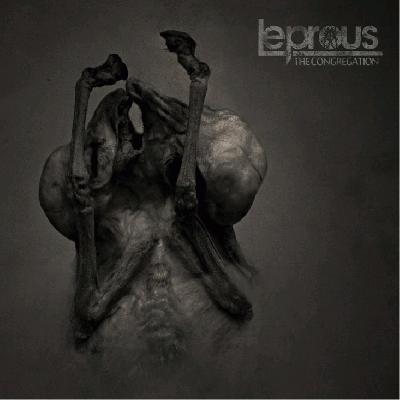
Review Summary: A highly abstract prog offering, proof that, sometimes, less could be more.
Leprous certainly had a lot of artistic choices to make in order to produce an integral work, especially when coming from albums that had so many things going in them, like Tall Poppy Syndrome, Bilateral and Coal. The Congregation is the result of keyboardist and vocalist,
Einar Solberg, assuming the role of composer for the whole album. Unlike previous albums, there isn't the slightest hint of uncertainty regarding his vision. He is adamant to what he wants and how it should be done, making The Congregation not simply a display of tight songwriting but one of the best examples of artistic vision put into motion in the strictest manner possible. The result is of great aesthetic value and it happens to be Leprous' catchiest and most technical offering to date while, at the same time, demanding the listener's full attention and not providing any easy listening reliefs.
Soaring melodic vocals, syncopating rhythm guitars, effect-loaded synths and intricate drum patterns dominate the song structures. All of the songs follow the same formula and are built around a drum pattern that never steps down a notch, resulting into songs that manage to be fast and rhythmically catchy (it somehow makes sense that Einar Solberg cites Massive Attack as his main songwriting inspiration). There are almost no time signature changes to be found in The Congregation. Instead, we are offered with different tempos between the melodic vocal parts and the structural rhythms. The linear song progressions are enhanced by sections that feature staccato playing and emphasize the atmospheric background elements like the synth sounds. A prime example of this approach being one of the album's highlights, "The Flood".
The melody is based almost entirely on Einar's vocal performance. And what a performance it is! His unique singing style comes to near perfection in The Congregation and makes the catchy choruses even more memorable. Furthermore, the verses are tied melodically with vocal passages and harmonies making them a vital component of the orchestrations and a prime example of using vocals as an instrument.
Drumming is perhaps the second most impressive element in The Congregation, closely following Solberg's vocals. The band's new drummer,
Baard Kolstad (street drummer and also part of several other projects), proves to be one of the most promising drummers in the prog scene today and puts on an amazing performance which is further enhanced by the great mix that makes every little detail concerning drums and cymbals distinguishable. It is not about what he does, but rather how he does it. Standard tempos are carried out with extreme technicality which is made even more impressive by the tendency to keep up the pace till the end of each song. Finally, there is not much to be said about the guitar work that is not evident by now. The band's guitarists,
Tor Oddmund Suhrke and
Øystein Landsverk, are not the main driving forces behind song progression, and instead help elevate the album technically by offering another layer of rhythm backbone. This kind of musicianship along with the memorable choruses (like the ones in "The Flood", "Triumphant", "Slave" and "Moon", to name a few) result in one of the most unexpectedly catchy albums you are likely to come upon. After some listens the rhythms and choruses will be injected into your brain in a borderline creepy manner.
The album is not without its shortcomings though. A potential one being its drawn out playtime. The other most evident being Einar Solberg's attempt to imitate the harsh vocals that were provided by the band's patron,
Ihsahn (from pioneer band Emperor), in past albums. The result isn't half bad, but Einar's blackish screeches definitely have a lot of room for improvement, especially when measured against the band's previous offerings. Furthermore, and given the emphasis on the rhythm section, one would expect the bass to be a more prominent element in the mix. This is not the case, and the bass' sound is inconsistent among the songs and the lines don't seem to be highlighted as much as one would expect from such a record. Perhaps, this is due to the fact that the band does not have a full-time bassist at the moment, so the spotlight is reserved for the other four members.
Lyrically, the themes that the album tackles are issues concerning the modern society, like the negative effects of mass production and consumerism. The underlying message aims to be unsettling as the listener and the artists themselves are part of today's massive society -
a shallow congregation as the track "Down" puts it - and cannot fully distinguish their conscience from the lifestyle they tread. The lyrics emphasize on the need to overcome the resistances built inside society itself and each person molded by it, and thus blindly following the flow is challenged. Paraphrasing the track "Moon", can a parallel be drawn between the average person and
a moon without lights of its own ?
Ultimately, The Congregation proves to be an anti-conformist album that manages to be consistent musically with the lyrical themes it portrays, even in an unorthodox manner. The more the listeners are immersed into the deceptively catchy flow of The Congregation, the more its unsettling nature will come forth to haunt their conscience and make them contemplate on its lyrical subjects.