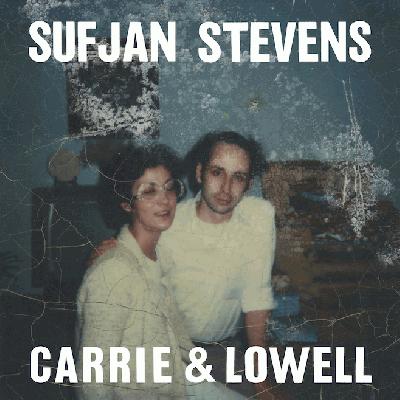
Review Summary: We're all gonna die.
How somber and painful grief is. It seems like nothing gets one closer to reality than when they have lost a piece of theirs. With Sufjan Stevens’s recently deceased mother, he discovers this feeling and embodies it into a beautiful piece of both memorabilia, and recognition of the fact that death always looms close throughout our lives.
Without listening to the lyrics, one can easily tell by the skeletal and haunting instrumentation that this music is supposed to be very intimate. Not in the romantic sort of way, but instead more akin to the gloomy kind of closeness one feels with the world upon learning about one of its dispiriting truths. Carrie and Lowell is intensely personal in that regard. Stevens rarely relies on more than a simple acoustic guitar and dreary atmospheric effects, like the ambient opening to “Fourth of July” and the ghastly morphing of his voice through the croons and moans in “No Shade in the Shadow of the Cross”. Even the more upbeat sounding “Carrie and Lowell”, a piece intended to remember the singer’s mother and stepfather, gives way to a mellow atmospheric outro, showing how grief can distort even the happy memories of those close to someone.
And it is this sensation of being so close to someone who is no longer alive prompts feelings of hopelessness. Steven’s bluntly delivered “*** me, I’m falling apart” delivered in “No Shade” is not an over exaggeration at this time of his life, as one loses part of themselves when they lose someone else close to them. And when he proclaims that “All of me wants of you”, it is because he is trying to get that part of his life back that he has lost, even if that means giving himself up in the process.
It is important to remember however, that grief does not just mean feeling sorrow. In finding himself so close to death, Stevens is able to forge new life out of that he has lost. While “Should’ve Known Better” may seem like a song of regret for things he should have done while his loved one was alive, it is more a focus on how he can move past his grief, and appreciate the beauty that still exists in his life; because his brother did have a daughter, and she certainly does bring beauty. Even “Fourth of July’s” direct image of Stevens’s dead mother is something that is okay, because after it all, she still is his little butterfly.
Stevens makes it clear that we are all eventually going to die, but that does not mean it should be something that destroys the soul. This album looks to be a testament to that, and why albums like this are so important – it shows death as a form of growth. We all may die, but that does not mean we can not find value in it.