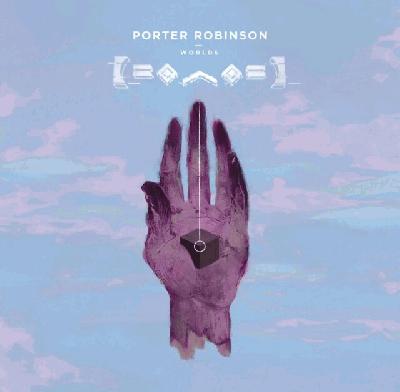
Review Summary: Worlds is the soundtrack to Porter's imagination. Can you find it in yourself?
Between the nostalgia and vibrant energy is the imprint of a young man doing nothing less than his truest artistic expression. Understanding Porter’s musical history is near-essential to see the story of a frustrated artist revolting against the mundane musical machine of popular electronic music with grandeur tenacity and earnestness. A self-described Japanophile, Porter found electronic music for the first time as a teenager playing Dance Dance Revolution. He has said himself that anime and video games were his influence for Worlds. However between then and now Porter found himself caught in the current of everyday life. His number one Beatport hit, Langauge, blew up and a career as a world class DJ precipitated from the hype. He spent the next few years touring with some of the biggest, baddest, groovy dance anthems and a live DJ set that had no less energy and majestic effect than a tidal wave or another grand expression of nature. Worlds is the rejection of the totalitarian effect of a pre-programmed musical blue print against individual artistic expression. It is not a direct protest against his musical heritage but the third person perspective derived from the real life of a young artist breaking down his claustrophobic musical prison to come into his own moment of realness. Worlds is the realization that occurred when Porter sought to end the story that others has been writing and instead show us his own tale of love, beauty and a wild imagination run exquisitely astray.
The sound retains the high octane stamina of its EDM musical origins but it is its distinctively video game soundtrack inspired direction that lends a hand to its imaginative bravado. The typical structure of the music in Porter’s history demanded he, the artist, give the listener what they want. They want a song structure that resembled the rising and falling of waves. They want to drop the bass. Rather than building his tracks only to reduce them to little more than endorphin-fulling bass hits, he follows the pattern of a symphony, a long climb followed by a crescendo of sound that is so much more than anything we would hear in today’s EDM scene. This is not a drug fueled dance hit, but rather a chronology of sound. This is part of the album’s brilliance. It’s a simple deviation from the norm, which is still able to find its unique niche in the world of electronic music. There was an ‘aha’ moment when I understood that this was the re-imagined world of another man. Considering that he is still nostalgic for and still participating in the creative universe of anime, the genius of Porter Robinson becomes glaringly obvious. As listeners, we have in our hands the captured essence of an art form, re-imagined in the mind of a budding young electronic composer. Here I find something special and fairly unique. In Worlds we find the typical energy and natural charisma of electronic dance music, but it becomes a vessel for the listener to see how the world of anime crept in to the mind of a young boy and inspired a musical craft to which he would dedicate himself. Worlds is the soundtrack to Porter’s imagination.
There are a couple fantastical moments that, standing alone, can encapsulate the grand imagination of the entire record. “Is anyone there?’ asks a lonely digital voice, followed by the sound of a machine powering down. To the reprise of the sad robot is an epic pulsating beat led by addictively disheartening keys. This is broken by pulsing synths that beat like excited hearts. The keys are now looped and the effect is a wall of sound seeping through your veins so that your body is vibing with the music in an intuitively automatic fashion. The same synthetic voice returns.
Who survived?
Somebody knew?
Anyone else but you
On a lonely night,
Was a burning light
A hundred meters out beyond the wall
It was this moment that I found myself lost in the reality of Worlds imagination. Throughout the record a lot of these moments focus on the grand images evoked by the lively characters in his story. The lyrics feel like a dialogue and the music a journey being undertaken. So it is in Years of War. A catchy synth melody begins and leads to what sounds like a young lady on the precipice of grand change. She sings in a frail but inwardly strong tone about standing up to treachery, of fighting the oppressors and taking back what has been stolen. When it turns to the chorus there is a large drum being pounded as if it were a war drum accompanying legions of troops into battle. A hazy synth chord is held low to create a sense of urgency. Now when the frail voice returns, it is no longer obviously unsure of itself and holding back. To her, it’s a full on war and she means to say so.
Oohooh, two hundred years of war
Fight till we are no more
A curse on the streets of gold, ohooh
Just know
That mine is the hand to hold
Take back what the kingdom stole
A curse on the streets of gold
This album plays out like a grand story devised by oneself after finishing a novel or a video game, when you find yourself dreaming of imaginary worlds. There is a beautiful heroine, a brave but unlikely knight and an invisible evil force. Characters run amuck in your mind and grand themes develop into your own grand insights. What effect anime had on Porter, created the same ignition of imagination and vibrant energy as Worlds did on myself. I began to play it during bike rides and walks as a soundtrack to the world around me. Working out became a little more magical. I still find myself on most days listening to new music but almost always returning for a play through of Worlds. It has become my decisive sound with which to do, learn and accomplish new things. It’s my interpretation of his vision, the grand, upbeat, voluptuous feel and the big room size of the music that transforms grand emotions into inspiration. It inspires me to imagine. It has become a soundtrack to the imagination.