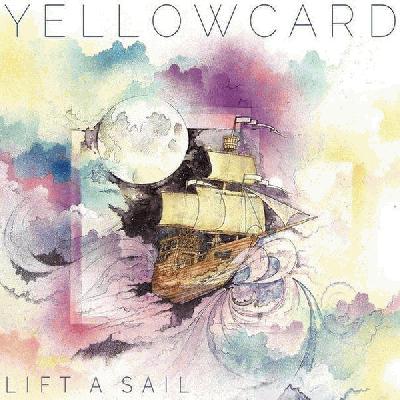
Review Summary: Sending the transmission home.
Anytime a band makes any sort of tweak to their trademark sound, there’s going to be controversy. Uproar within the change-resistant fanbase is to be expected, especially when what’s being changed has been their calling card for almost their whole career. For years, the brilliant use of violin made Yellowcard more than just a generic pop-punk band, and as time marched on they proved they could utilize it in many ways, ranging from emotionally to energetically. No matter what, they’ve always been consistent in both their quality and songwriting, and their track record proves it.
Lift a Sail brings a couple of huge changes to Yellowcard’s signature sound, yet only time will tell the longterm effects that have yielded from it.
From the get-go, it’s pretty clear that this is quite a different album than
Southern Air and even
When You’re Through Thinking, Say Yes. After a brief violin introduction, “Transmission Home” kick-starts
Lift a Sail with pounding drums and a nice, rock-driven riff, and that’s pretty much a sign of things to come. The instrumentation is a lot less pop-punk influenced, focusing more on anthemic, stadium-ready hooks rather than the fast, tight energy of records prior. The result is somewhat of a mixed bag; while some songs manage to take this formula and run home with it, others lack that spark and zest that they brought in the past. The stylistic change isn’t even the main culprit in this whole debacle, it’s the overall lack of inspiration. For more than a decade, Yellowcard played their brand of upbeat pop-punk, and it never got old even if that’s all they ever did. There was energy behind that, energy that is painfully lacking in certain areas of this album.
In addition, the tracklisting on
Lift a Sail is also something that factors into its quality. The weakest tracks are all clustered around the beginning, and thus the album feels incredibly back-loaded. Aside from the gargantuan feel of “Transmission Home” and the beautifully crafted violin introduction before it, there’s a serious lack of highlights on the first few songs. On the other hand, one thing the first half of
Lift a Sail certainly doesn’t lack is a good clunker, and their overabundance really kills anything the first two songs had going for them. “Crash the Gates” attempts to pull off a huge, stadium rock chorus but just ends up falling flat right on its face, while the saccharine and contrived “Make Me So” plays it way too safe, coming off as more of a teen pop song than a Yellowcard one. The album really doesn’t pick up until “Illuminate”, but thankfully, once it hits its stride, it’s all smooth sailing from there.
Lift a Sail is also the first Yellowcard album without Longineu W. Parsons III on drums, and the effect that his departure has had on the band can be felt throughout. Although his replacement, Nathan Young of Anberlin, clearly is talented, he doesn’t bring even half the spark he did to his former band, and if there’s a performance on here as tight as “Self-Starter”, it’s lurking in the shadows of imagination. The drumming on the album just feels a bit lightweight and mediocre, without any fire or energy. Granted, he does pick it up a bit once the album is already half over, and songs like “My Mountain” or “The Deepest Well” manage to exceed expectations, it’s a rare bright spot. Without LP, the drum section is just played so safe, and whether that’s a direction the band wanted to take or one that came out intentionally, it is noticeable given that the vicious drumming of Parsons played an integral part of the band’s sound.
Even through all of its flaws, one can always count on Yellowcard to at least deliver some quality material on their albums, and
Lift a Sail is no exception. Sure, it takes a while to dig through all of the dirt first, but once the first sight of gold is found, the rest is right beneath. Ryan Key is still shining vocally, managing to balance the fire and energy of “The Deepest Well”, featuring guest vocals by Matty Mullins of Memphis May Fire (hooray for alliteration) with the hefty emotions of songs such as “MSK” and the title track, the latter of which ranks amongst one of the band’s best tearjerkers. Inspired by the paralysis of Key’s wife, Russian snowboarder Alyona Alekhina, “Lift a Sail” reaches heights that few Yellowcard songs have reached before. “If a cold wind starts to rise, I am ready now, I am ready now / With the last sail lifted high, I am ready now, I am ready now,” belts Key at the top of his lungs. The guitar solo is used perfectly for maximum effect, and every word that is sung is coated with so many layers of emotion and passion that it’s hard not to be moved knowing the circumstances behind its story. “MSK” is one of the few songs on the record that heavily incorporates the use of violin, and Sean Mackin’s playing greatly complements the track’s somber mood. It’s clearly a tale of two halves, although it most likely would have been better if it wasn’t.
When it’s all said and done, what will
Lift a Sail’s legacy be? It’s way too early to tell, but the less-than-enthused response to it suggests that it could possibly go down as one of the band’s weaker efforts. While it isn’t bad by any means, there’s a clear regression in quality from
Southern Air. The huge, arena-ready choruses just don’t deliver, the drums are a bit weak without LP at the helm, and the tracklisting is just awful. Yet at the end of the day, there are enough highlights to cement this as another above-average album from Yellowcard, although not as above-average as records prior. The passion behind “Lift a Sail” and “The Deepest Well” stand out the most, and part of the reason why the second half excels is that it’s more slower-paced and emotional, offering earnest sentiments instead of faux-energized flat rock hooks. While it may not be the best direction the band could have gone in given the lack of energy at the beginning, at least they’re trying to do something different.