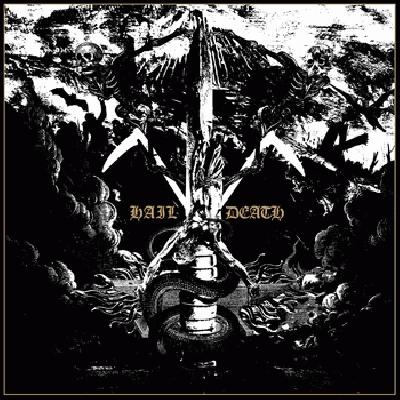
Review Summary: Hail Death? Hail Black Anvil.
The mere fact that all three members of NY extreme metal group Black Anvil used to and still do play regularly in hardcore bands may confuse some who listen to an album as dark, menacing and twisted as
Hail Death. Then again, Black Anvil's latest album has a recurring theme which channels utter woe and darkness from the crumbling heaviness of speakers to the unwilling mind of the listener, and the history of Black Anvil's career often emanates from the way in which hardcore never seemed to leave their core influences. That said, latest album
Hail Death can safely be a contender for the finest extreme metal album of 2014, if only because the sound in general is utterly focused and seamless.
The first thing which you'll notice instantly is how long-winded
Hail Death really is. Nine tracks spread across 67 minutes may seem gargantuan for some, and this isn't your average prog-meets-black-metal-in-a-psychedelic-forcefield sort of album. In fact, every song here explores the traditions of extreme metal's earliest occurences, and in that case it's not entirely surprising that the majority of the sound here often brings to mind Bathory and Hellhammer just as much as it does Deceased and Dissection. The songs which work the best here are the ones which have a mournful, evocative build up for a minute or so before exploding with menacing musicianship and a hateful vocal delivery. Opener “Still Reborn” definitely sets the standard for this sort of song structure, with its concrete fusion of heavy metal and blackened atmosphere searing through the thick atmosphere. At nine minutes long as well, this particular song has quite a bit of complex songwriting, but only in the second half is it really obvious. Following on from this musical formula are “Seven Stars Unseen” and “Until the End”, both of which are the most melancholic-sounding tunes the album has to offer.
The shorter, snappier likes of “G.N.O.N.” and “My Hate is Pure” may seem slightly ineffective compared to the longer songs, but the musicianship is still managed to sound concrete and solid. These particular songs have more of a thrashy sound and the speed at which the rhythm section rumbles along makes for an explosive set of riffs, something which Black Anvil seems revel in on a consistent basis. The drum and bass work often have enough time to shine through on their own, but are just as reliable in keeping with every riff and solos which comes their way, making for an excellent collaboration on songs like “Redemption through Blood” and “N”.
For the most part, the vocal delivery of Black Anvil is nothing particularly special, but there are times when the harsher style is put to rest by evocative cleans and, as on the outro of “N”, group vocals. The cleaner style, although somewhat rare compared to the harsher vocal delivery, proves every time to be a bonus for the band's sound in general. As on the chorus sections of opener “Still Reborn” and “Seven Stars Unseen”, the clean vocal style consistently performs at a high level of effectiveness, and proves harmonic, making sure that whichever mood created by the instrumental performances is matched by every other aspect of the sound. The group vocals are just as occasional, but when you can hear them, as on the outro of “N” and throughout “Still Reborn”, there's a great sense of co-operation which makes Black Anvil that extra bit unique in today's extreme metal scene.
Put simply, albums like
Hail Death are no joke. They are serious enough to be contenders for album of their respective genres and in this case, album of 2014. The consistency is kept to an all-time high and the musicianship flows seamlessly from one song to the next. The band's penchant for complex songwriting is just as important as the dark, dismal moods set from the very beginning, and together makes for a riveting listen. The only minor flaw for some would probably be how long the album really is, but when the music is as excellent as this, it's easy to ignore.