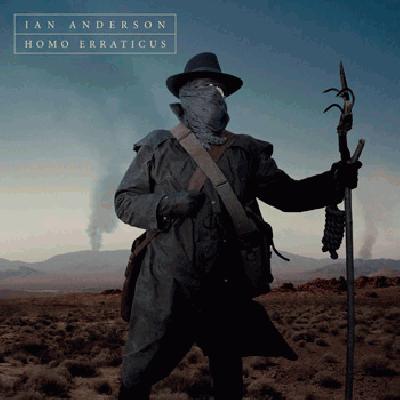
Even the most diehard Jethro Tull fan will concede that the majority of the material the band (and indeed Anderson as a solo artist) has released since Tull’s classic era, which ultimately ended after 1979’s Stormwatch, lacks a lot of the magic that made Tull so special in their heyday. This can be traced back to a number of possible reasons such as the demise of chemistry in the band or Anderson’s partly forced foray into various new and more contemporary styles demanded by the changes in the music scene. However one thing that has kept things consistently interesting as far as Anderson’s more recent output goes is the song writing. Tull have always stood out from their progressive rock contemporaries for placing more importance on song writing as opposed to more instrumental based excursions and ultimately it’s Anderson’s song writing that, whilst not a patch on what it used to be, manages to make his latter day music more intriguing than what most classic prog artists have managed in recent years. His latest release, Homo Erraticus is no different in that while the song writing never reaches the heights of that which dominated the material from Tull’s classic era, it is certainly interesting enough to make the album a more than worthwhile listen, even if it is somewhat inconsistent.
Lyrically the album once again follows the adventures of one Gerald Bostock, the fictional character that first emerged as the young poet who was the subject of Tull’s classic 1972 concept album Thick as a Brick and then returned for its less spectacular yet intriguing sequel in 2012. The aforementioned sequel and this album’s predecessor, Thick as a Brick 2, suffered somewhat from Anderson’s decision to label it so clearly as a sequel, thus leading to inevitable comparisons to the original which sadly (but not surprisingly) it didn’t come close to living up to. Homo Erraticus on the other hand feels much more like its own concept album, one that can be judged more on its own terms.
The tone and atmosphere of the album is set by opening track, Doggerland, which features some of the best lyrics on the album, displaying Anderson’s superb lyrical imagery as he describes a venture across the former landmass from which the song takes its title. Musically the song is typically folky but with a heavy, almost sinister tone that underpins the song’s chorus, while both Florian Opahle’s guitar and John O’Hara’s organ play a prominent role alongside Anderson’s flute and acoustic guitar playing. The instrumentation throughout Homo Erraticus is excellent with each member of Anderson’s carefully assembled “backing” band doing a great job in playing their part. Sadly, whilst in many ways the album’s biggest appeal, Anderson’s song writing isn’t quite as consistent and whilst it’s responsible for many of the album’s best moments it also contributes to some of the worst. Enter the Uninvited is the biggest offender in this regard with its rather uninspired lyrics and awkward composition marking the lowest point of the album. It’s not just the subpar quality of the lyrics that bring some parts of the album down, it’s also the subject matter; lyrics about Twitter and Apple Macs don’t seem quite right somehow coming from a man whose lyrics were once steeped in folklore and tradition to the extent that Tull’s music almost felt like an escape from modern life and all its ever advancing technology, although off course it would be naive to expect such an expansive lyricist to ignore the more recent facets of society.
When the album hits its highest points it really is excellent, reaching its peak with the brilliant Puer Ferox Adventus, a song which displays Anderson’s song writing at its best, at least within the context of his more recent material. This brilliant composition opens with a brief atmospheric intro, a moment of ambience augmented by a clap of thunder before Anderson’s instantly recognisable croon comes in over the top. The song’s complex and poetic lyrics are the most inspired on the album and are backed by some of the record’s strongest melodies with a chorus that will linger in the mind of the listener long after the song, and indeed the album, reaches its conclusion. At the other end of the spectrum The Browning of the Green borders on uncomfortable listening at points such is the almost cringe-worthy nature of its chorus refrain but fortunately there’s enough quality on show to make up for the album’s brief dips in quality, with songs like the aforementioned Puer Ferox Adventus, Turnpike Inn and album closer Cold Dead Reckoning suffering no such downfalls.
Stylistically Homo Erraticus features all the aspects one would expect to find on an Ian Anderson album (although at times with an almost metallic edge), mixing folk and rock in a way that is progressive in nature but for the most part bears little resemblance in sound and style to the kind of music that is commonly associated with prog rock as a
genre. One thing the album proves is that Anderson is still looking to move forward with his conceptual ideas and song writing, more so than most other “progressive” artists at this stage in their career. If anything, Anderson’s decision to refer back to the themes, or rather the character, that he wrote about when he and Tull were arguably at their creative peak suggests that he’s looking to recapture the essence of what made his song writing during that period so fascinating. As with Thick as a Brick 2, Home Erraticus is unable to come close to the quality or the level of innovation that he and his band showed back then but is no less a more than worthy addition to his latter day discography and one that provides plenty of interest for his ever faithful fan base.