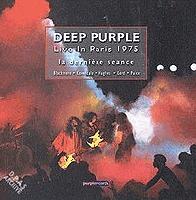
Review Summary: Even though not as magical as California Jamming or energetic as Live in London, Live in Paris 1975 is an excellent live album that marks Blackmore’s final stand with Deep Purple Mk. III
Live in Paris 1975 is one of the most significant live albums in Deep Purple’s catalogue for two reasons. Firstly, it’s the only Purple live album that contains “The Gypsy”, one of the best tracks from
Stormbringer. Secondly and more importantly, it marks Blackmore’s last appearance with the band until they reformed in 1984.
Most of you will already know that Blackmore was disillusioned during his last months with Purple in 1975 due to the direction the band had taken with Coverdale and Hughes in the lineup. After redefining themselves with the release of
Burn, the band went on to record
Stormbringer. However, the chemistry among the members had begun to decrease while at the same time the funk/soul elements in their sound increased. The last straw in that situation was the rest of the members’ refusal to include a cover of “Black Sheep of the Family” in
Stormbringer after Blackmore’s request. As a result, Ritchie Blackmore teamed up with Ronnie James Dio’s band Elf (sans their lead guitarist), formed Rainbow and on March 14, 1975 they completed the recording of
Ritchie Blackmore’s Rainbow. However, less than one month later they gave what was meant to be the last show of Mark III Deep Purple.
Ritchie Blackmore has the rumor of being a rather moody and irritable human being so knowing his decision to leave the band, someone would expect
Live in Paris 1975 to be a rather mediocre live album hindered by an unmotivated guitar player’s poor performance. However, this is not the case here as the band is on top form for Mk. III standards and Blackmore delivers another excellent performance. His playing is not wild but precise, imaginative and emotional. Those who are familiar with Deep Purple Mk. III would know that by the time the band had recorded
Stormbringer, Coverdale and Hughes had developed a high chemistry. This is very evident on this performance as Purple’s leading vocalists combine seamlessly. In addition, even though Coverdale doesn’t match his performance on
California Jamming, Hughes is more restrained and therefore avoids some of his vocal errors on the aforementioned live. Moreover, the album’s setlist is one of the most complete you’ll find on an Mk. III live as the album was recorded during the band’s tour in support of
Stormbringer.
On the other hand, the production could have been better as it’s a bit raw and Jon Lord’s organ is very high in the mix at times such as on “Mistreated”. Furthermore, even though the band provides us with some improvisations and extended solos, they lack the magic of Mk. II live albums.
To sum up,
Live in Paris 1975, apart from its historical significance, is a solid live album for Deep Purple standards. The fact that “The Gypsy”, ‘Lady Double Dealer”, “Mistreated” and “You Fool No One” have never been performed since then certainly adds to the mystique of an album that should be listened at least once by every Deep Purple fan.