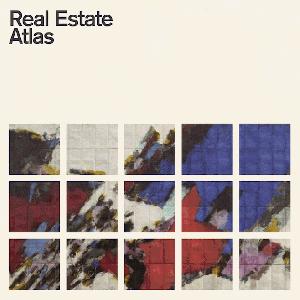
Review Summary: A more personal and textured affair than Real Estate's prior records – but at what cost?
Real Estate's 2012 album
Days opened with lead single "Easy," a sugar coated guitar-pop track built for sunny days and road trips. Amidst the high-pitched guitar squeals and lo-fi sonics, lead singer Martin Courtney rejoices, "I was just floating / on an inner tube / in the sun." But if
Days takes place up in the clouds, just two years later Courtney and Co. find themselves back on the ground with their latest release,
Atlas .
The metaphor isn't meant to a signal a fall from grace or a dip in quality, by any means. But those yearning for the idyllic visions of escapism and worry free pop of yesteryear are in for a bit of a surprise. On lead-off track "Had to Hear," the band's signature guitar twang is undercut with a degree of melancholy, and the concerns are just a bit weightier this time around. While prior lyricism has never really exuded confidence per se, much of
Atlas feels particularly ponderous and muddled. "I had to hear you just to feel near you / I know it's not true / But it's been so long," Courtney says, worryingly.
Yet, much of the album's achievements come by means of a newfound sense of sonic ambition. While the album shares many physical pieces with its predecessors – falsetto guitars, simple song structures, and reverb heavy lyrics – their means of arrangement demonstrates a desire for exploration that was all but absent on prior releases. "April's Song," is a solely instrumental piece, yet feels perhaps more rewarding than "Kinder Blumen," a track of a similar vein on
Days . The comparison between the two tracks perhaps highlights the most significant disparity between the records respective aesthetic achievements.
Atlas is decidedly more emotive and personal, and as a result, the barrier of entry feels a bit steeper. But its demand for a greater degree of attentiveness results in a deeper and more intricate listen.
Although highlights like "Talking Backwards," "Crime," and the aforementioned "April's Song" are perfect examples of the sonic middle-ground between both records, it's a sweet spot that the record perhaps doesn't achieve quite often enough. Its in this sense that Real Estate's "progression" doesn't feel as flawlessly executed as it could have been. The latter stretch of the album isn't lackluster by any means, but against the record's comparative high-points, it feels flat and uninspired. As it turns out, immediacy is still Real Estate's greatest strength, and though their increasingly dynamic sound often provides a more conceptually satisfying listen, it sometimes sacrifices the core of what it is that works. It has its hiccups, but
Atlas is a work of singular ambition and character, and one that feels necessary within Real Estate's still young and limited discography.