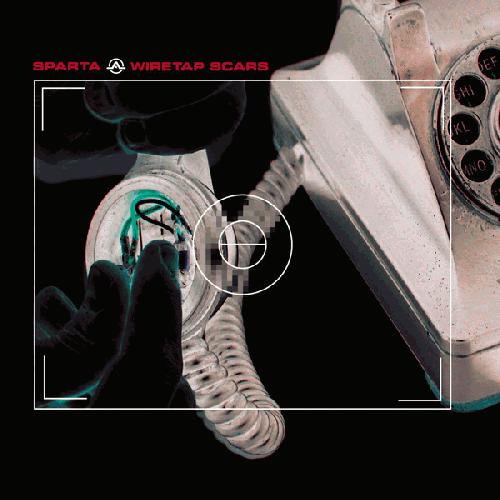
Review Summary: There's nothing "traditional" about Wiretap Scars, and while it may not announce its creativity loudly, it's certainly a strong departure from the members' post-hardcore past.
A lot of music publications consider
Sparta to be the stalwart defenders of Castle Post-Hardcore. While their
At the Drive-in brethren Cedric Bixler-Zavala and Omar Rodriguez-Lopez openly departed the genre to form their proggy headcase
The Mars Volta, many believe that Sparta’s Jim Ward, Tony Hajjar and Paul Hinojos stuck to the template of what At the Drive-in was. The reporters think that Sparta was a preservation of alternative music compared to the rampantly “against the grain” Mars Volta. To many, Sparta was not adventurous. They stuck to their guns. They knew what they liked and didn’t feel the need to change.
And that’s a load of crap.
Sparta’s debut studio album
Wiretap Scars isn’t as ruthlessly off-kilter as The Mars Volta’s was, but it certainly proves that Bixler-Zavala and Rodriguez-Lopez were not the only guys wanting a change from their post-hardcore roots.
Wiretap Scars is Sparta’s own way of breaking the status quo that they built with their previous band. This is an album that couldn’t exist within At the Drive-in’s walls.
Compared to the antics of Cedric Bixler-Zavala and Omar Rodriguez-Lopez in their prog-punk outfit The Mars Volta, Sparta’s music focuses less on eccentricity and energy and more on alternative rock melody. Vocalist Jim Ward has openly displayed his love of the alternative rock band
Sunny Day Real Estate and the punk-inspired melodies of
Fugazi, and both of these bands’ influences show in Sparta. While the energy is toned down considerably,
Wiretap Scars shows an evolution in songwriting and the members’ trademark ability to try new things in a subtle, but important fashion.
Many of the songs on
Wiretap Scars have influential ties to older At the Drive-in songs like “198d” on the
Vaya EP and “Quarantined” on
Relationship of Command. The tempos are steadier and groovier, while the heavy impact is slightly less forcible. One cause of this is that Sparta abandon much of the rhythmic quirks from their previous band, while investing in new, creative melodic approaches. Ward gets to use keyboards in much more prominent fashions, like in the simmering “Echodyne Harmonic.” The guitars, both from Ward and Hinojos, demonstrate a detour from traditional post-hardcore. They’re not nearly as heavy, but the melodies are noticeably deviant in how they stand in approachability. They’re certainly catchy, but they’re remarkably intricate and obscurely constructed, something that Ward has always been successful with as a songwriter. The melody especially shows in songs like the subdued “Collapse” and the almost dreamy “Cataract”, both of which have creative guitar melodies and do a great job of displaying Ward’s vocal skills beyond the rougher At the Drive-in vocals. He has a solid singing voice that surfs incredibly fluidly atop the instrumental melodies on many of the record’s tracks, like the smooth rocker “Air.”
But the guys in Sparta haven’t abandoned that post-hardcore vision entirely. There are still remnants of At the Drive-in’s stage-owning days still beating in their hearts. The shout-out-loud entrance of opener “Cut the Ribbon” is a pounding pendulum of a beat, with Ward’s rougher screams balancing incredibly well with the cleaner vocals heard in the song’s chorus. The revving “Sans Cosm” possesses a pace taken right from the At the Drive-in plate, with Tony Hajjar’s groovy snares and intricate beat patterns in the chorus. The riff-based waltzing of “Light Burns Clear” erupts into a powerful crowd-pleasing burst before recoiling back into a quieter verse. These moments are more nostalgic than iconic, because Sparta, despite being more in line with their previous band than The Mars Volta are, still find ways to evolve their craft. It’s just in more orthodox ways.
Wiretap Scars is no
Relationship of Command, but it never tries to be. Ward, Hajjar and Hinojos, like their afro-headed companions, didn’t want to stay in that circle of post-hardcore that they unknowingly created during their previous group’s heyday. They wanted to expand their sound into something more melodic and alternative for themselves and
Wiretap Scars certainly does that. Many of the tunes have traces of At the Drive-in in them, but the origin songs were usually hidden and didn’t get much attention compared to the blistering “Arcarsenal” or freefalling “Cosmonaut.” The guys in Sparta do retain the more alternative-driven spirit of At the Drive-in to a degree, but they, like Bixler-Zavala and Rodriguez-Lopez, were never content with the status quo of their musical culture. Sparta is Ward, Hajjar, and Hinojos’ way of being experimental. It’s not as obvious as it is with The Mars Volta, but there’s a clear sense of creative freedom displayed in
Wiretap Scars. This is a sound that wouldn’t have worked back with At the Drive-in; it’s melodic, but just technical enough to be a stellar showcase for what Ward, Hajjar and Hinojos can do as musicians. Sparta’s debut isn’t as ruthlessly bizarre as their proggy counterpart’s, but it’s a record chock full of ambitiously composed material, songs that show a band who wanted to set the past behind them and develop new musical ideas that their former band simply couldn’t make.