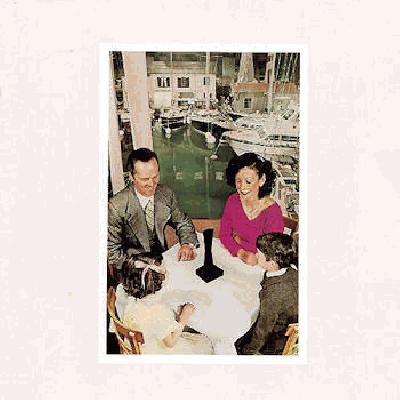
I’ve come to the conclusion that cocaine is to successful rock bands what the League of Shadows is to all-powerful societies. If they are too great, too powerful and too arrogant, cocaine will seep into them and turn the excess that defined them into self-destruction. It is a mark of the greatness of Led Zeppelin that they lasted for three years as a band both majestic and excessive, living the drug life whilst still making great albums – indeed, their 1975 double album
Physical Graffiti , stands today as a high-water mark of their achievements, as well as their definitive work. However, 1976’s
Presence marks the downhill slide: years of excess had rotted the glorious Zeppelin and brought it slowly plummeting to Earth in a ball of flame. Slowly, mind you: it would still be three years before the career-killing
In Through The Out Door . Nonetheless, on
Presence the decay is audibly in process.
Not that this is immediately apparent – indeed,
Achilles Last Stand is such a formidable opener that any listener would be forgiven for thinking that
Presence could be another Led Zeppelin classic.
Achilles is a masterpiece. It demonstrates the swaggering power that the band possessed in the same way that
Whole Lotta Love showcases their lust,
Stairway To Heaven their epic mysticism and
Kashmir their musical talent. Simply put, all four members are (seemingly) at the peak of their powers; the listener can here wrestle with the impossible question of who was the best of the four. Jones’ bass is a ten-minute stampede, whilst it seems Plant was born to sing of the Trojan War, so easily do his howls fit the track. And, of course, there is Page’s solo, which becomes a godly duel, which ranks among the highpoints of Led Zeppelin, between the guitarist’s lightning and Bonham’s thunderous drumming.
Alas,
Achilles is a false dawn and
Presence will never become that classic. When an album is just seven songs long, the margin for error is fairly slim. So
Presence’s case is not helped by the band’s decision to re-tackle making a good funk number. Funk was – and no arguments here, please – probably the only genre that Led Zeppelin repeatedly failed to master. Remember
The Crunge ? Or
Trampled Underfoot ? Admittedly,
Royal Orleans isn’t as bad as either, but it’s still average and, whatsmore, brings an unwelcome stranger into the Zeppelin mix: uncool. This is a significant indictment of the band’s gradual fall: throughout the first half of their career, Led Zeppelin were so awesome because they were so original. Jimmy Page’s farmer’s coat onstage in 1970, and all of those ‘Lord of the Rings’ inspired songs, were cool because they were unheard of. But
Royal Orleans is just daggy. And, in all honesty,
Candy Store Rock isn’t much better. It possesses a nice groove and little else. Whatsmore, Page’s fitful riffing to start the song indicates his fraying mental state (drugs, endless late nights and dabbling in Satanism and black magic are all bound to end badly. Page was doing them all, doing them hard and had been doing them for years).
Speaking of fitful, the other unwelcome stranger to
Presence is fatigue.
For Your Life , one of the more personal Zeppelin songs, describes watching a friend immerse themselves in drugs. Both the music and Plant’s vocals are weary and ragged, but not in a good way. The opportunity to shore the album up with a strong performance is missed:
For Your Life suffers under production that half-buries Plant’s crucial lyrics (and lines like “on the balance of a crystal/Paying through the nose” make the song a poignant one).
Hots On For Nowhere suffers a similar fate: Plant’s vocals are stuck behind Bonham and Jones’ rhythm section like a motorbike behind a caravan. An extraordinarily bitter tone (“I’ve got friends who give me f**k all”, snarls Plant) is unnoticed under the deceptively jaunty sound.
With two dark, disillusioned songs going unrecognised,
Presence’s intended message and identity is missing. Which particularly hurts, because, even with its flaws, it’s not far off being a strong album.
Nobody’s Fault But Mine is the classic blues piece: Page’s searing rig and Plant’s blazing harmonica (easily the best performance of his harmonica career is here) dominate over a hard rocking song. Then there’s the depressive epic
Tea For One , reflecting on the desolation and isolation of months on the road. “A minute feels like a lifetime”, croons Plant as the quietly desperate music swirls around him. Many have dismissed
Tea as a rehash of their early classic
Since I’ve Been Loving You , but, to me,
Tea stands up as its own classic: its tortured nature is perhaps the sole new development on
Presence that is welcome. Also, there is the poignancy of such a wretched piece being, chronologically speaking, the last great Led Zeppelin song.
I have heard people argue that
Presence is just one great song away from being a great album. I have heard many more argue that
Presence has just one passenger too many to be a great album. Both arguments are wrong. The curse of
Presence is that it was made a year too late to ever hope to be a great Led Zeppelin album.