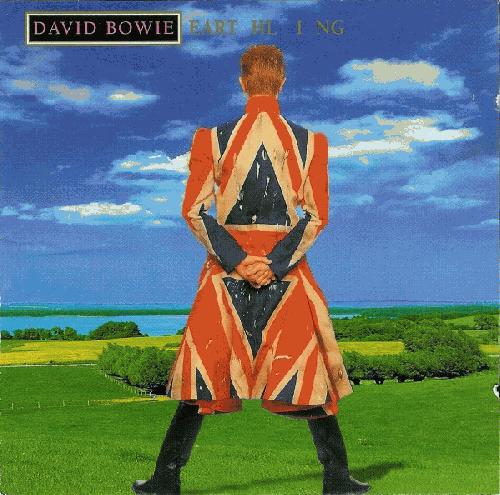
Review Summary: Influences from urban music of the entire 20th century make [i]Earthling[/i] a beautiful, restless experiment.
The fun thing about Bowie is that, whether he is
acting like a copycat or not, he never sounds like one. Jungle and Drum-'n-Bass were booming in the nineties, especially in England and the London scene, so his choice for the style of much of this album is quite obvious in vision. In sound though, it's not that obvious and it actually seems like one of the most creative works he has put out since "Heroes".
One of the things that strikes the listener immediately is that it's a weird combination. We know Bowie primarily from rock, and though he is a chameleon in adapting styles and picking his collaborators, his form has always stayed rock. To put rock songwriting on top of a Drum-'n-Bass concept is a double positive, especially in the resulting decibels and abrasive sound this record has to it. The funny thing is that Bowie does not substitute the Drum-'n-Bass programming for his normal rock drums, he lays them on top of another, resulting in polyrhythms and often the perception of two different tempi are performed at the same time.
He starts of the album with a kick and that's really all we get from this album. 'Little Wonder' seems to have a self-referential title and it still sounds totally contemporary, urban and still very true to Bowie's original vein of songwriting. The arrangements are also quite gimmicky: at some points it's the drums stripped bare, other times it's mixed with the characteristic, layered guitars that have persisted throughout his work from
Diamond Dogs. The lyrics to the song, sung in the fattest English accent we've ever heard from Bowie, are also quite self-referential, referring to his Ziggy Stardust-phase ("Mars-heavy nation sit on my karma") - something we'll hear more often on this album.
This reference continues throughout the album, most pronouncedly on the second track, 'Looking for satellites'. Its lyric sums up mundane interests and the missing of wonder in it and critical questions arising from it. It starts of with a very bluesy four-part Bowie chorus. Abrasive distorted guitars and electronic bleeps are everywhere on this number, which due to its game and exuberant arrangement manages to stay interesting on a repeated chorus and mostly one (varied) chord, D major, though sometimes underlayed with B-flats or overlayed with distorted G-sharps which makes the number dissonant and sometimes downright weird. A fun number, but it could've used a tad more on the songwriting side.
Glitches and Drum-'n-Bass re-enter on 'Battle of Britain (The Letter)', one of the most masterfully crafted tracks on the album in the sense that it combines a lyric that has a poetic, society-critical post-punk attitude to it, with more abrasive guitars and one of the most typical Bowie-vocals on the album, reminiscent of 'The Secret Life of Arabia'. Here Bowie shows that he is more than able to fit his style together with the seemingly unfitting DnB. The free-jazz interlude of a solo piano adds a really special flavour to this number. It seems to be sewing different periods in urban music together and succeeds.
'Seven Years in Tibet', being a conventional rock number, feels somewhat outdated compared to the rest of the album. Its heavily ring-modulated synths sound thoroughly old-fashioned in the atmosphere of London in 1997 (the year of Radiohead's
OK, Computer and Björk's
Homogenic, not to mention the 6th year Goldie had been active). While most of the album goes for a contemporary feel, this track fails to hit the mark. The lyric, once again with a political subtext, is a bit lackluster in terms of fulfillment of its premise.
The disco-stomper 'Dead Man Walking' incorporates one more element into the mix: europop. Its chord progression is typically Bowie and typically rock, but the number has a quick, catchy feel to it with a poppy synth riff. Jumping from abrasive to lyrical and from melancholy to ecstasy, along with its lyric, it manages to blend about every emotion there could be in Bowie about getting old ("And I'm gone like I'm walking on angels/And I'm gone through the crack in the past"). The blending of his 70's trademark layered guitars, the piano riff that enters, exits and closes off the number and the 90's-disco feel demonstrates the lyric about past, present and future perfectly and makes the number, loud as it is, self-conscious and at times touching.
The album highlight is 'Telling Lies', the track that most explicitly uses the double-tempo perception, mixing the DnB with Bowies rock and synth-strings. It's dreamy and earthly at the same time. Its kinetic rhythms and memorable chorus makes up for one of the most memorable tracks of Bowie's later career. It recalls the style of 'Lodger' somewhat, but it's more contemporary and uses a string section that wouldn't have sounded weird on a Massive Attack album which gives the track something of a melancholy glaze. Bowie conveys the track with a conviction that, especially in the eighties, had been absent from his work. I think this might well stand as one of the best Bowie tracks of his later career, which still sounds perfectly contemporary.
'The Last Thing You Should Do' is a hard song to put your finger on. It mixes a very nice beat with a quick, somewhat nostalgic synthesizer, the string section from 'Telling Lies', quite some guitar distortion, not much of a melody, but a quick, speedy feel to it and a somewhat disconcerting vocal by Bowie. This mix might have worked perfectly if it weren't for the structure of the song which just doesn't feel cohesive enough to sustain itself. It's not a bad song at all, but could have used some more concentration.
Luckily, that concentration comes with the next track, 'I'm Afraid of Americans', a rock track which marks a breach with Bowie's earlier rock style. It's way more abrasive, it uses layers of synth beats and synth basses, vocal samples. The layered song, co-written by the great Brian Eno and mixed by Nine Inch Nails, is one of the most freaky songs on the album, and fits perfectly in its concept, which is very much the opposite of the effect he went for on
The Young Americans which he seems to reference here as he breaches with another one of his previous incarnations, the soulful and swinging rocker of that album. This track is nineties rock at its best as the vocal and synth samples fuse perfectly with the beat and become part of it.
The dirty drum-and-saw bassline on 'Law' along with the radio glitches, with once again the euro-disco beat coming in, starts off a nice closer for the album. Its disturbing and largely constructed without a tonal centre, instead borrowing from the industrial clang heard much in nineties London. It sums up the influences on the album nicely and is as aggressive as any song on it and tells about what much of the album has been about
: the strife of people down here to fit into a changing urban landscape, wonder about things that aren't, but might as well be here. It seems like a despaired agnostic hymn as Bowie proclaims "I don't want knowledge. I want certainty." - the line which closes of the album. Bowie literally says here to "the sound of the ground" - a perfect description for the overall sound of the album.
In its time, 'Earthling' was criticized as jumping on to the DnB/Industrial wagon quite late. That's absolutely true, but as a result of his choice to actually jump on the DnB/Industrial wagon, however late, makes this album sound up-to-date in a way especially his 80's and his first two 90's records had failed to. The description of people, earthlings, and the mundane instead of the stellar (the whole Ziggy Stardust character), the anxiety instead of the soul (
The Young Americans) and the concrete instead of the abstract (which even breaches whith his last album
Outside) strips the sense of wonder from Bowie's language.
What comes instead is an abrasive and restless language that questions just about everything. That's also a bit of a problem of the album: its restlessness makes it way less accessible. Also, a distraction from its style like 'Seven Years in Tibet', which is the weakest track on the album, might as well have been left out, because it feels extremely outdated. The albums best tracks though live up to Bowie's best work and are memorable, intriguing and still sound contemporary. If you're up for a restless trip through urban life, it's the album to put on. And you will come back dazzled and destructed.