Review Summary: Disappointing.
I would argue that Dance Gavin Dance's popularity owes itself largely to Jonny Craig. The band has always been exceptionally talented at creating fun modern post-hardcore that naturally combines “Fall of Troy”-esque technicality with poppy catchiness that's often, but not always, brought on through the power of their constantly-changing vocalist roster. On
Downtown Battle Mountain, Craig's vocals were the show-stealer, and the power of his vocal capabilities was able to draw in audiences much wider than the typical post-hardcore crowd. But the reason that album holds up so well is that it isn't just a showcase for Craig's talent, even if the initial draw is exactly that. Dance Gavin Dance has always had songwriting that places emphasis on all members of the collective, which allows for tracks like “And I Told Them I Invented Times New Roman” and “Lemon Meringue Tie” to balance their hooks equally among Craig and screamer Jonathan Mess, and the vocal duo and instrumentation, respectively. It's easy to romanticize the early era of Jonny Craig's Dance Gavin Dance, but the reality is that the talent of the backing members never got to truly shine until Craig left, and the remaining members had something to prove.
Downtown Battle Mountain might represent a very small portion of Dance Gavin Dance's discography, but I genuinely believe that everything after has been a much different era of their work. Their self-titled album had to recover from Craig's absence, and more weight was placed on Mess and the instrumentation to support Kurt Travis's talented but less capable vocal abilities, which provided for some of the best interplay between all aspects of the band's sound in tracks like “Alex English”, but also demonstrated that Craig isn't necessary to create soaring, captivating cleans in “Me and Zoloft Get Along Fine”.
Happiness, even with the loss of band members (most notably being screamer Mess), solidified the Kurt era of the band with their most developed album yet, and the perfect, natural blend of every aspect of their sound. So naturally, Mess and Craig's re-entry into the band for
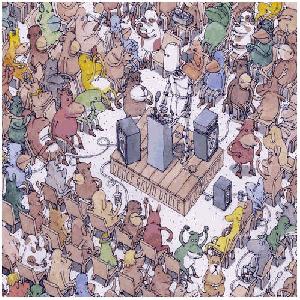
Downtown Battle Mountain II was met with mixed feelings from fans. It opened up the possibility for Dance Gavin Dance to bring Craig's undeniably powerful vocals back at a time when every other member of the band was at their absolute peak, which allowed for idealized visions of the perfect DGD album. The other school of thought was that the band was throwing away a lineup that produced their most focused album yet while completely discarding Kurt Travis's accomplishments as a vocalist for someone who has proved himself time and time again to be completely unstable. In the end,
Downtown Battle Mountain II was a solid album from a talented crew of musicians, but the accolades stop there. It is an obvious step back from the maturation found on
Happiness, and Craig is both less displayed and less appealing (which can probably be attributed to his unstable life at the time) than he ever was on the original
DBM.
So, is this all just a long-winded way of saying that Dance Gavin Dance's first release with Tilian, their third vocalist and second replacement of Craig, has a lot to prove? On some level, yes. But more importantly, so much of Acceptance Speech's disappointments, though clear on their own, become far more up-front and blatant when considered in the context of their past progressions.
In the same way that Jonny Craig's vocals were immediately captivating in the band's early work, Tilian's vocal presence is the immediately obvious difference here. Tilian has proved himself to be a competent post-hardcore vocalist in his work with Tides of Man, but his vocal work is – unfortunately - something entirely different here. Not only are the vocals produced in a way that gives them an artificial and thin crooning sound which becomes overbearingly sweet by about the third track, but the way they are utilized on the album completely discards the natural integration among the band that was found in their first four full-lengths. Gone are the passages that interweave harsh vocals with cleans, or really passages that interweave anything with anything. All aspects of the band are now segregated clearly into harsh sections, clean sections, and instrumental breaks, completely losing the natural groove that blended all aspects of the band's sound previously. It's not enough to bring down the album on its own, but with such little back-and-forth between Mess and his bandmates, his segments are almost entirely uninteresting, with one or two exceptions where his vocals are beefed up with the noodling guitars mimicking the timing of his vocals. But such a joint effort to produce something of interest from Mess loses any possibilities of the truly diverse hooks that found themselves providing the really diverse aspects of previous works.
On the other side of things, the isolation of Tilian's weakly produced vocals and their formulaic use makes his cleans come off just as saccharine and grating as they are on his simplistically poppy solo album. The majority of the time that Tilian's cleans take the stage, they're backed by instrumentation that works entirely to beef up his soaring vocals that might otherwise fail because of their thinly produced sound. The result is far too many segments that would otherwise benefit from Will Swan's guitar noodling to provide for multi-layered appeal, but instead are far too simplistic without any true power behind the vocals to make up for what is clearly lacking here. Tilian worked extremely well among the cohesiveness of Tides of Man's writing, but as a replacement for Craig or Travis, his vocals are completely devoid of soul and emotion, which is likely due in large part to the production here which strips any character from Tilian in favor of an overly polished sound. The one thing that Tilian does provide for the album are a few segments that capture such charming melodies that it becomes easier to overlook some of the other prominent flaws. However, even this benefit falls fairly short because the most notable and immediate example comes from the intro track “Jesus H Macy”'s latter half, where the relatively straightforward soaring of Tilian's vocals actually accomplish everything they aim for just because of how well-executed they are. But most of what follows on the album exists entirely in the shadow of that track.
Sure, the chorus of the second track “The Robot with Human Hair pt. 4” is plainly infectious, but it's entirely devoid of any real substance beyond its surface-level hooks and fun. And for most of the album, a lot of the intended appeal seems to be from the clean segments that never live up (or even really come close) to the first couple of tracks. The unimpressive and hollow cheesiness of the tracks are exacerbated by the shallow lyricism found here. And while strong lyrics have never been a major goal for the band or even something they really aim to accomplish at all, there's something forgivable about the drivel that comes out of the vocalists when so much else is going on. But when Tilian's vocals take the forefront and there's nothing else that provides any appeal at all, it's hard to ignore when songs will devote entire halves to cleans that provide lyrics as trite as “I'm the one, I'm the one with my hands around the gun. I am not afraid. I am not afraid.” or “Hush now don't you cry. Everything will be just fine.” repeated ad nauseam, which places most of the focus on just how cheesy they are, and combined with Tilian's already cheesy sound on the album, it becomes almost impossible to tolerate, and things that would ordinarily be passable as light fun turn into obnoxious and abrasive elements of a band that at one time was able to make every second of their work entertaining even when they slipped up.
I won't spend much time addressing some of the blatant missteps of the album because I could talk about them for days. But if I must provide an example, the most obvious and offensive would be the frat-party 3OH!3-esque gang vocals of “Death of the Robot with Human Hair” which obliterate any chance of the track being listenable despite the fact that otherwise it could've been one of the better tracks of the album. But I would like to draw some attention to the closing track, “Turn Off the Lights, I'm Watching Back to the Future pt. II”, the title of which indicates both a sequel to the
Downtown Battle Mountain track and also demonstrates a second meaning regarding the actual movie trilogy, which isn't really all that clever but it highlights a level of self-awareness that parallels the actual musical content of the track, which is actually the only track on the entire album that utilizes Dance Gavin Dance's full potential with a talented vocalist who could've worked well with the band, but doesn't because of reasons that seem like they could've been easily avoided. Because “Turn Off the Lights pt. II” provides moments for every member of the band to shine - the Tilian segments let the noodling guitar-work display itself prominently, the Mess parts have well-placed backing vocals from Tilian, and instrumental breaks transition smoothly into vocal passages that retain the energy that was developed in the break, and the slow vocal work of the bridge before the track's climax utilizes Pearson's obvious talent in a way that isn't forced for the very first time on the album. It's like the band finally remembered how to work as a cohesive unit rather than only focusing on one aspect of their sound at a time.
Listeners could almost look at the closing track as a silver lining of an album that fails on so many levels, but after being put through an entire album of such watered-down bull***, it's hard to think of it as anything other than a slap in the face saying “here's how good this album could have been”, which just highlights even more exactly how bad it really is.