My heart's made of parts of all that's around me, and that's why the devil just can't get around me.
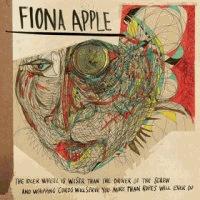
My mind continually circles back to these words on this brutally pained record; they serve as atonement for the anguish on display, asserting faith in one's loving heart. Because the devil is omnipresent here, lurking behind every self-loathing statement and every episode of self-harm. I'll be upfront and state that bonding deeply with
The Idler Wheel is all about personality: it takes a certain kind of person to connect with the mental masochism on display here, the obsessive rumination, the thrill in self-destruction, the comedy of actively existing this way. Because intelligence and self-awareness certainly don't guarantee happiness; rather, they can contribute to chronic insecurity, as laughable as that may seem. But I do relate, with gut-level empathy, and that's why I find
The Idler Wheel infinitely more gripping than any sh
itty Laura Marling record.
Was that jab uncalled for? "Rude" even? That's the venom that laces Fiona's verbal lashes, caustic anger directed outwards instead of inwards, for a change. Pain is a
second skeleton on this album, one assembled by a volatile psyche. No album this decade other than
James Blake is this solipsistic, to the point that the music often functions as a depiction of the mind: where James uses electronics to map out his brain circuitry, Fiona employs erratic percussion as neurotic webbing and atonal piano chords as nervy thought trails. But she goes further, as her thoughts
trickle down the spine, form the belly swelling to a blaze, all-consuming dissipation through the body. The origin of divergence is the same, defeated realization:
I don't cry when I'm sad anymore. James follows with numbness while Fiona simmers with anger, pain overflowing to a point of collapse. I reckon some of you reading this are thinking: "But Ali, James Blake is an electronic artist and Fiona Apple is a piano-focused singer/songwriter! How can you compare the two?" If you actually think that, then you are a peripheral idiot that shouldn't bother reading the rest of this review.
Fear of mortality is etched into
The Idler Wheel, and terrifyingly so. Fiona articulates this in an interview with Pitchfork where she describes her mindset on a day that inspired "Jonathan": "I had been thinking about dying a lot. I would never kill myself, but you can kind of let yourself die." That disregard for well-being is hinted at early, in the wide-eyed desire of
I just want to feel everything. But the lethal undercurrent of that intent is revealed in the following track:
I don't feel anything until I smash it up. That she compares herself to a "daredevil" is hilarious: while some people jump out of planes and perform death-defying stunts to earn that label, she extracts the same mental thrill from the comfort of her own home, in wild self-destruction. This impulse is so enticing that she projects it as a threat, morbidly intoning
don't let me ruin me over piano chords that reverberate like tremors, like warning signs of looming crisis. She stresses the dependency by framing herself as a child with the pathetic
I may need a chaperone, a grown woman calling for supervision so that she doesn't, you know, destroy herself. It's alarming and uncomfortable, as is the pleading on "Left Alone," where she quivers
nothing, nothing is manageable, helpless in her inability to handle the most basic responsibilities.
That song is the breakdown of the album, the dissolution into hysteria that
The Idler Wheel persistently veers close to. Take this following scene as imaginative context: you're on a dinner date with this confident, sexy guy – he's damn perfect – and it's going amazingly well. You're spitting out your drink with every joke he makes and swooning in his seductive presence. He locks hands with you later on a midnight stroll across a starlit pier – he even sneaks a kiss as he drops you home! But Fiona isn't interested in those Instagram effects, no; she captures the crushing realizations that sear through you that night: that chronic isolation has made you impenetrable, that you
beg to be left alone, that you
still think about dying on a daily basis. Watch the self-hatred with which Fiona stammers
this guy what a guy oh god what a good guy and I can't even enjoy him 'cause I'm hard, too hard to know. The snarl of those last words is piercing, capturing the misery of having everything you could want, other than actual self-worth.
The Idler Wheel finds humor in that while you're curled up in bed ruthlessly scrutinizing yourself, other people are leading Stable Lives as Stable Adults. Watch how Fiona puts her intellect to use on "Valentine" as she deprecates herself with remarkable creativity, deadpan delivered in sequence.
A fugitive too dull to flee. A still life drawing of a peach. I’m a tulip in a cup; I stand no chance of growing up. These are dry, sad jokes that recognize the comedy of self-pity but make no attempts to move past it. Earlier in the song, she takes lurid glee in observing the object of her affection –
I watch you live to have my fun – and states with nonchalance:
I stared at you and cut myself. Bizarrely, it's one of the more comfortable lines on the record, less transgressive than the theatrical suffering that pervades
The Idler Wheel. And what to make of the wild contempt that forms the chorus of "Regret"?
I ran out of white dove feathers to soak up the hot piss that comes from your mouth every time you address me. On paper it's an uneasy laugh, but as Fiona scraps her throat on the words, she forces silence. There's much dark humor to
The Idler Wheel, but don't think to deny the intensity of feeling from which it originates.
There's a smile-inducing shift at the album's end, after the pain has been fully exorcized. Fiona is now
happy, playfully suggesting a tryst with her lover on "Anything We Want" and gushing about his attraction on "Hot Knife." This is atonement for the anguish, an apology for the outbursts, the verbal slaps, the self-laceration. Because sides of Fiona's personality are in opposition to those that dominate
The Idler Wheel, as is true for us, the listeners that have lived this record. Shame brings its own pain, requiring an earnest plea for amends. So we extend an apology, hoping that you find enough love in your heart to accept it.
And if you don't, well it didn't mean sh
it anyways. Ha!