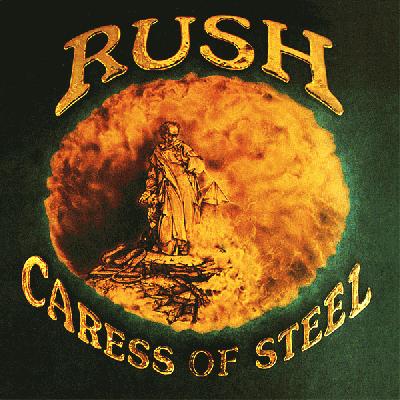
Review Summary: An album that marks a huge leap forward for Rush musically, but three leaps back in terms of quality.
After getting their feet wet in the music industry with two blues-rock albums, Rush decided that they would completely abandon this style on their next album and fling themselves head first into progressive rock music. This was the style that they would later redefine with albums such as 2112 and Moving Pictures, but for 1975's Caress Of Steel album, this was really a mixed bag of an album. Instead of gently easing themselves into the progressive style that defined the better years of their career, Rush threw an album of that nature straight into the faces of many of their fans and it was rebuked. The band would possibly have completely faded out if not for the album that followed, but despite this this is not an awful album.
The song structures here, as should be expected with progressive rock music, are all over the place and at times they really work well. Opening track Bastille Day constantly transitions between different guitar lines with some groovy bass work and vocals that spew confidence all over the ears of the listener. This song has speedy sections driven by some awesome guitar work and slower moments that are well integrated so it never feels remotely disjointed. Shortly before the two minute mark (and the guitar solo) the song drastically changes in style and gets much quieter before an awesome riff backs up the solo to make for musical heaven. This is a track that is rightfully considered one of the best tracks the band put out in their first few albums, and it is amazing to think that the band could write tracks such as this less than a year after the release of their previous release.
Sadly, not all the tracks are great and this is a hit and miss album. The most striking example of this is the fifteen minute closing track, Fountain Of Lamneth. This track opens up rather well with a really nice soft instrumental and some perfectly executed vocals from Geddy, with his wailing style that gradually comes in as the song progresses feeling perfectly at home among this. As the track builds up, however, one can not help but start to nod off from the fact that this track does very little to keep you interested. The drumming is, for the most part, very one dimensional, with some of the drum rolls standing out, whilst the bass work is just there, for once being rather dull and uninspired. Geddy's vocals are on point here, but they are just about the only thing that is, as there was no need to write a fifteen minute track to close off this album aside from to show off. This track is actually split into six different sections but these are not seamlessly played, but instead fade in and out, of which only three are actually any good, and one just serves as a drum solo primarily. This track contains all the signature constant tempo changes of Rush's longer songs, but they are just not as well performed as they could have been.
Lakeside Park is the only other song on here that really is amazing throughout, particularly the guitar soloing. The solos on this release are one thing that has been massively improved from the two releases that preceded it, and they add a whole new dimension for the music. They are not just used to fill in time as on Fly By Night but actually serve a purpose to link two parts of the band's music together. Lakeside Park has some really cool vocals that could not be better performed by anyone in the world and the bass and drumming are as sharp as ever. This album is also rather well produced, which is another positive to add to the rather short list of good things about it, with crisp tones for each instrument and a solid mixing job. Sadly however this was a huge letdown for a band that scarcely puts a foot wrong usually.