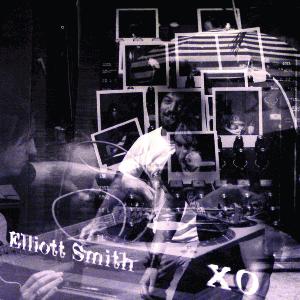
Review Summary: The songs on XO are gateways to new worlds: It is through their inherent poetry and the fragile whisper of their delivery that we begin to understand Elliott Smith, and by extension come to understand something about ourselves.
There is a popular, and quite justifiable, proverb amongst musical enthusiasts that goes, ‘If Kurt Cobain hadn’t died young, he would have never become a legend. If Jeff Buckley hadn’t died young, he would have become a legend’.
However, Buckley’s name is interchangeable with that of another tragic artistic figure of the nineties, Elliott Smith. Then again, so is Cobain’s. You see, the truth is, the impact of Elliott Smith’s brutal self-stabbing in 2003 was a double-edged sword (inappropriate pun certainly not intended). His death both denied and ensured Smith his legacy.
The myth of Elliott Smith, of the alcoholic, drug fuelled, isolated depressive, is not nearly as contrived as Cobain’s, but is arguably just as essential to understanding his art. It’s the underlying force that elevates tracks like ‘Everybody Cares, Everybody Understands’ from being merely great pop songs to being something more. The songs on XO are gateways to new worlds: It is through their inherent poetry and the fragile whisper of their delivery that we begin to understand Elliott Smith, and by extension come to understand something about ourselves.
XO represents a pivotal moment in Smith’s career. This record marked the midpoint in Smith’s transition in focus from lyrical excellence to rich arrangments and cleaner production. The result is as clean and polished as any of Smith’s later material without this detracting from his original lo-fi formula of vocals and acoustic guitar. Rather than hinder the pure essence of Smith’s delicate vocals and intricate chord patterns, the added instrumentation only serves to elevate his sound to new emotional heights, as exemplified by tracks like ‘Sweet Adeline’, ‘Bottle Up and Explode’ and ‘A Question Mark’. The jazz undertones that run throughout the latter of these tracks hint at the Beatles influence which would later come to dominate Smith’s approach to song writing, and would inspire the likes of Belle and Sebastian’s Dear Catastrophe Waitress.
Lyrically, Smith has always been hard to pin down, effortless layering poignant moments of intense intimacy with cryptic poetry. This has the tangible effect of drawing the listener in, only to shove them violently away, so that we never can put our finger on that exact ominous line which forebodes Smith’s final tragic decision. All we can do is sit back and let Smith narrate our lives as they truly are; complex, chaotic and depressingly beautiful in their tragedy.
Smith’s greatest tragedy is summed up in a single line, halfway through the haunting a cappella closer ‘I didn’t Understand’, in which he concedes, ‘I always feel like ***, I don’t know why’. It is the most honest and beautifully understated piece of lyricism he ever wrote, and perhaps anyone has ever written when trying to put the unspeakable experience of depression into words. Putting the unspeakable into words was what Elliott Smith did, and for those of his disciples that keep the faith, it is something that he continues to do every day of our lives.