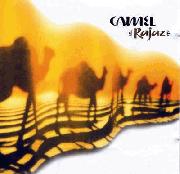
Review Summary: They've made a machine, a new fangled device.
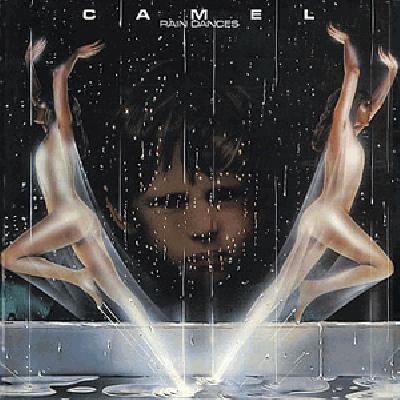
After a little more than six and a half years together, Camel had managed to gather a great amount of friends and become renowned for doing “progressive melodic rock”, a title that admittedly sounds dubious. But no matter what one may call them, they’ve almost always done a superb job – which is shocking considering the band they started out as since 1971, as The Brew. 1976’s Moonmadness was fantastic, but it also marked the departure of Doug Ferguson, bassist and vocalist, who was kicked to the curb in their search to find someone more technically proficient – it would later prove to be a bad decision – and thus, they replaced him with original member of ‘Caravan’, the gloomy Richard Sinclair, leaving from Canterbury to help the band out with their numerically important fifth album, Rain Dances.
It was a bold move to kick Ferguson to the curb, and Sinclair’s presence was totally different in comparison to the previously optimistic bassist – he was now a moody guy in a group of moody artists. With Sinclair came a burst of jazz that was previously unheard of in Camel’s albums, fusing in with the complex and theatricality of Camel’s progressive rock. So, a bold move, but Rain Dances is a pretty bold album in its own right, featuring a ton of additional musicians but also removing a fair amount of key elements – the nine or ten minute songs were swapped in favor of four or five minute songs, less instrumental passages, but keep the same amount of intricate, subtle musicianship that progressive rock is extremely well-known for.
Despite these changes, and the fact that Rain Dances is the weakest album out of Camel’s genuinely fantastic first five, it is still a pretty damn fine LP. They waste little time in setting a precedence with “First Light”, a bright instrumental passage featuring famed saxophonist Mel Collins, who does an excellent job alongside Sinclair’s natural talent for bass: it’s a five minute monster that showcases what is to come, with Andrew Latimer and Peter Bardens having a counterpoint of guitar and dazzling keyboard, respectively, amongst Sinclair’s bass warbling and Andy Ward’s nifty drum fills. “Highway Of The Sun” is another one of the album’s better moments, a song that has a commanding, marching keyboard by Bardens (it’s worth noting he gets many good moments here) and Latimer taking control of the main vocals: it is structured as if it was a single.
Even though tracks like these and the ebullient, jazzy instrumental “One Of These Days I’ll Get An Early Night” join the ranks of some of Camel’s best songs, there is fault with Rain Dances, and it is easy to find. It is clear from the approach of keyboards and the lack of significant melodies indicated an approach towards mainstream music, a move that was common amongst prog rock bands from the 70’s; almost all of those bands did so with little success, and though Camel does not fail here, there are some very noticeable flaws. “Metrognome” is a lame bid for that, and so is “Skylines”; although “Skylines” does have a very funky beat, but it is an unfocused number that seems confused whether it wants to be a straightforward pop number or not.
So, in the end, despite Rain Dances having a few great successes, it is really just an awkward and uneven album, one that seems a bit unsure of what it is trying to do and where it aims for. Despite this, when Rain Dances is good, it is very good, the band members playing a major role in its success. Unfortunately, Camel was never able to top this in the late 70’s and 80’s, and so came forth a string of albums just as if not more confused as this one. Rain Dances is great, but a word like that comes with a hint of caution.