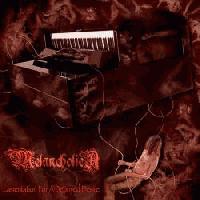
Review Summary: An experimental ambient/doom record with the ambition and continuity of a movie soundtrack, which despite lacking in harsh vocal performances and production, still manages to introduce new musical and lyrical ideas into the genre.
A semi-thematically charged examination
Here’s an oddball of a record coming out of the exceedingly growing number of thrash metal and metalcore releases in the underground Iranian metal scene. “Lamentation for a deprived desire” is the rightful child of the Iranian cellist and keyboardist, “Afshin Effati”, released under the musical project named
Melancholica which gathers guest musicians with varied artistic backgrounds. The result is an experimental, atmospheric gothic/doom record with the ambition and the continuity of a movie soundtrack; that is to say, those who except to find the typical ominous, low-tuned doom metal riffing in this will be disappointed, as the album is almost devoid of distorted guitars. This is not a bad thing per se, in fact “Lamentation…” is one of the few Iranian albums which willingly or not, attempts to capture the essence of metal without binding itself to the genre’s standards.
Being a fan of progressive rock/metal concept records, what caught my attention most was how the musical and lyrical themes of this album guide the listener through the tracks. There’s a distinction between rock operas, namely
Ayreon’s “Into the electric castle” or
Genesis’ “The lamb lies down on Broadway”, whose storyline becomes the navigation thread, and the likes of
Pink Floyd’s “Dark side of the moon” or
Dream Theater’s “Octavarium”, in which the overarching themes make up for the main plot. And then there are some that fall in between, meaning, there appears to be a vague storyline and faceless characters lurking within the album but the themes are what actually move the plot forward, as in
Opeth’s “My arms, your hearse”. “Lamentation…” happens to be among the latter group, so why not look into the lyrical content while reviewing the music?
(Let’s not forget that the analysis of a work tends to be mostly subjective and expressive of what the recipient has inferred from the content. Therefore the following is nothing more than a personal interpretation of what the artist might or might not have had originally intended the lyrics to mean.)
The album is predominantly narrated by a single entity that I’d rather refer to as ‘The mournful soul’ for obvious reasons…a character who appears to be trapped in a hypnotic state, constantly shifting between two realms; the dark, cold and horrifyingly silent underworld of the grave and a vast yet intensely gloomy, limbo-esque, incarnation of the afterlife (the Sorrowland, mind you.), which are contrasted by track titles containing derivations or symbolic equivalents of the words “dark” and “sorrow”, essentially dividing the album in half. Aside from the lyrical landmarks, there are also musical elements helping us distinguish the two worlds; the darkened songs mostly feature piano passages whereas the ones in Sorrowland are more strings-oriented. In fact one impressive conceptual structure of the album is the way the Darkened and Sorrowland tracks are interleaved, so that for the most part, one type follows the other.
The opening instrumental pair, “Angel of distress” plus “Dark fortress”, is among the album’s stronger points; the former sets the overall tone well with a melancholic piano piece, while the latter, (whose title could be a metaphor for the sealed coffin of the ever-confined Mournful soul), aims for the grandiose with the ‘alarming’ synth sounds reminiscent of
Jean Michel Jarre’s “Second rendez-vous”. It all sits well with the soundtrack quality of the piece except for the jumbled distorted guitars section which sounds out of place and more like an outro to a closing song from a NWOBHM concert.
With the grainy or rather nostalgic phonograph(ic) sounds, we delve into the dark world of the Soul’s grave in “Goddess of darkness” as he regrets and yet longs for a desire, fearing the next day when he’d have to face nonexistence and vanity. The indication of mourning sends him on a self-revelatory quest. The piano lines work fine and bring some of the transitional gothic/doom sounds from the 90’s to mind (such as
Within Temptation’s “Restless”.). But here’s also my main issue with the album: The harsh/growled vocals fail on every level in conveying the sense of the lyrics… judging by the album’s bleak themes, one might expect creepier, more profound, or downright ballsy growls, while here most of the performances fall short in delivery and (as weird as it may sound) intonation and the result feels more like a bad audiobook.
Leaving the dark we step into the Sorrowland. With a background music reminiscent of
Black Sabbath’s “Planet Caravan”, “Sorrow’s creation” is probably the weakest track on the album, as it simply goes nowhere. Here we’re introduced to this strange place fueled by sadness and tears, where there’s a fierce, illuminating sun guiding the Soul through this maze, leading to an abyss of despair, down the ‘rabbit hole’. The fire and water motifs are mentioned here in the lyrics and are revisited throughout the album. This and the following track, “Oath to darkness” (despite its directionless music at times) feature some of the most imaginative lyrics on the record, as in the latter, the Soul hears a ‘silent’ requiem from beyond the grave and makes an oath to coldness and pain as, fittingly, his body disintegrates. The constant shifting between the two worlds goes on till midway through the album with the narrator becoming more and more confused as to whether he should rest eternally in the dark or seek his desire. The sound of thunder and the screeching strings help reinforce this dilemma and the inherent tearful quality of Sorrowland musically, in “Sorrow is begun”.
After making up his mind in “Ignorance” (the transition point) and deciding to carry on, ‘sun-lantern’ in hand, the Soul descends into a “sinister masquerade of the darkness” where he faces his inner demons through smokes and mirrors in “Territory of sorrow”, one of the most curious tracks on the album. The opening organ sound helps set the imagery of a spiritual trial, as the Soul is haunted by his own reflection. There is a glimmer of hope, though, in recalling the enchanting “corpse bride” who may have a lot to do with the regret.
The conceptual centerpiece, a solid ballad titled “Gravestone of desire”, is one of the better tracks on the record. It also brings us to the first major revelation, as the Soul becomes aware of his own demise and that he has most likely been repeating the process of revelation and repression over and over again. “May your time be a remembrance…”. The album culminates on two mellow tracks as the quest for desire ends with the embracement of love. The Soul shares his sorrow with the lingering memory of perhaps the aforementioned corpse bride then ascends towards enlightenment, accepting his fate. Finally in “Wail my sorrow” we get hints of how the Soul might have died in real life, figuratively, of course.
Throughout the album perhaps it’s “Love is a way to die” which best showcases the influence of ambient crossover genres, sharing similarities in atmosphere and instrumentation with the soundtrack of “Silent Hill” franchise composed by
Akira Yamaoka (that is, up to “Shattered memories” so far.). Without giving away too much, the overall plot of the album shares many metaphoric and symbolic similarities with the Silent Hill games, especially with the second installment, when it comes to exploring the themes of sorrow and guilt. Then of course, the story of a confused protagonist trapped in some sort of a purgatory more or less happens to be the plot of “My arms, your hearse” as well.
In the end, “Lamentation…” is a captivating album, filled with great musical and lyrical ideas, with a rather consistent conceptual structure, but lacks in vocal performances and production. An overwhelmingly melancholic, yet subliminally evocative experience which leaves ambient/doom fans craving for more.
~Written by
Aria Mohtadi Haghighi
You can find my reviews/observations on TV shows such as "Dexter" and "Breaking Bad" over at www.seriable.com.