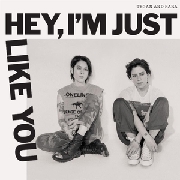
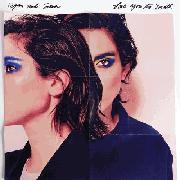
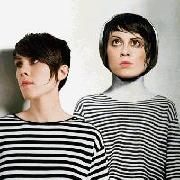
Review Summary: Predominately what you'd expect from a duo who abandons rock for synth pop.
Tegan and Sara Quin's status in culture is undeniable, even if they are, for all intents and purposes, not an icon. They've built a considerably large legion of fans after releasing six, rock-charged albums to their name, in particular
The Con, a frequently mirthless, confrontational album that spoke to quite a lot of people; they are well-known for being very strong, strange women who nurse a lot of self-deprecating jokes; folks such as Neil Young (they are, in fact, signed to his Vapor Records), Alkaline Trio, and NOFX (who presently wrote a song about the duo) have openly expressed their admiration for the band, which led to numerous covers from a wide range of bands.
Now, the concept of pop music is not new to Tegan and Sara, to those unfamiliar with the band (to those living in complete isolation), and they've been met with more and less success in different cases, but with
Heartthrob, it's not even worth trying. At first they started as an independent, raw punk duo but ones who made a deliciously streamlined shift into pop, and every "power pop" album up to this point had a lot of good factors on that front:
So Jealous was a catchy, fun record that used the new sound to its fullest,
The Con played fast and loose with emotions and structured tunes, and
Sainthood was an awfully sophisticated album that was the most summery up to that point. But all of them are simply very good releases, whereas
Heartthrob takes a bit of a tumble. It is a good album in every way that counts: music, lyrics, performance, vocals, except it feels pettier.
For starters, there's no denying that Tegan and Sara, both lesbians, have begun blowing the mainstream's D at this point, because Heartthrob is completely packed with dance-y synthesizers, massive glitter-rock hooks, and some gigantic bass. It's a full-blown pop record that's sure to recall an odd mix between Passion Pit and Rilo goddamn Kiley, and one that starts strong: quite strong.
Closer is unexpectedly sharp and well-used for a single, uptempo and over-energetic (not to mention featuring some pleasingly absurd production by Greg Kurstin) that is not unlike Kelly Clarkson with a chain smoking habit. (And the godawful lyrics are tolerably bland:
I want you close, I want you / I won't treat you like you're typical)
After this point,
Heartthrob becomes a living mixed bag, some songs really good and emotional, and some other songs quite flimsy and unimaginative. Perhaps the best thing about each song on the album, and perhaps what keeps Heartthrob alive, is the undeniable fact that most of them contain some deep, bittersweet emotions and lyrics.
I'm Not Your Hero has perhaps the best songwriting, a track that falls in love with a key-heavy, motion-packed anthem rhythm and its use of cynical lyrics: this track, I'd say, perhaps breathes with the richest tune on the album.
Shock to Your System and the other big number, an pseudo R&B track
How Come You Don't Want Me are also lifesavers in this regard, the former of which gives the album a prickly swagger with just enough pounding music that it comes across as a great batch of invective to end the album on. Unfortunately, it's the album's mind-numbingly tepid middle that brings it down, all of it, largely because it gets so lost in its own identity.
Now I'm All Messed Up is the album's nadir, lyrically or otherwise, due to its headache-inducing rhythm and saccharine lyrics (
Go, go, go if you want / I can’t stop you / Go if you want / I can’t stop you, and it's adjacent to the Alanis Morisette ripoff
Love They Say, a track so unmemorable it's easy to say it is memorable solely for its faux-Morisette tones (particularly in the lyrics and counter-melody).
I Was A Fool is a
Prince-y track full of annoying echoes and nasal instruments, even though it does feature one of the most beautiful vocal performances on the album.
Taken as a whole, Heartthrob is quite flawed, though it is an album that is far more deserving than most of its predecessors, spiked with enough personality to rise above its generic trappings. Indeed, the parts that work are enough to justify making a synth-pop album in the first place, and are almost enough to make you believe that this is just a beginning album, one that the two sisters will work on. So despite its wholly obvious flaws, as the first transition to a genre Tegan and Sara didn't need to take on in the first place, it acquits itself tolerably well.