Review Summary: Truly remarkable.
It's tough to discern whether today's musical landscape, pop culture or not, is really leading to anything particularly good; most musical scholars would scoff at many of today's standards, especially in the pop scene, but I'm here to say that I can't fully agree with their sentiments. Thing is, as most people know, the more underground genres of music have a certain tendency to delve into more dense musical arrangements and/or subject matter; basically, stuff that wouldn't strike a chord with the masses. However, there's still a certain magic I can't deny about popcorn genres like pop and the more accessible, poppy forms of hip-hop and R&B. Think about it in terms of action and adventure films; they aren't always supposed to be high art, but usually more as an escape from ordinary everyday life. These movies are built to suspend the viewer's sense of disbelief, and that's what makes them so entertaining. And frankly, I think Regina Spektor knows this when it comes to her music as well.
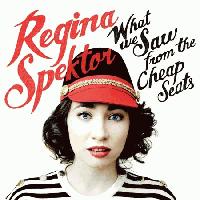
Being a notable product of New York's Anti-Folk movement, Spektor is known for expressing her poetry in such a way that the listener may relate to what she's going through, and yet there's usually some deeper meaning lurking beneath the initial impression of her songs. However, while her words may be layered so heavily, the music is another story. Her folky piano pop style is very simplistic and usually very easy to listen to, many resembling even zen-like new age piano arrangements. This is where that "escape from reality" concept comes from. Spektor's music is able to balance food for thought and feel-good sensibilities wonderfully, and it shows in her records. This leads us to her sixth recording What We Saw from the Cheap Seats; frankly, this is her best record so far and easily the best album of this year.
The album is a grand showcase of what Spektor could really accomplish when perfecting all of the elements of her previous records We get the same Joanna Newsom-esque eccentricities, the same beautiful and haunting balladry, and the same bold diversity on this album, but it's all cleaned up and honed further. Songs like "Firewood" and "Small Town Moon" could quite possibly drive one to tears with their simplistic (yet typically beautiful) piano-driven signs of promise and hope, while the melancholic clean guitar runs of "Oh Marcello" suggest the theme of desperation; it's all still played out with the typical quirks Spektor provides, as if she's having a conversation with the listener. Even more notable, however, is the real sense of flow in the track placement for this album. The record goes through so many different thoughts and tones, and yet gets all of them right, with nothing sounding really out of place. And when Spektor's lyricism turns to scorn, she really does mean it. When listening to "Ballad of a Politician," it's hard not to imagine an all-out political World War III from how she reacts to the concept of corrupt power.
If there's one song I didn't enjoy from the album, it'd have to be "Don't Leave Me (Ne Me Quitte Pas)." It's not really a bad song, but just not as memorable as the others. The peppy sound of it starts to get pretty overbearing, and the synths have a little too much... "fluff," if that's what I'm trying to say. Any flaw with the album (tiny flaws, mind you), however, is totally forgotten once the ballad "Open" comes on. This song is essentially what pop music should strive to achieve, with an absolutely perfect balance of tenderness, a stunning and intense climax, and of course, the beautiful recurring "potentially lovely" verse section. While mainly piano driven, the subtle nature of the vocals, piano work, and minimalist atmosphere of the song is a perfect buildup for the scary climax, which includes really exaggerated breaths from Spektor. What they symbolize is open for interpretation, but I'd say they give a frantic edge to the piece to create a contrast to the calm and collected conclusion thereafter.
The few flaws of What We Saw from the Cheap Seats are honestly just nitpicks for the most part. What we get is a near-perfect slice of pop bliss that never manages to get tiring in any conceivable way. Spektor made the most logical next step and provided a fantastic journey through her many musical environments while still keeping true to her style, conveying deep expressionism with a nice dose of aural escapism for good measure. This one's an absolute must.