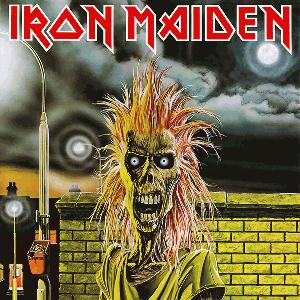
Review Summary: A consistently brilliant debut from one of the most enduring heavy metal acts of all time.
The Ruskin Arms pub, tucked away in a little corner of the East End of London, may seem an unlikely place to spawn one of the most famous and enduring heavy metal bands of all time but back in the late 70's this was the spiritual home of a fledgling Iron Maiden. At around this time the NWOBHM was starting to gather momentum and Iron Maiden had released an EP entitled 'The Soundhouse Tapes' followed by a couple of excellent singles which had gained them some recognition. An emerging fan base were desperate for new material, the music press were showing an enthusiastic interest and the scene was set; Iron Maiden were in the right place at the right time with the right music and when they finally released their debut album in 1980 it was obvious that something exceptional had been born.
There were many reasonably competent heavy metal bands garnering interest around the UK at the time of this album's release but when you compare it to what else was on offer it is immediately apparent that Iron Maiden were head and shoulders above the rest. There was an extra dimension to their sound, a complexity and an originality that was missing from the great majority of the music extolled by their heavy metal contemporaries. Drawing on influences such as Budgie, Wishbone Ash and even some of the prog rock dinosaurs of the 70's there was an intense and dramatic quality to their music but also a willingness to expand upon the simple song structures that typified much of the metal scene at the time. This is exemplified on stand-out track 'Phantom Of The Opera' with its galloping urgency, tempo changes and willingness to pursue dramatic impact through the use of light and shade. Vocalist Paul Di'anno drawls and spits his way through this seven minute mini-epic and when you listen to his vocal style it is apparent why Maiden gained some grudging respect from the punk community of the time. The Budgie influence is betrayed by a middle section whose bass line is lifted note for note from 'You're The Biggest Thing Since Powdered Milk' but Maiden's sound is all their own and has an intense, energetic quality that is very different to that of the relatively tired sounding heavy metal bands of the 70's.
Steve Harris was of course the driving force behind the band and his intelligent song writing skills along with his superlative bass work has dominated the Maiden sound to this day. Notwithstanding the well documented problems with the engineering and production of the album there is still a raw and biting feel which suits the music well and Harris's bass in particular has a full and wholesome quality which is in contrast to some later releases during the Dickenson period where his sound begins to take on a more middley and tonally focused quality. Harris's simple but effective bass line introduces 'Remember Tomorrow' which shows that Iron Maiden weren't afraid to embrace metal balladry. The dreamy passages that dominate much of the song recall early Judas Priest and it features a dark soaring chorus replete with trademark Di'anno screams and a riff to die for. As is typical within Harris's song writing the music steps up a gear with a mid-song jump in tempo allowing Stratton and Murray to display their considerable skills before falling away to once again embrace the retrospective mood of the opening section.
Iron Maiden's melodic sensibilities come to the fore on 'Running Free' which is almost a masterclass in how to formulate the perfect heavy metal single. Burr's irresistible drum beat is joined by a characteristically tasteful Harris bass line before Murray and Stratton get in on the act with some incisive harmony riffing. Di'anno's throaty growl suits the driving mood perfectly and the song includes some great interplay during a highly entertaining middle section with Harris, Stratton and Murray trading licks over Burr's pounding drum fills. Instrumental piece 'Transylvania' hits you like a ton of bricks with Murray's fluid Stratocaster lines flurrying over a driving rhythm section. The song builds and builds in intensity with both guitarists trading solos and licks and Harris's excellent bass work weaving in and out with a busy and restless approach not too far removed from that of legendary Rush bassist Geddy Lee.
Anthemic crowd favourite 'Iron Maiden' is a typical example of Harris's ability to pen a straighforward metal number elevated to greater heights by applying a touch of extra creativity. The twin guitar fanfare of Dave Murray and Dennis Stratton introduce the song but it is Harris's ever dominant bass which drives much of the rhythmic and indeed much of the melodic qualities of this, their signature song of the time. There is a rare song writing contribution from Dave Murray in the form of 'Charlotte the Harlot' which is an ode to a certain lady of the night. Whether Charlotte was a fictional character or not there is no myth here as to one of the greatest strengths of the band in their ability to pack idea after idea into a compact four minutes of urgent rhythms, tempo changes, infectious hooks and blistering soloing.
The quality, consistency and maturity displayed throughout this album is quite astounding considering that it is a debut release. Iron Maiden had of course honed their skills during incessant touring running up to its release but it is not only the quality of musicianship that impresses. There is a depth to the song writing and arrangements that totally belies their relative inexperience and, furthermore, Iron Maiden show that they have already captured the basic essence of a very individualistic sound that marked them out from their contemporaries. This is without a doubt one of the strongest debut releases of all time.