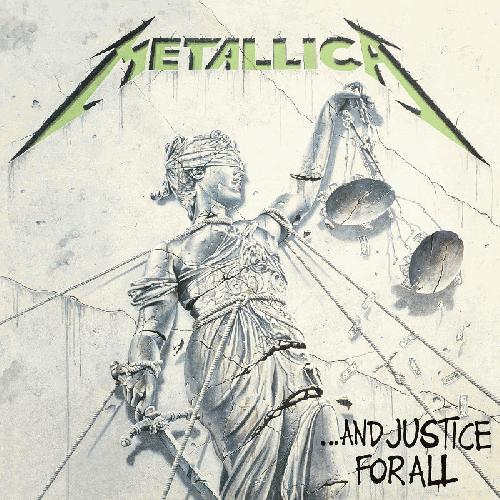
Review Summary: "Justice is done."
Master Of Puppets wasn’t a perfect album.
There, I said it. Yes, it was and remains one of the most important metal albums of all time. Yes, it was undoubtedly better than pretty much anything metal that had come before it, and yes, it was a vast improvement over Metallica’s sophomore effort, Ride The Lightning (which says a heck of a lot, since Ride The Lightning was also remarkably good). But Master Of Puppets still sounded like another stepping-stone for the band, just another stage in their journey towards the masterwork that they would ultimately create. To put it simply, they just weren’t quite mature enough to fully realize their potential yet.
But then, the unthinkable happened, and Master Of Puppets would be the last album to feature Cliff Burton on bass. When his sudden and tragic death took the other members of Metallica by surprise, they would then find themselves growing much older, much too fast. One can imagine that James Hetfield, Kirk Hammett and Lars Ulrich were overtaken by grief and sadness, as any human being would be in their situation. But what did they feel most of all? Well, from listening to this album, one can only guess.
Anger.
Anger towards the irresponsible bus driver whose careless driving resulted in the death of their friend. Anger towards fate. Anger towards God, anger towards the world, anger towards society. The anger that was already evident in Metallica’s music was amplified a hundred times over when they began work on their next album. This album is essentially the musical embodiment of that anger, and boy, it is a force to be reckoned with.
Every note that is played, every word that is sung, every drum that is struck throughout the 65 minutes of .…And Justice For All is filled with burning hatred and spite. Even One, the ballad of the album, is not lacking in dark, malicious undertones as it tells the horrible story of a man crippled beyond functionality by war. Similarly, To Live Is To Die, Metallica’s solemn instrumental tribute to their fallen bandmate, is played with a beautifully tragic bitterness that only partially subdues the anger felt in this album, as it is then followed by perhaps the most brutal track that they ever made: the legendary Dyers Eve, which is delivered at breakneck speed and makes for a chilling conclusion. The lyrics on the album are the most politically driven of any of Metallica’s works, and they are simply scathing, creating a vivid image of the corrupt motives of the human race. There are some more personally driven lyrics as well (Dyers Eve), but they are no less dark in their social implications. The bone-dry production throughout only helps to create the atmosphere necessary to convey the band’s artistic vision.
...And Justice For All is not only a musical masterpiece on an emotional level, but on a technical and compositional level as well. The songs are not only longer than they had ever been before on a Metallica album (the title track and To Live Is To Die both clocking in at almost 10 minutes, and the shortest track, Dyers Eve, still being over 5 minutes in length), but they are also more expansive, more mature, and more filled to the brim with originality than on either Ride The Lightning or Master Of Puppets. The title track, for example, is arguably the most progressive song that the band ever produced, filled with very unusual rhythmic patterns and chord changes that still somehow manage to work perfectly in context. It is a perfect example of just what Metallica was able to do compositionally at this point in their career. The album also has a couple of fun moments, believe it or not. The Frayed Ends Of Sanity begins with a bizarre and rather amusing allusion to The Wizard Of Oz before its infectious guitar riff finally sets in, and the solemn, melancholic cyclical ending of To Live Is To Die is rather rudely interrupted by Dyers Eve’s boldly abrupt introduction.
But, of course, there forever remains the anger; the impermeable anger towards EVERYTHING that rings through every moment on this record, and continues to ring through the ears of the listener long after the music has stopped playing. …And Justice For All is a classic because it was and still remains Metallica’s most complex and demanding effort to date. It’s a classic because it is the quintessential expression of frustration and desperation, of hatred and hopelessness, of everything that this band’s music stood for up until things went sour in the mid-90s. And finally, it’s a classic because it is an indescribably passionate tribute to their fallen bandmate, a farewell that could be no more fitting to their dear friend. To put it quite simply, …And Justice For All is the pinnacle of Metallica’s creative achievement and an absolute masterpiece. R.I.P. Cliff Burton. Justice really has been done.