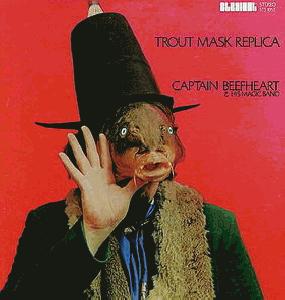
Review Summary: A surreal, incomprehensible Zen koan of an album that will make you hate it or love it. And if you love it, you may not be able to explain why. I do, and I can't either.
It’s impossible to do this album justice with any verbal description. It has to be heard. It’s not immediately comprehensible, but, in some way, it invites you in anyway.
Captain Beefheart was Don Van Vliet, a painter, singer, and free-associating musician from Glendale, California. In the heady days of the 60s, when the psychedelic movement was exploding the possibilities of recorded music, Vliet was inspired by the craziness of his schoolmate Frank Zappa to pursue his goals of blowing people’s minds.
Trout Mask Replica, strictly Beefheart’s third album release, is widely considered as his magnum opus. Throughout the album, Vliet basically growls in a delta blues throat, while his accompanying musicians (Guitarists Bill “Zoot Horn Rollo” Harkleroad and Jeff Cotton, and drummer John French) build a patchwork of free jazz. Lyrically, Vliet slips into improvisatory scat that anticipates rap, albeit with a mentally impaired, beat-poetry style.
With this mix, Vliet and his carefully chosen musical cohorts create the kind of improvisatory atmosphere that Krautrock bands like Can were simultaneously producing in Europe in the 70s. However, Vliet’s songs have a strong affinity for American folk music styles, especially country blues guitar. His compositions acquire a quite odd effect, due to the fact that he wrote most of the songs on piano, an instrument he didn’t know how to play.
Trout Mask Replica was a major influence on experimental and noise music; one can hear his affinity to Tom Waits on “Well” and “Ant Man Bee,” among many other songs (showing the influence of both Kurt Weill and minstrel shows).
Every song is spontaneous, and every note and word feels like a freshly picked nut. The whole album has a refreshing, living Zen feeling, even if the topic of the song is the Holocaust (“Dachau Blues”). “Orange Claw Hammer” exults in the rough joy of a hobo’s life, and “Hobo Chang Ba” lets Vliet play out his fantasies of a truly free hermit.
But maybe the best expression of the freaked-out morality of Vliet’s recording ideal can be heard on “Veteran’s Day Poppy.” “It don’t get me high/It can only make me cry...” How can a poppy be a good remembrance of the dead buried beneath it, when all it does is create sadness? To Captain Beefheart, all of life – whether celebration or mourning – is created by experience, and emotion. The sadness of the free-jazz riffs that follow underscore the concept: how can anything match the kind of emotion I can create through my music?