Review Summary: Creating a common ground ultimately allows this album to transcend the rest, allowing its strong imagery, styles and themes to create a classic album.
Many words come to mind when thinking of how to describe
A Sun That Never Sets. Varied, atmospheric, divergent and unique will certainly be fitting adjectives tossed around in this small, insignificant corner of the internet. However, one would be hard-pressed to find "Classic" included with the list of adjectives. Indeed, this isn't a classic Neurosis album. I'm sure somebody could make the case that there really isn't an album that is the most "Neurosisy" due to their ever-evolving sound, but that's a load of crap. We all know that
Through Silver and Blood is going to be the first album people suggest when being asked for an example of Neurosis. After all, it's
the Neurosis album.
That's fine and dandy, if you live in a box.
What sets
A Sun That Never Sets apart from the rest of Neurosis' truly impressive discography is that it ultimately strikes a perfect balance despite being their most eclectic album. It retains many of the aggressive characteristics of
Through Silver and Blood while implementing a more reserved style of that which was predominant in their next release,
The Eye of Every Storm. Creating a common ground ultimately allows this album to transcend the rest, allowing its strong imagery, styles and themes to create a classic album.
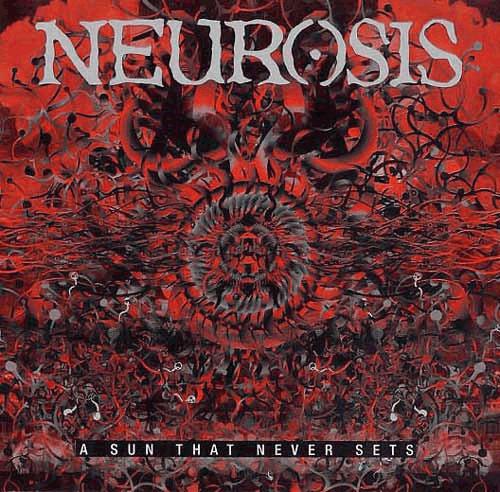
Neurosis really sets the tone of this album not with its first song, but with the artwork and title. A sun that never sets: not necessarily a frightening image, but rather a grossly unsettling one. A world where the sun burns on and on is one of uncertainty, fear and disarray. The chaotic and unorganized artwork reflects this hopeless state. Yet in all this chaos, one can't help but notice elements of sheer beauty. This beauty isn't cheerful, but it's something else entirely. Rather than piercing through the intensity of our surroundings, it offers solace such that we may accept everything as it simply is. Serenity. This may seem an odd interpretation, but I feel it's ultimately what Neurosis is trying to convey. Through the whole album, we experience many trials and tribulations to ultimately arrive at a conclusion that does not tell us there is hope, but rather that we may be at peace.
This album is a complete one. The calm before the storm of
The Tide sends signals that we are to begin a journey in this land where the sun never sets. Melancholy strings, soft strumming and an ever-present bass allow for a transition into the intensity of the storm.
From the Hill starts in a similar vein, but with remembrance of the storm we had previously passed through. However, the path Neurosis sets for us is different in theme and structure, the use of more divergent instrumentation signaling this change. We haven't traveled to some other land, just another part of it. Next, we are greeted with wind instruments and an unsettling tribal percussive set. Throughout the title track, we are met with a true unsettling feeling, yet we being to also feel our first glimpse of acceptance.
The blood that flows through me is now my own.
The blood is from the past, not my own.
The blood that leads my life is not my own.
The blood is strength, I'm not alone.
This reassurance is soon to be tested, though.
Falling Unknown is Neurosis' manifestation of the journey we take through the album. The first half of the song is a personal dialogue -- can we make it? The shroud of uncertainly looms as we begin our fall into the unknown, and a wall of sound begins to grow and grow until it climaxes with vocal counterpoints between Steve Von Till and Scott Kelly. The profoundly intense ending truly feels appropriate for the sonic journey we've experienced.
From Where the Roots Run is our arrival at sheer chaos. Tribal percussion, recital of the names of ancient runes and distant chanting returns us to an unsettling feeling, yet it tacks on a reminder: we're not out of reach of the sun just yet. The sheer enormity of this musical and thematic journey also has a human toll.
Crawl Back In is a personal reflection and deeply melancholy experience. Yet at the same time, there is more going on. Wind instruments playing a slow melody showcase a short scene of serene beauty rarely heard in the world of music. That instant also shows us that this album isn't just about the journey, but also about the moments where you forget you're listening to music and the sound envelops you. These moments don't last long, but they are unforgettable. As soon as it begins, the reminder that we are not finished rears its ugly head. We trudge through a variety of emotions and themes as we traverse
Watchfire and
Resound until we arrive at our final destination ... Stones From the Sky.
Special note should be given to
Stones From the Sky as it acts not only as an end to the superficial journey the album leads us through, but it also draws in all the emotions, imagery and themes we've had the pleasure of experiencing for the previous fifty-eight minutes. It seems that for an album such as this, a finale that does not allow the album to act as a sum that is greater than its parts is doomed to mediocrity. Gratefully, this is not the case. The hopelessness, chaos, fear and uncertainty are all present here, and we traverse them once more without tire to arrive at the end of our journey. And what an end it is. Here the crushingly heavy mixture of ambient sounds and thundering chords send the message of acceptance and peace. This isn't a happy ending, but it is one that we allow to happen. Thus ends
A Sun That Never Sets.