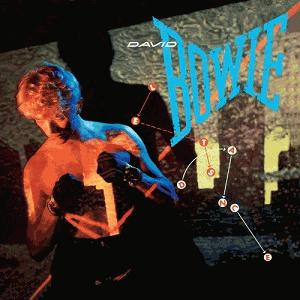
Review Summary: Put on your red shoes and prepare to feel blue.
Let’s Dance marks the first point in Bowie’s career since before the seventies where he wasn’t ahead of the curve. The polished synth-pop beats and the album’s accompanying music videos signalled something was up - in particular, that Bowie was out to smash the charts. He did.
Let’s Dance - both the LP and its eponymous title track - hit #1 on both sides of the Atlantic, but sadly not because of an artistic triumph or a radically groundbreaking sound. Quite simply,
Let’s Dance succeeded because it was a perfectly observed and instantly accessible photograph of pop music circa 1983.
The kids who championed Bowie as teenagers, and who saw the possibilities of what could be extrapolated from 1980’s
Scary Monsters were, by 1983, enjoying chart success of their own. Bands like Duran Duran were ruling the charts with their catchy expansion of what Bowie blueprinted, and instead of swooping in and setting the next trend, Bowie merely followed it; gate-crashing the party he inspired. That makes
Let’s Dance both weaker and stronger, in effect pulling it in opposing directions. In other words, it’s easy to both justifiably slate and acclaim
Let’s Dance to equal measure.
On the one hand,
Let’s Dance deserves praise. No-one can say with great honesty that in its quest to top the charts,
Let’s Dance failed. It’s first three tracks are a trio of stellar 80s pop moments, each progressively stronger than the last, starting with the light piano and quirky sax of ‘Modern Love’. ‘China Girl’ (which dates back to Bowie’s co-writing position on Iggy Pop’s 1977 classic,
The Idiot) is even better - a clever reworking of a menacing post-punk track into a shimmering, oriental-tinged pop hit. It’s ostentatiously heterosexual music video and Bowie’s deep croon helped make him a commercially viable artist for the first time in the US since before his characteristically ironic “I’m Gay” interview of the early seventies. That, alongside the new tanned, bleach-blond, pastel suited look he sported made him a pop superstar all over again, despite being in his thirties with a messy divorce and child behind him.
Without a doubt the title track is the album’s crowning glory - the 7.30 version that features is an extended edition of a true dance floor classic. Its infectiousness, sublime vocals and polished synth beats almost makes the price of admission for the full album viable by itself. Stevie Ray Vaughan’s fabulous guitar work and Nile Rodger’s sharp, pop-sheen production ensure ‘Let’s Dance’ is an alternate, but compulsively enjoyable Bowie classic.
But on the other hand,
Let’s Dance justifiably earns its detractors with the remaining cluster of songs. ‘Without You’ is languid and stale; as is its similarly unimpressive brother, ‘Criminal World’. ‘Ricochet’ and ‘Cat People (Putting Out Fire)’ are slightly more enjoyable, particularly the latter with its moody build up, but ultimately suffer from the same laborious curse the aforementioned cuts do. The set is squared off by the overly familiar ‘Shake It’ - a briefly pleasant but ultimately weaker, low budget reworking of the title-track’s melody, marking the end of very inconsistent disc.
Let’s Dance is a mixed effort in every sense. It boasts three glistening pop classics early doors, but shapes up as a tedious and uncompelling record towards the end. It doesn’t really feel like a Bowie album either. Nile Rodger’s shiny, but terribly anachronistic production and its deliberately commercial slant make it a distant and disappointing counterpart to Bowie’s incredibly unique seventies antecedents. Still, it was one of the most successful and popular albums of the eighties, and its early tracks are delightful, ultimately saving it from condemnation. But whether the album is worthwhile firmly lies in the eyes of the beholder. Picking up
Let’s Dance will get you a flawed and unessential, but sometimes hugely enjoyable record - its value depending on just how much you wish to put your red shoes and dance the blues.