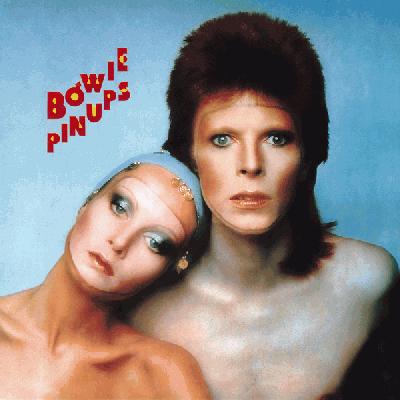
Review Summary: Pinning up the poster of disappointment.
By 1973 David Bowie was a genuine superstar. His succession of fiercely original LP’s and constant toying with his image had forged him into rock’s most exciting new commodity - pushing the boundaries of seventies rock ‘n’ roll, album after album. Then
Pin Ups hit the shelves - an album comprised entirely of covers of mostly British hits from the 60’s. To cut a long story short, it was a disappointing aberration.
That’s the big issue with
Pin Ups - it just didn’t deliver what the fans craved - more originality; more Ziggy or Aladdin; basically anything as long as it was an original Bowie lick. So the 12 cover versions, despite their Ronson and Bowie glam reworkings, gave the fans exactly the opposite of what they wanted - stale, unoriginal material.
Technically speaking, there’s nothing one could slate with great certitude on
Pin Ups. It features the majority of the Spiders From Mars, rocking as solidly as they ever did; nor could Bowie’s vocals be faulted, sounding distinctive and satisfying throughout. To be fair, it works quite sufficiently on the album’s scant highlights: a cover of the Syd Barrett-era Pink Floyd ‘See Emily Play’, with its odd demented choral backing; and ‘Sorrow’, swaying with a sophisticated breeze of backing violin and original sax interjections, resulting in one of the stronger outings on the disc.
But as solid as it all sounds, none of it is that exciting or compelling - doubtless down to the fact it’s merely a covers album.
Pin Ups begins to seem more dubious if one begins to believe the rather plausible rumours that it was conceived as a stop-gap release between
Aladdin Sane and whatever Bowie would do next. In other words, the album was, essentially, a compilation of filler produced in order to give Bowie some time to rest and recharge his creative batteries for 1974. An even worse, although tenuous theory, is that
Pin Ups was released as a stalling manoeuvre while Bowie’s management (MainMan) resolved a royalty dispute with publisher Chrysalis.
Ultimately,
Pin Ups is unnecessary and underwhelming. It was either a big bout of self-indulgence or, more likely, a way of keeping the record buying public satisfied whilst Bowie figured out where he wanted to steer his musical ship next. It’s solid and far from terrible, but wholly superfluous, and only recommendable to those Bowie fans who must have a complete collection of his material - even if it means acquiring mediocre outings such as
Pin Ups.