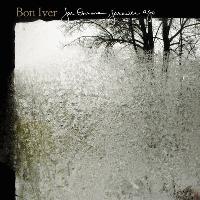
Review Summary: It's not often that an album comes along which is so resolutely more significant than the relatively unimpressive sum of its parts. For Emma, Forever Ago is one of those albums, a record which really does, for once, have the X factor.
The story of For Emma, Forever Ago's genesis has attained such a legendary quality in folk music circles that it's almost easy to forget about the album behind it all. As evocative and poetic our mental images of Justin Vernon locked away in a cabin in Wisconsin are, they shouldn't come into play when considering For Emma, Forever Ago's quality as a collection of nine songs. It's quite lucky, then, that it more than holds up to its fairytale origin story.
It's hard to describe the actual sounds of this album without it sounding like the kind of music one would hear emanating from some godforsaken Starbucks, with the CD being touted as their 'hot new pick.' Yes, Bon Iver's music is fairly minimalist, primarily acoustic folk, with layered falsetto vocals. Yes, the lyrics are somewhat obfuscatory in terms of revealing any actual meaning at points. And yes, some people might call this 'hipster music,' whatever that means. So whilst those three things might sound rather like a recipe for a cliched musical disaster, For Emma manages to shrug off any trepidation one might feel when going into it, and it ultimately comes together as being so, so, so much more than the sum of its parts that one would be forgiven for wondering if they had fallen foul of some sort of musical trickery.
Opening track 'Flume' is demonstrative of the template for much of the album; incredibly simple chord progression, lovely falsetto vocals delivering oblique, heartbroken one-liners about love, all topped off with some impressive layering as it goes along. The second track doesn't do too much to mix up this formula. The third track, too, manages to keep this up. The fourth track... well, you get the idea. The only real variety to be found on For Emma is in it's quasi-title track, as some unexpected but welcome horns feature alongside a slightly less melancholy chord progression than we're used to. Overall, though, I find myself frustratingly able to sympathise with some critics' complaints that the album is 'samey,' and that it can quite easily 'all blend into one song.' Whilst these complaints are actually fairly justifiable, I'd also be quick to point out that such people are quite missing the point of the album.
As one-dimensional as it could be deemed to be, For Emma, Forever Ago has slowly been working its way up my 'all time favourite albums' list ever since I first heard it. It's the kind of album that feels enchanted, like it's been given some unfair advantage against other music by just having this innate sort of depth, an inherent sense of meaning, which other folk albums lack so pitifully. By the time you reach the album closer, Re: Stacks, on your first listen, you'd have to be pretty stoic to not be at least a little more affected than you normally are by this type of music. As Justin Vernon tells the listener that 'this is not the sound of a new man or crispy realisation,' hearts will break. There's something so poignant in the man's delivery, so profound in his poetry, that this review couldn't help but be utterly taken in from his first listen to his fiftieth, years later on.
And whilst it might well seem like I haven't actually given a sufficient reason for For Emma, Forever Ago's ability to tower so effortlessly over its peers in the genre, that's most likely because the reason has to be experienced by listening. Sure, Damien Rice's voice is just as pleasant, his lyrics just as nostalgic and his music just as basic. Sure, Bright Eyes might have a keener knack for storytelling, and so on. But what Justin Vernon has is, for lack of a less overused term, 'the X factor.' There's simply some magical ingredient, some perfect quality which For Emma, Forever Ago is naturally imbued with, and it's something that's severely lacking in most music today.
So if you're one of the many who's listened, digested and still come away unimpressed, maybe it just didn't hit you in the same way it has me, and countless others. But if it did work it's magic on you, if it did touch you in a way in which music hadn't done since the time of Dylan and Springsteen, then you know just how lucky we all are to have Justin Vernon's unequivocal masterpiece immortalised for our pleasure. I read somewhere that Vernon originally intended to only release the album on a limited run and distribute it exclusively amongst his friends before the record label picked it up; unlike the man himself's sentiments as expressed on the album, what might have been lost really does bother me. Now, you'll have to excuse me while I go and let Re: Stacks destroy me once again.