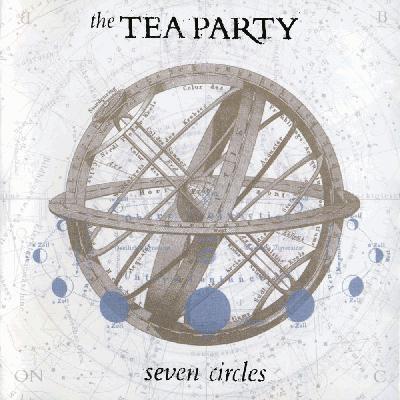
Review Summary: both a deviation and conglomeration, "Seven Circles" may have been The Tea Party's last album, but their legacy would live on.
It’s actually quite impressive how selective The Tea Party’s fame was. Never an international sensation, the band was a massive hit in Canada, but if you asked anyone outside the country if they knew them, you would receive blank stares. Unfortunately, the band’s invisibility haunted them since day one, and it would further haunt them until
Seven Circles, which signified the final album The Tea Party would ever release. Although it reached number five on Billboard’s Top Canadian Album chart, and received a nomination for “Rock Album of the Year” at the Juno Awards, the rest of the world apparently never got the message. Completely under the radar their entire career, the classic band, The Tea Party, left silently a year after
Seven Circles was released. They were never heard from again.
The Tea Party were always bizarre due to their obsession with the Indian and middle-eastern scales. Surprisingly, in
Seven Circles, their obscure world-influence is barely noticeable. Saved for select tracks such as ‘Luxuria’ and ‘Coming Back Again’, it would seem at first that they were barely themselves, but in reality The Tea Party were always prone to change. Bearing the largest similarity to
Tryptic, this album is straightforward hard rock. With heavier guitars and more immediate, obvious hooks, the guitars have made the transition well. There is also a larger emphasis on strong choruses, and creating songs with simple structures. It all adds to the band’s smoothest and easiest album to listen to, which is definitely a plus. Their albums usually take a bit of getting used to, but this one is immediately gratifying.
The main reason why the album is so instant, is that
Seven Circles effortlessly combines The Tea Party’s influences into a seamless, slick package. The band’s experiments are still here, but their usual excessive drama is nowhere to be found, and considering the mainstream approach to the album, this is a good thing. Of course, this does not mean that the band is any less mystical, it just means that they’re less obsessed with pushing that agenda. In ‘One Step Closer Away’, for instance, their past dabbling with industrial and electronic ideas can be heard, but the song eventually leads into a nice, rockin’ chorus.
Seven Circles is basically comprised of good old rock songs, and although the old influences will pop up now and then, The Tea Party just wanted to rock, and rock they did. The only conceivable downside of the music is that it is less intriguing than before, but all things considered, it turned out very well.
The most unfortunate aspect of this entire ordeal is that
Seven Circles may have appealed to a broader audience with its accessibility, but we all know that this was the band’s last album. As such, it is odd to end a career after an album so different from their previous releases. However, if anything,
Seven Circles proved that The Tea Party were veterans in the music industry, and could still produce mature, quality songs that other bands could only dream of writing. So what if the album is a smidgen different from previous releases, The Tea Party ended on the top of their game. What’s not to like?