Fates Warning is one of those bands that have gone under the radar, and yet, have one of the most loyal fanbases. They formed back in 1983, and if you read the band description on the previous page, they were just an Iron Maiden replica. Their 1983 debut, Night on Brocken, reflects this quite well. With The Spectre Within, their 1985 release and second album, they started to explore medieval and mystical themes in their songs, as well as longer song compositions. Though not quite progressive yet, long songs and DnD lyrics are always fun to listen to . .
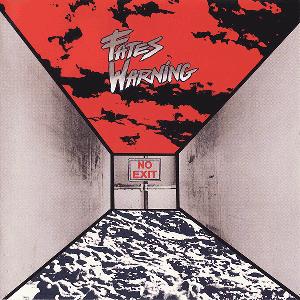
In 1986, Fates Warning took a leap in terms of musicianship, and in their third album, Awaken the Guardian, they started to explore the mechanics of (more) DnD lyrics, blistering guitar solos, and odd time signatures. Awaken the Guardian was truly progressive, and their 1988 album, No Exit, is an evolution of their past progressive metal explorations in Awaken the Guardian. No Exit is often considered to be Fates Warning's heaviest album (think Iron Maiden, but slower, heavier, and with progressive elements). It's also worth noting that John Arch, the Dickenson clone and the vocalist from 1983-1986, left the band, and on No Exit was their first album with new vocalist Ray Adler
Well, you clicked on this link for a reason, so without further delay, let us begin .
Lineup:
Ray Alder - vocals
Frank Aresti - guitars
Jim Matheos - guitars
Joe DiBiase - bass
Steve Zimmerman - drums
1. No Exit (0:41)
Nothing special with this track, just Ray Adler wailing away and Jim Matheos picking away slowly on the acoustic guitar. It’s almost an overture, as it sets a dark, dreamy and moody feeling for the rest of the album . . . No Rating/5
2. Anarchy Divine (3:46)
Now you'll understand what I mean when I said that this is Iron Maiden, but slower, heavier, and with progressive elements. Matheos and Aresti open the song with two solos, both of which shouldn't be overlooked. Matheos and Aresti can both do their fair share of shredding, as well as acoustic finger picking, and Anarchy Divine is basically just a show-off of the former. Zimmerman has some nice drum fills here and there; DiBiase's pounding and punchy bass is quite audible and adds to the rhythm nicely, and Ray Adler's siren-like vocals are commendable, as he can reach notes that comparable to James LaBrie of Dream Theater and Alan Tecchio of Watchtower. Anarchy Divine seems to deal with desensitization of the individual in society, though the lyrics are quite vague and are open to interpretation . . . 5/5
3. Silent Cries (3:17)
Silent Cries opens with more crunchy distortion, though it comes to a close about twenty seconds in, and a lone clean guitar and vocals take it from there. Then a distorted guitar enters again, followed by the chorus of, "Silent cries, behind outcast eyes, hides a child who cannot speak, silent cries!" Then same formula is repeated again until the bridge, where Matheos and Aresti shred up and down their necks. It's quite predicable after that, with the verse and chorus repeated again ...4/5
4. In a Word(4:25)
The second song on the album to start with an acoustic guitar arpeggiating (the first being the title track). It's a rather depressing and solemn melody, until the bass and drums enter (no distortion yet).Adler's beautiful vocals join the mix, with the lyrics, "We were born to brave cold weather, stormy seas in search for treasure, light you must wield to blind another, doomed to run forevermore." A distorted chorus follows, then a short guitar solo, and the verse, chorus, and bridge. The bridge though, unlike the previous songs, is the opening arpeggiated riff, with a very melodic lead guitar line. It comes to a close with a marching bassline and drumline, though they only serve as a segue into another solo. Then the chorus is repeatedly and faded out slowly . . . 5/5
5. Shades Of Heavenly Death (5:56)
Opens with some rather melodic drumming, giving way to a very thrash/metallic influenced riff. The riff then simplifies down to repeated triplets, with some catchy fills here and there. This is actually repeated throughout the whole song, and the only real standout here are two guitar solos and some cool, metallic riffage, so there's not much else . . . 3/5
6. The Ivory Gate of Dreams (21:50)
Yea, that's right, twenty-one minutes and fifty seconds long, with eight movements.Of all the twenty minute epics that I've heard, "The Ivory Gate of Dreams" beats out "Echoes", "Lizard", "Octavarium", "Black Rose Immortal," "A Change of Seasons", etc. It's melodic, yet heavy, and it never really gets boring (for me at least). All instruments have some really neat parts here, especially DiBiase's occasional catchy bass fills, and Matheo's Spanish influenced acoustic guitar, as each movement alternates between crashing metal and mellow acoustic riffs. The heavy movements of this song have some unconventional time signatures, and the solemn moments are ecstasy for the ears. Adler limits the siren-like wailing, and you get to listen to melodic, emotional wailing instead :) .The song seems to deal with the Greek myth of the ivory gate of dreams, that is, everytime before you wake up, you can either enter the gate of horn or the ivory gate, the former lets you remember your dream, the latter makes you forget. You really have to listen to this song yourself, and judge it with your own standards, but as for me, this epic track easily gets . . . 5/5
Conclusion
Now that I've given you an overview of the album, your best bet would be to either download it, or to buy it. It's worth the $9.99 for the CD or the ten minutes or so that it takes to download, and I highly recommend this if you're into progressive rock or 80s (not really hair) heavy metal. Besides one weak track, the only other con of this album is horrible (but bearable) production quality. Pros consist of interesting melodies, heaviness, and an excellent closer. Overall, this album gets (5 + 4 + 5 + 3 + 5)/25 = 88%, or about 4.5/5 . . .
Well, this is my first review, hope everybody liked it, though it probably got a bit boring at times, and thanks for reading it . . .



 . . .
. . .
