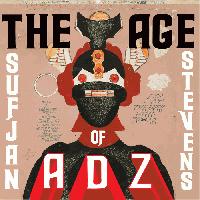
Review Summary: Sufjan Stevens learns the meaning of life and turns it into an album.
You all should have seen this coming, so stop blaming Sufjan for the fact that he caught you with your collective pants down.
See, I've never paid much attention to Sufjan Stevens before. But even
I heard the Dark Was The Night compilation released last year which contained a song that was full of bleep-bloops and orchestrations and weird vocal effects and general mind-f
uckery. That song? "You Are The Blood," by Sufjan Stevens. Oh, and one more thing: it was over ten minutes long. So I'm not sure what the fuss is about or why everyone is making such a big deal out of this Sufjan character like he's committed some act of betrayal with The Age Of Adz. Even the people who love the album are losing their sh
it and can barely get their thoughts in order to explain just why they love it so much. To me - and again, I have never been a close follower of Sufjan and have only heard one of his albums in full (Seven Swans) and a scattering of his other material - this album is a good representation of Sufjan Stevens the man - not the folk artist or the electronic artist or the guest artist or the full of sh
it artist who proposed the fifty states idea - but the man himself in all his Sufjan-ness. Because more than any of the things that he has purported to be in his colorful career, Sufjan Stevens is a
composer, and he has proven that the term is not archaic. It may have to be dusted off and polished each time it's applied to a modern musician, but composers are certainly not absent and Sufjan is the most prominent of them.
And you can see him there, can't you? In front of an orchestra, waving his hands around with his eyes closed, tapping his foot, totally
into it, lost in this thing that he's created? I can see it too, but that's not the way I mean to portray him. The composer has become a parodied thing in this modern day: in cartoons we see them with wild white hair, twirling a stick meaninglessly, and in movies we see the high school band teacher who regrets every damn choice they've ever made, wondering just how the hell they wound up trying to teach a bunch of snots an art form that they don't care about. Of course, those images are precisely what makes The Age Of Adz confusing, because there are points where Sufjan embodies them both, albeit in a skewed manner. The thing is, The Age Of Adz seems like what would happen if one of those high school band teachers were suddenly given a record deal and decided to shove every single thing they could possibly think of into the music as a "f
uck you" to everything that took place in their life beforehand. This band teacher would be so bitter by that point that they wouldn't even be worried about making the album good or not. They would just want it long and bloated and full of things that shouldn't go together and they would want to complete it as fast as possible to get the f
ucking thing
out there to show everyone they hate that their name is attached to something real. The difference is that Sufjan Stevens is a friend of chaos and wields the power to control it, to compose it and ply it into something manageable, to take one thousand different elements and, in a convincing, atom-smashing display, pile them on top of each other in a way that makes sense.
We, as the listeners, are left to wonder why everyone else isn't doing this. I don't mean to say that every musician needs to start stuffing their music with things that would sound foreign to it. But Sufjan has accomplished what, theoretically, every musician is striving to do - he has taken his art to a level much farther than anyone thought possible,
and he made it look like the most logical thing ever. You see, "You Are The Blood" would fit right into this album, but that was just one song. It was only ten minutes. The Age Of Adz is one hour and fifteen minutes of that and it doesn't overstay its welcome, because there is a difference between an album that tries to do everything and suffers because of it and an album that really does do everything and makes it sound effortless. It would be easy to say that The Age Of Adz is just Sufjan combining all of the things he's done into a single album, but it is more than a bunch of acoustic progressions overlaid with electronic drums and underlaid with ghostly backing vocals and cemented with spastic flutes. As much as I would love to simplify the album, it's just not that simple. There is a level of care here that is rarely present in today's music, as if that jaded band teacher had a sudden change of heart and approached the tuba player and inspired him to do something amazing, and patted the oboe player on the shoulder and taught him how to truly play his instrument, and on and on, even approaching the third chairs and telling them that their contributions are heard, that the whole f
ucking composition would fall apart if they weren't sitting there chopping up their souls and inserting them into the music - and therein lies the essence of this album, the adjective that best describes it and answers all its dwindling questions while simultaneously raising a whole new level of discussion -
soulful. The word isn't something that can only be applied to a specific vocal delivery or an inspired guitar solo. It can sum up an entire body of music.
That is what Sufjan has done with The Age Of Adz. It is my belief that the closest humanity can come to having a soul is through music. Conversely, never do we show how soulless we really are through music that expresses nothing, that adds nothing to mankind's collective consciousness, that is thrown together haphazardly and spits in the face of every musician who has ever toiled endlessly to insert themselves into a piece of music, to find out who they are and to find out who the people around them are, to understand the world and how it works. In any analysis of The Age Of Adz, what must be focused on is not the change in sound or the length of the album or the preposterousness of a twenty-five minute closing track or whether or not Sufjan is indeed f
ucking around. What matters is that someone has never come so close to revealing
fucking everything through music as Sufjan has here. If the point of music is for us to take something from it - whether it be an emotional response or a change in mindset or any sort of inspiration - then The Age Of Adz is the most selfless album ever recorded, and Sufjan is the most giving composer. Although the majority of what he spouts on the album is personal, even going so far as to
namedrop himself, he is also showing us who we are, and more importantly, what we can do. The sheer emotional weight behind this music is so hard-hitting that you've got to wonder how anyone could possibly deny it, how anyone could resist its force. It isn't enough to say that people who haven't heard this album are missing out. They are missing out on something essential. The variety of sounds present on The Age Of Adz might cause one to use a word like "pointless," but the music here represents everyday life in all its mundane drudgery, all the little moments that seem meaningless and are not remembered while we lay in bed, and at the same time the music embodies what life could be if we would just follow the path, if we would just follow our hearts, if we would just stop f
ucking around, if we would cut our bodies open and rip out our souls and turn them into something that means everything.