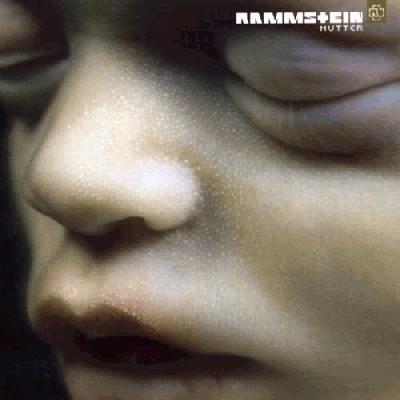
Review Summary: A breaktrough that promised a lot.
It is not like Rammstein were unknown prior to 2001; if 1995 debut "Herzeleid" had not made much of an impression on the European metal base with its combination of techno beats and rather weakly mixed guitars, certainly 1997 "Sehnsucht" (with hit single "Du Hast") and stunningly well performed, choreographed and recorded live CD/DVD "Live Aus Berlin" (1999) had thoroughly introduced a new, outstanding industrial metal act. But it wasn't until the release of third studio album "Mutter" that things started taking off properly. During the following years, Rammstein slowly grew an enormous reputation all over Europe. Ahead of the release of 2004 follow-up "Reise, Reise", the band started selling out concert halls with up to five-six times the audience size they had played to before. (And on top of that in no time, leaving the reviewer - who thought himself to be well prepared - no option but having to turn to the black market for their visit in Stockholm).
What makes this appear even more interesting almost 10 years after the release of the album is that "Mutter" is by no means a perfectly created whole. One could even argue that there is a dip in intensity already after 4th track "Ich Will" that the rest of the album can't entirely compensate for. That is not to say that that rest should be mediocre; "Rein Raus" provides for some brutal headbanging, "Spieluhr" delivers a haunting poetic atmosphere, and selected moshing parts in "Zwitter" and "Adios" are quite enjoyable. But there is no doubt that the strength of the album lies in the the four opening tracks that until this very day remain some of the most popular songs the band has written.
"Mein Herz Brennt" opens with melancholic strings that seem to capture a type of damaged "German-ness" that only Rammstein could bring about; it is hard not to imagine a rising sun revealing a Berlin in ruins. The use of the Babelsberg film orchestra provides a symphonic landscape that mixes utterly well together with both acoustic and distorted guitars. (Ever since the song was used in the film "Lilja 4-ever" it became, annoyingly, more or less routine to use it as a soundtrack for any independent European movie or theatre production.) Till Lindemann's vocals are as usual deep and "kraftvoll", but turn out to be more melodic than before, something that feels very welcome.
Heavy marching music is being brought about in all it's simplicity in "Links 2,3,4". The track more or less follows the same chords from Herzeleid hit "Asche zu Asche" and lyrically deals with the accusations towards the band regarding political ideology. Apparently guitarist Richard Kruspe-Bernstein dubbed guitars 24 times (!) for this song, which you could almost tell. The result is an addictive wall of sound that makes you want to join into the marching straight away.
Third song and first single "Sonne" is a masterpiece within itself. A simple, lead-heavy riff in the intro and verses is followed by a majestic chorus. The video depicting the band members as the dwarfs around Snowhite gave the song an even wider dimension. (It really is all too sad the band didn't hold on to this very promising 1800's romantic mixture of epic-Grimm-brothers-fairytale and industrialism). "Ich Will" is centered around a simple keyboard melody followed by guitars and massive crowd shoutings in a playful exchange with Lindemann.
As for the two ballads on the album, they remain quite a disapointment. "Nebel" might be some of the most uninteresting the band has ever put out, and "Mutter" is just too much a copy of Metallica's "Unforgiven". Even though "Seemann" from "Herzeleid" had some interesting thematic ideas (and showed of a really sweet bass line by bassist Oliver Riedel) it feels that ballads were never quite Rammstein's thing.
Some had hoped the above mentioned romantic style of Sonne would have continued on "Reise, Reise". It didn't. And it seems that according to Rammstein themselves, the band will never consider to hit the path that could have made them truly outstanding. At least this album contains a small fraction of what could have been.