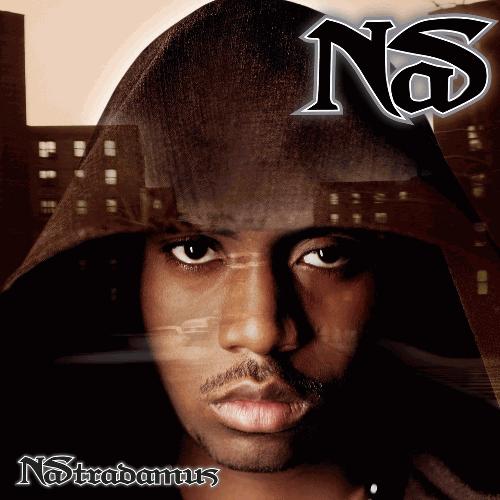
Review Summary: The minimalist, pop tendencies of Nastradamus make the record just as bad as Illmatic is good.
They say that you’re a product of your environment. For Nasir Jones, that was true – at least in a musical sense. The 20-year-old middle school dropout grew up in the impoverished Queensbridge slums with his father, jazz musician Olu Dara Jones. As a result, his debut album
Illmatic was a street watcher’s journal filled with tales of gang violence and project life spilled out over jazzy soundscapes. With such a successful style that pushed
Illmatic into the realm of classic status, continuing in a similar vein throughout his career would've been a sure bet. Sadly,
Nas chose to move in different directions, and as a result, an argument could be made that he's yet to come anywhere close to hitting the milestone of
Illmatic. Dissapointingly enough, his 1999 effort
Nastradamus embodies this to the harshest extent in
Nas’s discography. I cannot fully comprehend the street poet’s motives that drove him to make
Nastradamus, but one can only imagine. Money, his rivalry with Jay-Z, or implausibly enough, Y2K (which he mentions on the track “New World”) could all have served as creative motivation. The minimalist, pop tendencies of
Nastradamus make the record just as bad as
Illmatic is good.
In 1999, hip-hop had come a long way from its production origins of rubbing fingers on vinyl records. Digital audio workstations like FruityLoops Studio were around, and well, the music behind hip-hop was no longer being conducted through seemingly stone age efforts. So why Columbia Records, a premier rap outfit, would allow one of its key artists to make an album with such archaic production techniques is beyond me. Most of the cuts on the album see only three different sound loops, and some even have only two. Normally, three elements wouldn’t be a bad thing, but when they’re so unpronounced, predictably looped, and one of them is a constant, basic drumbeat that almost drowns out the other elements, it is. The title track sports some cheesy pop synths taken from
EPMD’s “Let The Funk Flow” and a bland drum number, and the intermittent, barely audible triangle twinkle. But the minimalism doesn’t end there; rather, it gets worse. The beat on “Last Words” features a sample snatched from the Ohio Players and then a drum kit layered over that while Nas and his associate
Nashawn exchange verses over a looped and somewhat misplaced female backing vocalist, undramatically reciting "hoo"; that while relegated to a backing chant ends up standing out more than it should. Even the most creative track “Quiet Niggas” – which samples “Final Fantasy VII” and a
Tupac song – is nothing but a quaint, dark piano sample, finger snaps, and rapid, but looped, percussion.
Lyrically, the album encounters problems as well.
Nas’s back-of-throat delivery, gravelly voice, and agile flow geared him to be the storyteller of the slums; the reporter of the streets. However, on
Nastradamus, he branches into an area he’s not prepared for. He unsuccessfully blends egocentric arrogance and violent bravado with world awareness and consciousness. On “God Love Us”,
Nas tries to explain in the corniest, most illogical way possible that God loves lower class African-Americans the most out of all his children, and in the meantime, somehow manages to rhyme “in the hood” eight times in a row, then seven times in a row (with only two lines separating the sequences of annoyance.) When he’s not doing that, it’s back to rapping about hood life. But even then, he appears to try way too hard to sound like he’s patrolling the streets while toting an uzi. On
Nastradamus, there are too many I’s and not enough eyes. That is to say,
Nas went from being the witness to the perpetrator. He resorts to the all too typical hyper-masculinity you’d find on, dare I say it, a
G-Unit record. A perfect example of his lyrical style can be found on the title track, where he proclaims himself as an intelligent prophet, affirms himself as a street soldier, and then brags about his rockstar lifestyle,
consecutively. “
Century twenty-one, solar eclipse/While you listenin’ to the words that I wrote on the disc/The Lonius/My description is do-rags, pant sag down to my feet/AK is my heat/Everyday in the street/Till I lay six feet/QB PJ’s, and we playin’ for keeps/Jewelry, cars and Jeeps is my motto,” Sadly,
Nas, one of hip-hop’s most hailed lyricists sounds too much as if he were just another dime a dozen MC who makes rounds on MTV.
All that saves this record from being a complete train wreck are tracks four through seven. Although not brilliant in any manner, they’re good in a redemptive way. “Some Of Us Have Angels” is a dark track with an eerie xylophone loop and sinister, soaring synths, “Project Windows” is a soulful cut that bears the most resemblance to
Illmatic-era
Nas, “Come Get Me” is the only track in which he minorly succeeds in being a thug but being backed a DJ Premier beat is a big help, and “Shoot ‘Em Up” has Nas swiftly flowing over an oddly catchy instrumental with twinkling harps.
In the end,
Nastradamus was a record intended for the masses, and it ended up succeeding as just that, going platinum and peaking at #7 on the Billboard 200. But at what cost? The album is a blemish on
Nas’s widely heralded career and just a downright terrible album. Proof that even the best falter,
Nastradamus is to be avoided at all costs.