Review Summary: I SEE A RAINBOW RIIIISIIIINGG!
Soon after Rainbow’s debut was released, Ritchie Blackmore fired everyone in his newly found band, except for Ronnie James Dio. Seeing the incompetence of the musicians in his band, he put together a new formation, adding bassist Jimmy Bain, keyboardist Toney Carey and drummer Cozy Powell (who had previously played with
Jeff Beck). In 1976, the new line-up released follow-up
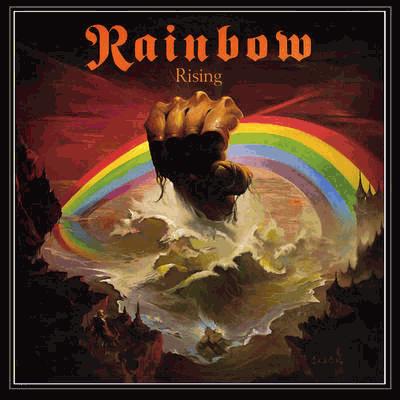
Rising. Many a Rainbow fan regard it as their best work.
Compared to their somewhat shallow debut,
Rising is a tremendous step up. Not only do Bain, Powell and Carey each have their share of talent, these five know how to play together.
Rising has chemistry, and that’s what makes it stand out next to many of Rainbow’s other albums. The instrumentation is tight, and Blackmore and Carey know how to play off each other, be it not as brilliantly as Blackmore and Lord could. Bain’s bass is quite audible, and while perhaps not technically very accomplished, Powell is a drumming powerhouse.
At 33 minutes,
Rising is also Rainbow’s shortest output (though most don’t even make 40 minutes), but what’s on it is mostly killer. The output ranges from straightforward rockers in the middle part, being
Run With the Wolf,
Starstruck and
Do You Close Your Eyes to grandiose epics
Stargazer and
A Light in the Black, wisely placed at the end of the album. Opener
Tarot Woman falls a bit in between, and is a perfect introduction to what is a much better realization of Blackmore’s initial view of Rainbow. After a luring, spacey synthesizer intro by Carey, Blackmore’s heavy riffs sneak in with a true passion he hadn’t showed since
Burn. Even more noticeable is Dio, who at this point has reached the true potential of his voice, as well as lyrical ability. As he belts out the catchy lines between Blackmore’s revitalized guitar work, we all know this is the Rainbow we had hoped to hear on their previous album.
Being the most straightforward, the middle part is also the least impressive, but holds its own appeal.
Run With the Wolf is incredibly catchy, and while the same applies to
Starstruck and
Do You Close Your Eyes (an very direct song about making sweet luv’, certainly for a time innuendo was all the game), it should be noted that these kind of choruses only work with someone of Dio’s calibre behind the mic. The gift to make cheesy lyrics sound convincing is difficult to come by.
But as the expression goes: save the best for the last.
Rising closes with a climax, two sprawling epics that only Rainbow could have created in this form and potential. The former and better known,
Stargazer, relies more on Dio’s performance and the appearance of the
Munich Philharmonic Orchestra (those things always work wonders on them epics), while the latter,
A Light in the Black, relies more on the abilities of Powell, Carey and Blackmore, and especially the interplay between them in the middle of the song. These last two cuts are among Rainbow’s very finest tracks, and are of a quality Blackmore has not ever equalled since Dio left, with any band.
Rising shows Rainbow at its very peak, and Ritchie Blackmore at the most creative years of his life. Featuring the band’s strongest formation without question, it is a truly overlooked hard rock classic of the 70’s. It put a genius guitarist and a masterful vocalist together, this time in a context that made it all work. Blackmore would never equal it, although Dio would twice, with
Black Sabbath’s
Heaven and Hell, as well as
Holy Diver. For him, Rainbow was only the beginning of a long and fruitful career.
Rising’s Rainbow was:
- Richard Hugh Blackmore ~ Lead Guitar
- Ronald James ‘Dio’ Padanova ~ Vocals
- James Stewart ‘Jimmy’ Bain ~ Bass Guitar
- Colin ‘Cozy Powell’ Flooks ~ Drums
- Antony Laurence Carey ~ Keyboards
Essential listening:
Tarot Woman
Run With the Wolf
Stargazer
A Light in the Black