Review Summary: I'M THE MAAAN ON THE SILVER MOUNTUUUN!
Richard Blackmore is a man known mainly for many things: Being one of the most accomplished guitarists of the 70’s, including the massive ego that came along with it, having the tendency of firing everyone he worked with, and nearly always playing on a Fender Stratocaster. He was initially, and still is most famous for his time in
Deep Purple, who have since some time gone on without him, continuing still today after four decades of quality hard rock. What most people don’t seem to know however, is his rather significant side-project, which quickly grew out to be his main band. Blackmore had grown frustrated with the funk and soul tendencies brought in by David Coverdale and Glenn Hughes in Deep Purple’s Mark III, and by the time those became too dominant for his liking on 1974’s
Stormbringer, he called it quits.
Blackmore hadn’t been idle all that time, however. While Deep Purple was touring for their album
Burn, they were supported by a blues rock outfit called
Elf, led by the then-unknown Ronnie James Dio. Blackmore had expressed interest in the band, and especially Dio’s vocal abilities. Eventually, he ended up recording an entire album’s worth of material with them, minus their guitarist. When things in Deep Purple didn’t go right for him, he decided it was time to take over Elf. So it happened, and they were redubbed (Ritchie Blackmore’s)
Rainbow, ready for a fresh start as a new band.
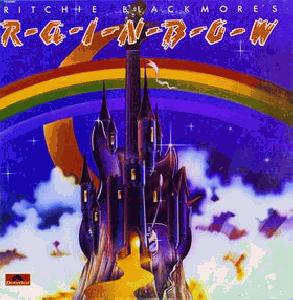
Thankfully, despite Blackmore’s creative leadership, Rainbow never became a Deep Purple clone. The guitarist obviously felt like change after his disappointments with his previous band, and Rainbow’s early years were marked by an influence of both classical music and medieval/fantasy themes (a courtesy on Dio’s part). The first Rainbow formation released their debut in ’75, the self-titled
Ritchie Blackmore’s Rainbow (Blackmore would change their name to just Rainbow after this album). Soon after it was released, Blackmore would fire everyone except Dio, and put together a completely new outfit. He would go through this between virtually every album, never satisfied. As a result, Rainbow’s line-up was never the same, except for of course its creator. Potentially, this is very interesting, and could result in a great variety of musical influences.
Their debut isn’t exactly a flying start to Rainbow’s career though. The blame can be laid completely upon the Elf musicians (yes, except for Dio, of course). Neither bassist Craig Gruber, drummer Gary Driscoll or keyboardist Mickey Lee Soule is very competent, and for the most part, they go by unheard. The mix allows their respective parts to be all quite audible, but unavoidably, they get overshadowed by the two greats because of the enormous difference in creativity and innovation between them and the two main men. Blackmore’s bluesy leads and Dio’s big voice will instantly distract your ears, so they’re not entirely to blame either. The three of them get somewhat of a better moment on the catchy
If You Don’t Like Rock ‘N’ Roll. The bass is funky, the keyboards are nicely upbeat, and the drums can actually be called noticeable. Ironically, the entire rhythm section goes by unnoticed for almost the entire album, and then gets better on the very same track.
That doesn’t mean our guitarist and singer are on top of their game. Blackmore had to settle in a bit, or so it seems, because in his prime time with Purple, he has been much more consistently delivering excellent leads. As for Dio, his power is undeniable, but his voice was still a little underdeveloped in this point of his career, and would much improve on his later work with Rainbow, and later
Black Sabbath and his own band
Dio. That said, he is far from unconvincing.
Average, too standard-fare blues rock to the likes of
Self Portrait and
Black Sheep of the Family drag this debut down, but there are a few occasions upon which the combination of Blackmore’s and Dio’s talent truly slides into its just form. Without question, the two best moments of the record are when it’s at its heaviest, and when it’s at its lightest. Opener
Man on the Silver Mountain, a minor hit at its time, is about as good a start as it gets with this formation, and pairs some of Blackmore’s more heavy, Purple-esque leads with Dio’s mighty voice, as he belches out the catchy chorus in the way he would keep doing it in the near future. The very soft ballad
Catch the Rainbow is a different matter, and marks Rainbow’s own identity and classical influence, and is a showcase of how Dio can use his voice in a different manner than the one since long standard to him.
Don’t expect too much Blackmore/Dio magic just yet. Most of the work on Rainbow’s debut is quite decent, but mostly, it was a stepping stone for upcoming greater achievements. The mystic
The Temple of the King, for example, marks a style the band would carry out again on follow-ups
Rising and
Long Live Rock ‘n’ Roll, to much, much greater results. It is catchy blues-rockers such as
Snake Charmer that you should like if
Ritchie Blackmore’s Rainbow is to appeal to you. It provides only subtle hints of the band’s best 2nd and 3rd works, and probably has more historical value than anything else.
Ritchie Blackmore’s Rainbow Rainbow was:
- Richard Hugh Blackmore ~ Lead Guitar
- Ronald James ‘Dio’ Padanova ~ Vocals
- Craig Gruber ~ Bass Guitar
- Gary Driscoll ~ Drums
- Mickey Lee Soule ~ Keyboards
Essential listening:
Man on the Silver Mountain
Catch the Rainbow
Snake Charmer
If You Don’t Like Rock ‘N’ Roll